The emerging alignment among China, Türkiye and Pakistan is increasingly linking the security dynamics of South Asia, the Gulf and the Eastern Mediterranean. For New Delhi, these developments underscore the need for a networked regional strategy that links its security interests and strategic partnerships across these interconnected theatres.
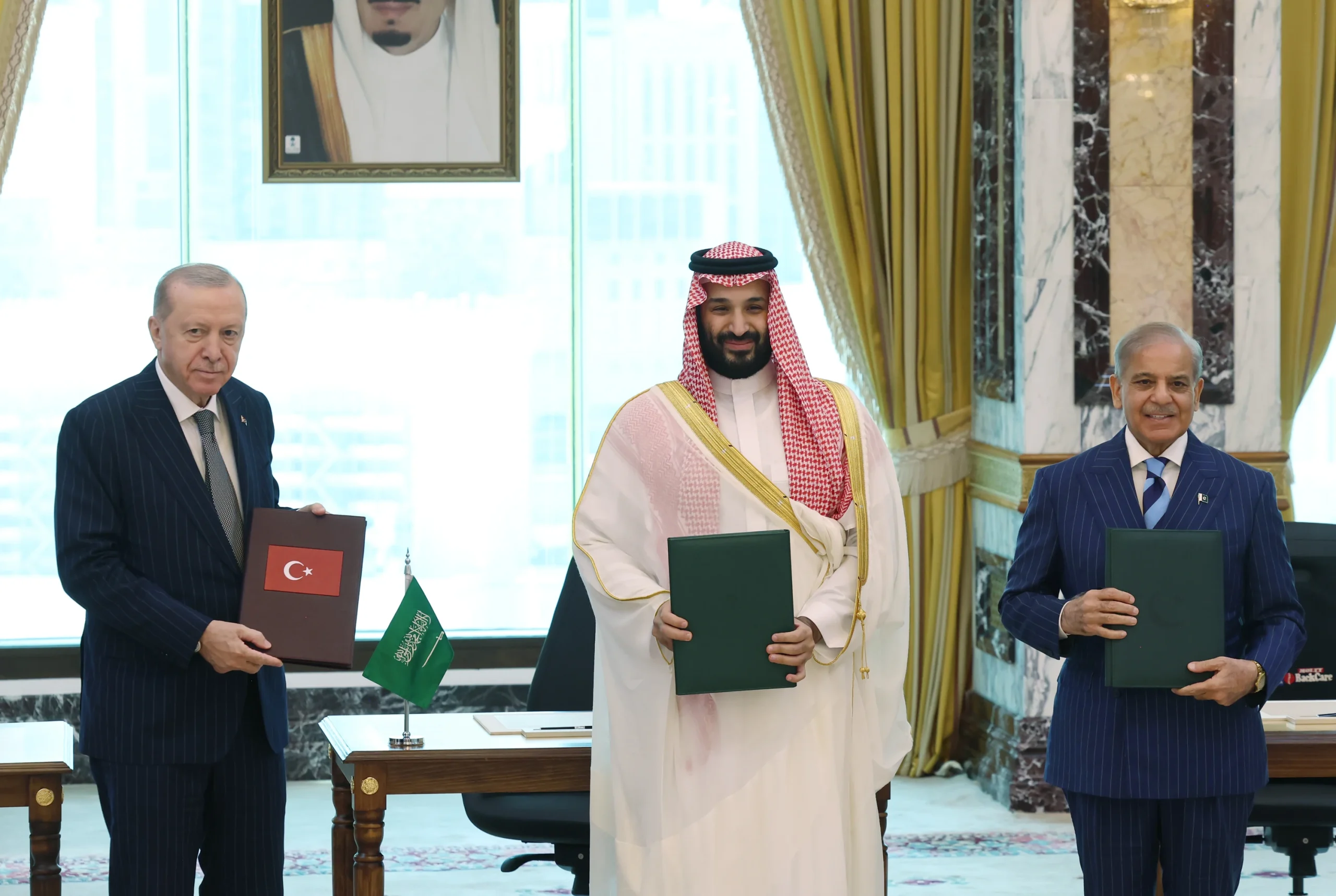
Amid the rapidly changing geopolitical dynamics in the region, the security architecture of the Eastern Mediterranean, the Middle East, and South Asia is increasingly becoming interconnected. The problems and security challenges of these regions can no longer be viewed separately. Recent developments indicate that a new strategic environment is emerging in which developments in one theatre can increasingly have direct consequences for another. Following the signing of the Makkah Joint Defence Agreement by Saudi Arabia, Türkiye, and Pakistan on August 7, 2026—a NATO-style collective defence pact stating that an attack on one would be considered an attack on all—reports indicated an unusual surge in Chinese and Turkish military transport activity involving Pakistan, accompanied by the movement of advanced military equipment and technology.1
From Pakistan to Syria
Indian security sources reportedly tracked heavy airlifters, including Chinese Y-20 heavy transport aircraft and a Turkish Air Force C-130 cargo aircraft, conducting repeated and highly coordinated logistics flights over a tight 60-hour window around August 20, 2026. These aircraft landed at strategically important facilities, including Nur Khan Airbase near Rawalpindi and Masroor Airbase in Karachi.2
Pakistan also issued a NOTAM restricting a large area of its airspace—reportedly covering roughly 750 kilometres.3 Although the exact purpose of the Turkish and Chinese transport activity remains unclear, open-source flight trackers and defence analysts suggest that this coordinated surge may have involved the delivery of advanced surveillance hardware, electronic warfare systems, radar equipment, and kamikaze drones to rapidly boost Pakistan’s conventional military capabilities. This is a massive development following the signing of the Makkah defence pact, and the timing makes it even more significant.4
Given that Israel has recently attacked Syria—specifically targeting the Abu Al-Duhur air base amid concerns over a potential Turkish deployment—and is opposed to Türkiye’s objectives of expanding its influence in post-Assad Syria, while Pakistan sees India as an enemy and both China and Türkiye have actively supported Pakistan, the arrival of Turkish and Chinese military airlifters in Pakistan cannot be considered insignificant.5 It indicates that a highly synchronised, multi-theatre strategic contest is taking shape, with developments unfolding simultaneously across the Middle East and South Asia in ways that could increasingly challenge India’s strategic interests.
The coordinated arrival of Chinese and Turkish military assets also indicates that Beijing is backing this emerging strategic alignment and could use the Makkah Defence Agreement to pursue its own objectives in the region, given that China and Pakistan are already deeply integrated through their defence and security cooperation. According to the Stockholm International Peace Research Institute (SIPRI), more than 80 per cent of Pakistan’s major arms imports between 2020 and 2024 came from China, highlighting the depth of their defence relationship. This integration extends beyond arms supplies to intelligence and security cooperation, joint military exercises, defence production, technology cooperation, and other strategic dimensions.6 This deep integration with Pakistan allows Beijing to use Pakistan as a strategic instrument to pursue its objectives across different strategic theatres, particularly in South Asia and the Middle East, while expanding its influence and strategic reach in the region.
Recently, Syrian Foreign Minister Asaad Hassan al-Shaibani also visited Pakistan, marking the first such diplomatic visit in nearly two decades, shortly after Israel attacked Turkish-linked interests in Syria. This raises the possibility that Syria may soon join the Makkah grouping, as Damascus has officially confirmed that it is reviewing its options regarding the pact.7
This picture becomes even more complex with Pakistan’s recent outreach to Iran. Pakistan’s Army Chief, Field Marshal Asim Munir, recently visited Iran, and reports also suggest Iran has been invited to join the Makkah Defence Agreement. If confirmed, this would suggest much bigger strategic games are being played behind the scenes that we may not yet fully see.8 When Saudi Arabia signed the agreement with Pakistan and Türkiye, one of the key interpretations was that the pact would serve as a deterrent against any potential Iranian attack on Saudi Arabia. However, if Iran itself is now being considered for inclusion in the same framework, it suggests that the strategic calculations behind the agreement are far more complex than they initially appeared. Many regional and extra-regional actors are clearly involved, pursuing different interests and objectives across multiple theatres. What appears to be a series of separate developments may therefore actually be part of a much larger strategic game unfolding across the Gulf, Iran, and South Asia.
Moreover, recently, Tarique Rahman, the Prime Minister of Bangladesh, who was supposed to visit India, cancelled his visit, while at the same time he was invited by Saudi Arabia. Adding to this shift, the interim leadership in Dhaka, through Foreign Affairs Adviser Humayun Kabir, has openly expressed its interest in exploring the Makkah agreement to protect its changing economic and trade interests.9 Although Dhaka has not decided to join the pact, its willingness to consider such a framework suggests that broader strategic calculations may be shaping Bangladesh’s foreign-policy choices.
From Separate Theatres to a Networked Regional Strategy
These developments show that the region’s security dynamics can no longer be viewed through separate geographical frameworks or understood in isolation. As Saira Bano, Assistant Professor of Politics at Thompson Rivers University, writing for the Lowy Institute, recently argued, the most consequential feature of the Makkah Joint Defence Agreement is that it “collapses the strategic distance between the Gulf, the eastern Mediterranean and South Asia.”10 The Middle East and South Asia have effectively turned into a single integrated chessboard. India’s security challenges are increasingly connected with developments involving Türkiye, Pakistan, China, Iran, and other regional and external powers. The geopolitical dots are increasingly interconnected through emerging security, defence, economic, and strategic partnerships, making it difficult to assess developments in one theatre without considering their implications for others. The old assumptions underpinning India’s approach to these regions are increasingly being challenged, requiring developments in each theatre to be placed within a wider strategic framework to better understand their broader implications. The regional environment has become more complex, with regional and extra-regional actors increasingly part of the same strategic equation, prompting India to reassess its strategic approach. These emerging challenges require a networked regional strategy that connects India’s interests across South Asia, the Gulf, and the Eastern Mediterranean while maintaining and further strengthening its bilateral partnerships. Strengthening strategic partnerships with like-minded countries, improving intelligence and defence coordination, and building stronger connectivity and economic partnerships will become increasingly important as these theatres become more closely linked.
The copyright of this article remains with the Politeia Research Foundation ©️PRF.
*****
References
1 “60-Hour Military Airlift: Chinese, Turkish Aircraft to Pakistan Spark Defence Transfer Speculation,” Firstpost, accessed August 24, 2026, https://www.firstpost.com/world/60-hour-military-airlift-chinese-turkish-aircraft-to-pakistan-spark-defence-transfer-speculation-ws-e-14039608.html
2 Moneycontrol World Desk, “Surge in Chinese, Turkish Military Aircraft Activity in Pakistan Raises Eyebrows, Sparks Defence Transfer Concerns,” Moneycontrol, August 20, 2026, accessed August 24, 2026, https://www.moneycontrol.com/world/surge-in-chinese-turkish-military-aircraft-activity-in-pakistan-raises-eyebrows-sparks-defence-transfer-concerns-article-14011082.html
3 Arishaa Izaj, “Pakistan Issues 750-km NOTAM: Major Missile Test on the Cards?” Moneycontrol, August 20, 2026, accessed August 24, 2026, https://www.moneycontrol.com/world/pakistan-issues-750-km-notam-major-missile-test-on-the-cards-article-14011253.html
4 “Unusual Airlift: China, Turkiye’s 60-Hour Military Surge in Pakistan Puts India on Alert,” CNBC-TV18, August 2026, accessed August 24, 2026, https://www.cnbctv18.com/india/unusual-airlift-china-turkiyes-60-hour-military-surge-in-pakistan-puts-india-on-alert-19973516.htm
5 “Syria Says Israeli Strike near Damascus Violation of International Law,” BBC News, August 22, 2026, accessed August 24, 2026, https://www.bbc.com/news/articles/c2dkdegr2xeo
6 Hayley Wong, “China Supplied 81% of Pakistan’s Arms Imports in the Past 5 Years, SIPRI Says,” South China Morning Post, March 16, 2025, accessed August 24, 2026, https://www.scmp.com/news/china/military/article/3302515/china-supplied-81-pakistans-arms-imports-past-5-years-sipri-says
7 Anadolu Agency, “Pakistan Seeks Stronger Syria Ties as PM Invites al-Sharaa,” Daily Sabah, August 20, 2026, accessed August 24, 2026, https://www.dailysabah.com/world/asia-pacific/pakistan-seeks-stronger-syria-ties-as-pm-invites-al-sharaa
8 “Iran Reportedly Invited to Join the Mecca Defence Plan, Official Claims Ahead of Munir’s Visit,” Firstpost, accessed August 24, 2026, https://www.firstpost.com/world/iran-reportedly-invited-to-join-the-mecca-defence-plan-official-claims-ahead-of-munirs-visit-14040273.html
9 “Bangladesh Says PM Tarique Rahman Will Not Visit India until Sheikh Hasina’s Extradition,” The Hindu, August 16, 2026, accessed August 24, 2026, https://www.thehindu.com/news/national/bangladesh-says-pm-tarique-rahman-will-not-visit-india-until-sheikh-hasinas-extradition/article71352525.ece
10 Saira Bano, “The Mecca Pact Redraws the Indo-Pacific’s Western Edge,” Lowy Institute, August 10, 2026, accessed August 24, 2026, https://www.lowyinstitute.org/the-interpreter/the-mecca-pact-redraws-the-indo-pacific-s-western-edge