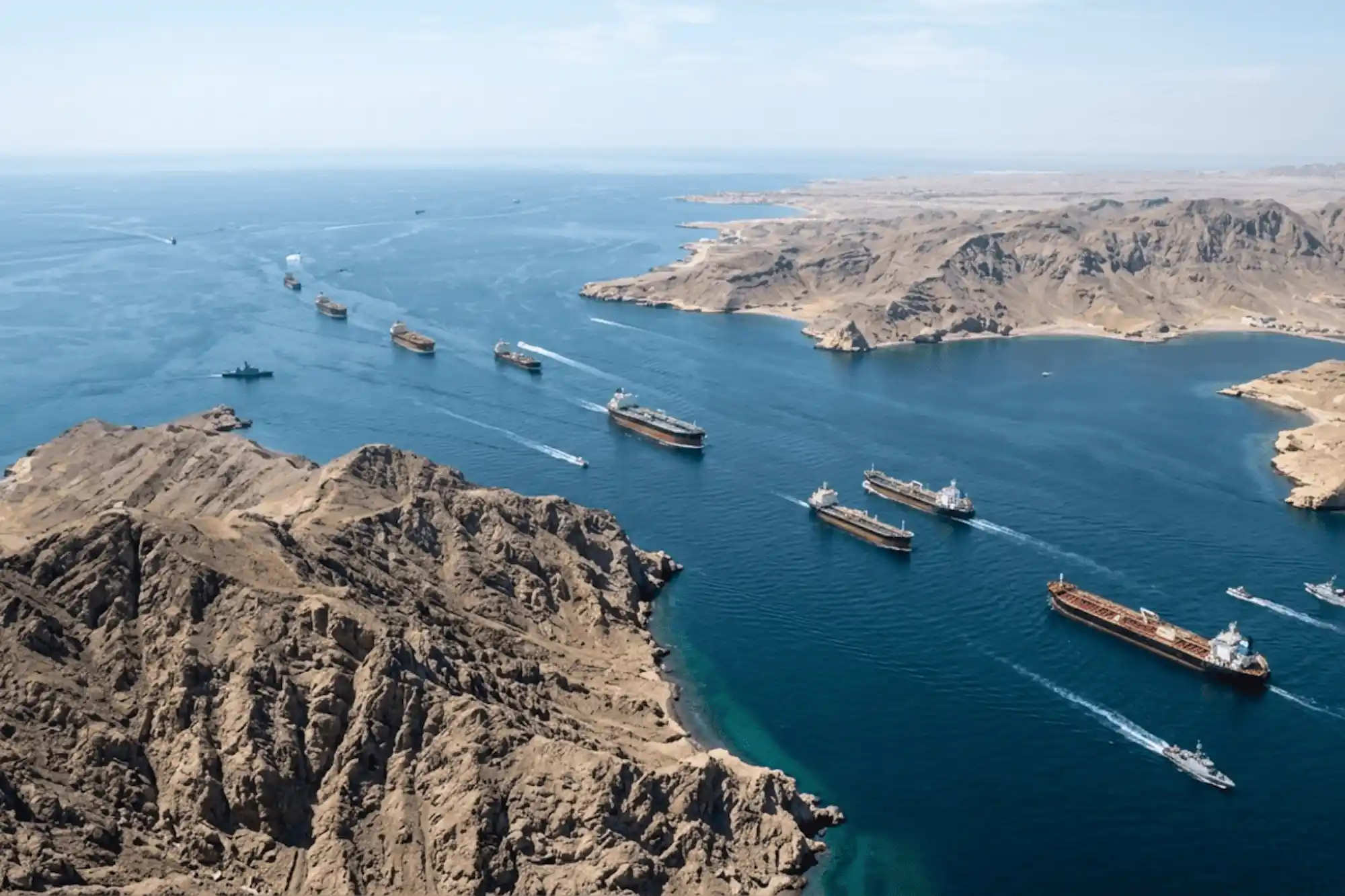
The Strait of Hormuz is named after the historic kingdom and island of Hormuz. The word “Hormuz” originates from the ancient Persian name Hormozd or Ohrmazd, which derives from Ahura Mazda—the supreme deity of light, wisdom, and creation in Zoroastrianism. During the Middle Ages, the Kingdom of Hormuz grew exceptionally wealthy as a maritime trading hub connecting Persia, Arabia, and India. A well-known medieval Middle Eastern proverb described its legendary beauty and strategic riches:
“If the world were a ring, Hormuz would be the jewel set in it.”
Today Hormuz has acquired an even greater significance. By denying freedom of navigation, Iran has handed American primacy its first strategic defeat in 250 years and opened up a new world order. US’ main ally in the gulf, Saudi Arabia, has signed a mutual Defence pact with Turkey and Pakistan as a desperate consequence of American recklessness. America’s main partner in South Asia namely India is reeling under the onslaught of American policies undermining the foundations of the bilateral relationship. America’s main ally in West Asia Israel is suffering isolation in global and American public opinion as a rogue state. America’s premier ally in Northeast and Southeast Asia – Japan – is rearming in violation of its pacifist constitution. America’s main ally in Europe – Germany is actively advocating militarization to be able to prosecute a war against Russia. Whether it opens or not is secondary to the fact that the Hormuz has already metaphorically opened up to a new world order.
The Absence of a Hegemon is Progress
People often ask what’s next? They argue Russia is in decline and China is not ready so there is no alternative to US leadership. Countries want to feel secure and willing to overlook great power violations of international law. I would argue that absence of a hegemon is progress.
American decline is caused due to the erosion of the United States’ political, economic, military, and cultural hegemony compared to its peak during the post-WWII and immediate post-Cold War eras. Economically and geopolitically, this trend is driven by the rapid rise of peer competitors, particularly China, alongside emerging middle powers in the Global South that increasingly looking to bypass Washington-led arrangements. Domestically, structural economic issues like persistent wealth inequality, mounting national debt, decaying physical infrastructure, and deindustrialization have chipped away at the foundational pillars that long underpinned American global dominance and economic agility.
Simultaneously, American decline is characterized by intense political polarization and institutional paralysis within the United States, which has undermined foreign policy consistency and public trust in democratic systems. This domestic friction, coupled with long and costly military engagements in the Middle East and strategic overreach, has weakened foreign alliances and dulled the efficacy of American soft power. While the U.S. retains unmatched technological innovation, capital markets, and military power, the era of unipolar supremacy has increasingly yielded to a fragmented, multipolar world order where American influence must be negotiated rather than assumed.
There will be winners and losers in this Global Transition but there need not be conflict
Schelling introduced the concept of focal points (or Schelling points): shared expectations that allow actors to coordinate their behavior without explicit communication. When a global transition occurs, the old focal points erode, and new ones emerge. Winners are the actors who successfully anchor the new focal point to their own institutional frameworks, currency networks, or technical standards. Losers are those whose existing capital, infrastructure, and influence were optimized for the obsolete focal point, forcing them to absorb high transaction costs or face exclusion from new coordination networks.
A global transition rarely happens linearly; it reaches a threshold where staying loyal to the old power dynamic becomes riskier than defecting to the new one. As middle powers, corporations, and financial institutions collectively tip toward a rising order—such as adopting new regional trade pacts or alternative settlement systems—the shift accelerates. Winners capitalize on early adoption, riding the momentum of the bandwagon. Losers are either left isolated on the wrong side of the tipping dynamic or stranded as the old equilibrium collapses faster than their ability to adapt.
During a systemic transition, established powers often attempt to enforce old rules using strategic commitments (like economic sanctions, tariffs, or military alliances), while rising powers commit to building parallel infrastructure (like alternative development banks or new trade corridors). Because these commitments create rigid bargaining boundaries, the transition is rarely a frictionless, zero-waste negotiation. Winners leverage their strategic credibility to reshape the terms of international cooperation, capturing surplus value from the new distribution of power. Losers suffer from miscalculated commitments—either overestimating their ability to preserve the status quo or failing to credibly deter the revisionist strategies of emerging competitors.
Is China the alternative and has India’s multi-alignment failed?
A China-led order would not be a “Pax Sinica ” maintained by military treaties, but as an asymmetric bargaining equilibrium. China wins not by convincing the world to adopt its ideology, but by unilaterally rewriting the global payoff matrix—making compliance with Beijing the most rational, low-risk path for rational actors pursuing their interest.
India thought of itself as a quintessential rational hedger. Rather than paying the high costs of trying to become an overarching global hegemon, India wanted to adapt to the global payoff matrix—ensuring that in any game of international coordination, the lowest-cost, highest-reward outcome for every major power required keeping India on its side. This was the logic of multi-alignment.
Multi-alignment is a peacetime strategy for extracting economic and diplomatic surplus, but it fails as a complete strategic framework. It leaves a nation exposed during high-stakes crises, exposing it to aggressive actors who know the multi-aligned state has no formal allies obligated to step in and defend it.
Alternatively, a successful non-alignment strategy is hedging through active engagement. The winning non-aligned state avoids the high cost of total alliance loyalty, adapts to the global payoff matrix to make its neutrality valuable to all sides, and builds sufficient domestic strength so that no rival can easily coerce it. It’s high time India resumed its role as a responsible & receptive rational actor as the new world beckons.