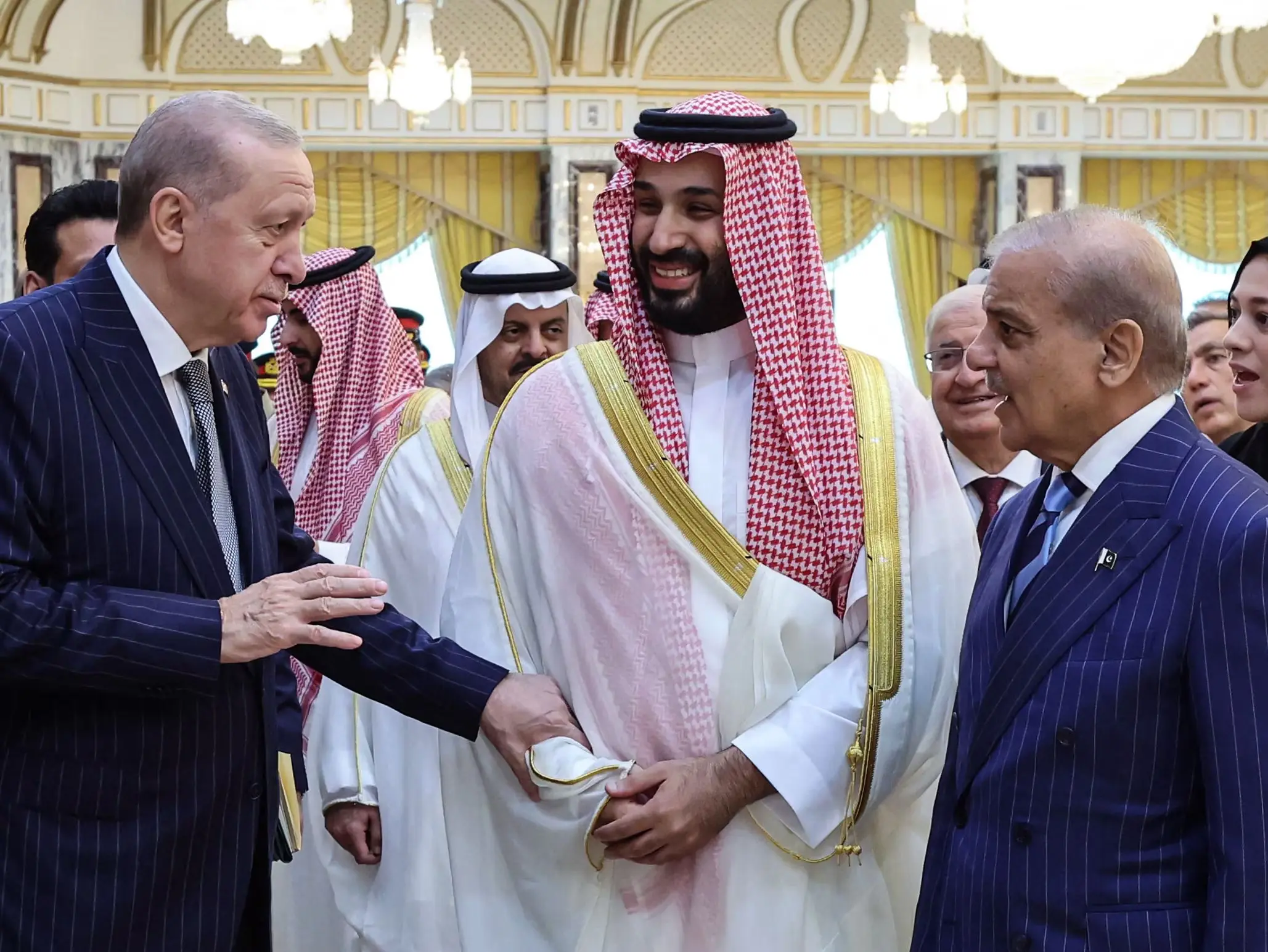
At Al-Safa Palace in Makkah (Mecca), on 7 August 2026, three men signed a piece of paper the wire services have already, with their customary appetite for drama, begun calling an “Islamic NATO.” Crown Prince Mohammed bin Salman, President Recep Tayyip Erdoğan, and Prime Minister Shehbaz Sharif put their names to the Makkah Joint Defence Agreement — a trilateral collective-defence framework whose operative sentence reads exactly as one would expect: an armed attack on one signatory shall be regarded as an attack against them all. One is reminded of Musketeer bravado — tous pour un, un pour tous — except that the three parties here are not fictional swordsmen but a monarchy sitting on the world’s spare oil capacity, a NATO member with the alliance’s second-largest standing army, and a nuclear-armed state whose army has, for three-quarters of a century, treated India as its organising principle.
For the subcontinent watchers, this signing cannot be read as a self-contained South Asian story; it occurred in a region where very little is self-contained just now. Gaza remains a theatre of grinding conflict between Israel and Hamas, its ceasefires provisional and its humanitarian toll a running wound on the international conscience. Israel’s campaign against Hezbollah positions in southern Lebanon continues in parallel. Iran sits under the shadow of what can fairly be called a home-front war-risk crisis — its regional proxy network degraded, its own territory and leadership calculus one strike away from a wider conflagration. And further off, but never far from any serious strategic reckoning in 2026, Russia’s war in Ukraine grinds on, reshaping the calculations of every arms exporter, every energy market, and every middle power deciding which patron, if any, it wishes to be seen standing beside. It is against this fuller canvas — not merely the bilateral India-Pakistan lens through which the pact will first be read in Delhi and Islamabad — that the Makkah Agreement deserves assessment: neither the reflexive alarm of the television panel, nor the equally reflexive dismissal of “just another Gulf photo-op.”
A signing in a region at war with itself
The timing is not accidental. A trilateral collective-defence pact does not emerge from a vacuum; it emerges from an environment in which every regional actor has spent two years recalculating who might come to its aid, and at what cost, should the wider Gaza-Lebanon-Iran conflagration widen. Saudi Arabia has watched missile and drone threats reach uncomfortably close to home, and has watched Hezbollah’s degradation and Iran’s exposure with the calculating eye of a state planning for contingencies its patrons may not always underwrite in full. Turkey, a NATO member whose regional posture — on Syria, the Eastern Mediterranean, and an Israel it has criticised sharply over Gaza while maintaining working ties with Washington — has grown steadily more independent of alliance consensus, sees in this pact both leverage and insurance. Pakistan, its economy dependent on Gulf remittances and capital even as its domestic house remains, by any honest reckoning, only partially in order, sees a chance to convert geography and manpower into standing that its economic indicators alone could never purchase. None of this makes Makkah a response to any single crisis — Gaza, Lebanon, Iran and Ukraine each has its own logic — but together they form the weather system in which the pact was signed. No serious reading can proceed without acknowledging that weather.
What the document actually says — and the considerable silence around it
Any officer trained to read a file before minuting it will begin with what is on record. Islamabad and Ankara have disclosed three substantive elements between them: collective deterrence against “any act of aggression”; the treat-one-as-attack-on-all formula; and a commitment to enhance “all aspects” of defence cooperation. Erdoğan has added a gloss about defence-industrial cooperation and counter-terrorism, plus the now-obligatory reassurance that the pact “targets no country” and remains open to “other friendly states.”
What is missing is everything that would make a defence lawyer’s job possible: no published treaty text, annex or protocol; no visible joint command, force earmark, basing arrangement, common rules of engagement, intelligence-sharing architecture, funding formula, or decision procedure for invoking the clause — and, a detail commentators keep skating past, no legally automatic obligation to go to war. A file with a resounding preamble and an empty schedule is a familiar species to anyone who has drafted government orders for a living; the operative paragraph is stirring, the implementation rules are, for the moment, blank.
Not NATO — not yet, and perhaps not ever
The “Islamic NATO” tag is rhetorically irresistible and analytically premature. NATO’s Article 5 does not merely declare solidarity; it obliges each ally to assist “by such action as it deems necessary, including the use of armed force,” within a treaty architecture — SHAPE, an integrated command structure, decades of interoperability, standing consultative machinery — stress-tested since 1949. Makkah, by contrast, is closer to the first half of Article 5 without the scaffolding that gives the second half teeth. Chatham House’s pre-signing assessment made the point with economy: the label overstates both the membership and the actual role of religion in what is, at bottom, a hard-nosed calculation of complementary assets — Turkish and Pakistani military capability, Turkish access to NATO-standard training and shipbuilding, and near-unlimited Saudi capital.
The trilateral is also not conjured from nothing. Riyadh and Islamabad had already signed a Strategic Mutual Defence Agreement in September 2025, with near-identical language, after a Saudi official’s loose talk of “all military means” set off speculation about a Pakistani nuclear umbrella over the Kingdom. That speculation remains speculation. Neither the 2025 bilateral nor the 2026 trilateral confirms nuclear sharing, forward deployment, or extended deterrence of any kind, and readers would do well to resist filling such silences with the most cinematic possible content.
The transactional logic beneath the theological wrapping
Strip away the venue — chosen, one suspects, less for doctrinal resonance than for the photogenic weight of the Kaaba as backdrop — and the bargain is unsentimental. Saudi Arabia, having watched the reliability of its traditional guarantor come into question during a season of missile, drone, and maritime crises, is diversifying its security portfolio the way a prudent treasury diversifies its reserves. Pakistan converts decades of quiet security ties with Riyadh into a formal architecture, gains strategic stature it has been starved of since at least 1971, and opens a larger market for its deployable manpower and defence exports. Turkey gains a foothold — and prospective capital — in Gulf security affairs, a new customer base for its defence-industrial sector, and a hedge that Ankara insists — and NATO, for now, seems content to accept — sits alongside rather than instead of Article 5.
Five questions the summit did not answer.
A treaty’s credibility, as decades of drafting rather less consequential instruments in the Punjab cadre teach, lives in the schedules nobody has yet written. Here they remain unwritten on at least five counts.
What constitutes an “armed attack” — a drone strike, a proxy militia’s action, a cyber intrusion, maritime sabotage?
Who attributes responsibility when the perpetrator is Iran, a Houthi formation, or an unmarked non-state actor with plausible deniability? What does “assistance” mean in practice — intelligence, air-defence cover, arms supply, naval escort, or boots on the ground?
How do three entirely different force structures — NATO-standard Turkish, Western-procured Saudi, and doctrinally distinct Pakistani — interoperate under a single command philosophy?
And what happens when Riyadh’s, Ankara’s and Rawalpindi’s calculus diverge, as the pact’s silence on dispute resolution allows?
Until implementation protocols, joint exercises and procurement announcements answer these questions, Makkah remains a treaty whose deterrent value exceeds its demonstrable operational content.
The Pact and the Wider War: Gaza, Beirut, Tehran, Kyiv
No honest account of Makkah for an international readership can treat it as if it occurred in a Gulf bubble sealed off from the region’s other conflicts. On Gaza, the pact is silent by design — Riyadh has calibrated its normalisation-adjacent diplomacy carefully enough that it wishes to be seen as underwriting neither Pakistani nor Turkish positions on the Israel-Hamas war. Still, Ankara’s sharply critical posture toward the Gaza campaign, and its history of hosting Hamas political figures, means any deepening of the Turkey-Saudi defence relationship will be read in Jerusalem and Washington as a data point on where Gulf sentiment is trending, disclaimers notwithstanding. On Hezbollah and southern Lebanon, the calculation is more indirect but no less real: a weakened Hezbollah and diminished Iranian proxy network have altered the threat perception that drove Riyadh toward Islamabad and Ankara in the first place, teaching the lesson that state-to-state guarantees offer sturdier ground than reliance on a single patron’s forbearance. On Iran, the pact functions, whether or not its architects say so, as a partial hedge against Tehran’s own home-front war-risk crisis — a Gulf monarchy a few hundred kilometres from Iranian shores has every reason to want guarantees on the books before, not after, any wider Iran-Israel escalation. And Ukraine, though geographically distant, supplies the background music: it has shown every mid-sized power watching — Ankara and Islamabad included — that Western security guarantees can prove slower and more contested than the guaranteed party might wish, lending every new mutual-defence instrument in 2026 an added air of urgency regardless of its actual content. Together, these four theatres do not make Makkah a response to any one of them; they make it a symptom of a broader moment in which middle powers, watching great powers hedge or overextend, have concluded that the safer course is to build their own overlapping insurance policies — a lesson India should absorb for its own purposes rather than merely observe from the gallery.
Reading the Signal for India
For India, the immediate military arithmetic changes little, but the medium-term signal cannot be read carelessly. Nothing in the public text names India, Kashmir, or a South Asian contingency; the pact triggers only on an armed attack, and even then only after a political interpretation three sovereign capitals must separately reach. The alarmist framing — that Ankara and Riyadh have signed up to fight India’s next war with Pakistan — finds no support in the public record, and India’s messaging would do well to resist amplifying Pakistan’s preferred “Islamic bloc” narrative by overreacting. That said, the strategic drift ought to concentrate minds in South Block. On the diplomatic-narrative front, Pakistan gains real uplift — it can present itself as backed by Saudi weight and Turkish depth before a single joint exercise has occurred, and deterrence operates as much on perception as on demonstrated capability; India’s response should be calibrated, treating the pact as a developing architecture rather than a settled bloc, precisely because overreaction confers a stature the document has not yet earned. More materially, India must watch — with an intelligence officer’s patience rather than a television anchor’s excitability — for the indicators that would actually matter: Turkish drone, naval, electronic warfare, or training cooperation with Pakistan, financed by Saudi capital; joint production lines; expanded exercises; liaison structures. These, not the communiqué’s prose, would convert a political signal into an operational threat, and India’s intelligence establishments should be tasked accordingly — watching in particular for Bayraktar-class UAV transfers, naval modernisation financing, and any Chinese fingerprints attaching themselves to Pakistani procurement through Saudi or Turkish intermediation.
What India Must Now Do
Three lines of action follow.
First, India’s Saudi relationship — built over two decades of energy interdependence, a substantial diaspora, and the Gulf’s own quiet interest in diversifying away from any single security patron — remains an asset outweighing Riyadh’s Pakistan tie; New Delhi’s task is not to treat the Kingdom as having chosen a side but to keep demonstrating, through defence-industrial engagement, energy cooperation and counter-terrorism coordination, that India offers what Pakistan structurally cannot — a stable economy and a partner whose interests genuinely converge with Gulf stability rather than depend on its cheque-book.
Second, Turkey requires clearer-eyed calibration: Ankara’s persistent tilt toward Islamabad on Kashmir, and its expanding defence-export relationship with Pakistan, warrants engaging Turkey transactionally on trade while not pretending defence-industrial neutrality exists where it does not — and deepening, in parallel, India’s own defence-industrial ties with Greece, Cyprus and Armenia, not as an anti-Turkey coalition but as ordinary diversification of the kind Riyadh itself has just modelled.
Third, the larger lesson of Makkah is that middle powers are now assembling flexible, transactional security groupings rather than binary blocs. India’s own instruments — the Quad, I2U2, the India-Middle East-Europe Economic Corridor, deepening defence-industrial ties with France, Israel and the Gulf states — should be pursued with the same unsentimental clarity Riyadh, Ankara and Islamabad have just displayed, rather than the residual non-alignment reflex that still colours Indian strategic thinking. India needs no “Islamic NATO” of its own. Still, it does need its own web of partnerships to remain at least as resourced, and considerably more operationally credible, than the one just inaugurated at Al-Safa Palace.
A closing caution
Decades of minuting files teach the difference between a Government Order that changes the world on the date of issue and one that merely announces an intention to do so, pending the framing of rules. On present evidence, the Makkah Joint Defence Agreement belongs to the second category. Its significance lies not in what it commits Saudi Arabia and Turkey to do in a hypothetical India-Pakistan conflict — remarkably little, on the public text — but in what it reveals about the reconfiguration of Gulf and wider Muslim-world security thinking at a moment when Gaza still burns, Hezbollah’s Lebanon still absorbs Israeli strikes, Iran still weighs its exposure, and Ukraine still supplies the era’s grimmest lesson in the limits of guarantee. In that reconfiguration, Pakistan finds itself, for the first time in decades, less a supplicant than a supplier of manpower and military experience to wealthier patrons — a reversal worth noting quietly, without alarm or applause. Whether the coming months produce joint commands and procurement contracts, or merely further summit photographs, will determine whether historians file 7 August 2026 alongside the founding of a genuine alliance, or among the many well-photographed communiqués a crowded and combustible diplomatic calendar has a way of forgetting. For readers scattered across the world, watching the subcontinent from a necessary distance, the task is the same as it is for South Block: neither panic nor complacency, but the unglamorous, continuous work of alliance-tending that a serious strategic autonomy has always required — in a neighbourhood, and a world, currently offering very few guarantees to anyone.