The Indo-Pacific is no longer simply a diplomatic idea. It has become the strategic reality of contemporary Asia. The Pacific and Indian Oceans are increasingly understood as a single strategic space—connected by trade, maritime security, technology, and shared strategic interests. For Japan and India, the free and open Indo-Pacific vision has gradually evolved into a shared strategic purpose. Their partnership, once driven by aspiration, is now judged by a more demanding test: whether they can preserve openness, strengthen regional resilience, and help sustain a stable Indo-Pacific amid growing geopolitical uncertainty.1
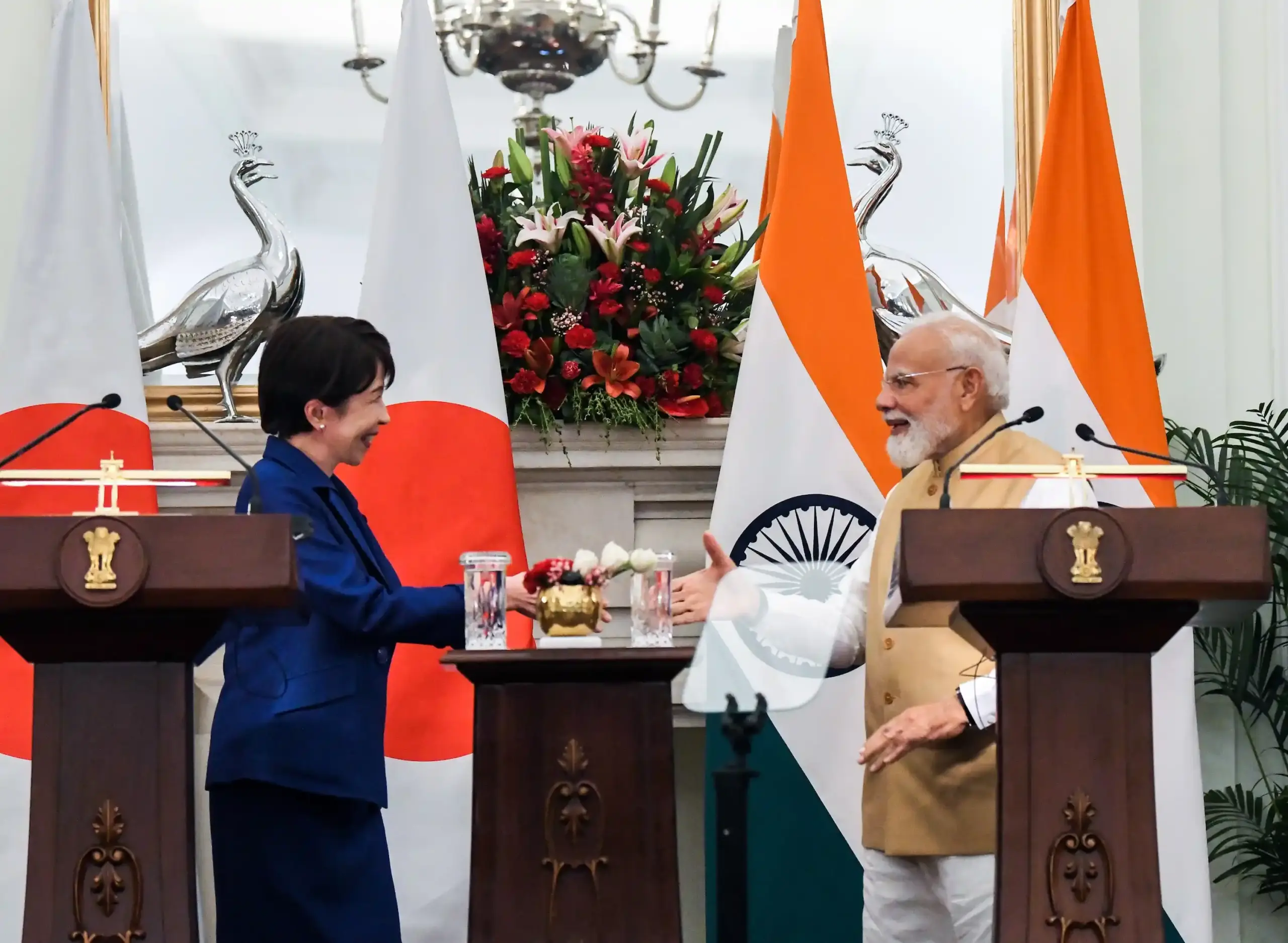
The July 2026 summit between Prime Ministers Sanae Takaichi and Narendra Modi was widely described as opening “a new chapter” in Japan–India relations. Such language accompanies almost every successful summit. It captures the political moment, but not necessarily its historical significance. Rather than marking a new beginning, the summit revealed how far Japan and India had already travelled over the previous quarter century. 2
The conventional explanation is straightforward: China’s rise brought Japan and India together. There is considerable truth in that argument, but it tells only part of the story. China’s growing power undoubtedly accelerated strategic cooperation between Tokyo and New Delhi. It cannot, however, fully explain why that cooperation continued to deepen across successive governments, changing strategic circumstances, and shifting domestic priorities. The deeper transformation was that Japan and India had already begun to rethink Asia—not simply as the Asia-Pacific, but as an increasingly connected maritime region.3
Over the past twenty-five years, Japan and India have done far more than deepen a bilateral relationship. Together, they helped establish the Indo-Pacific as the organising strategic framework of contemporary Asia. The latest Takaichi–Modi summit did not initiate that transformation. It confirmed how far it had already progressed.
This essay offers a different historical interpretation of Japan–India relations.
The Indo-Pacific did not emerge simply as a response to China’s rise. It should instead be understood as the product of a long process of Japan India strategic dialogue and convergence, first articulated with remarkable clarity in Shinzo Abe’s 2007 Confluence of the Two Seas address. 4
Rather than viewing Japan–India relations simply as the story of an increasingly close bilateral partnership, this essay argues that the partnership itself helped shape the Indo-Pacific. Japan and India did not merely deepen bilateral ties. Through their long strategic convergence, they helped shape the Indo-Pacific as an emerging regional order.
That Japan-India bilateral evolution unfolded in three stages. First came the formation of strategic trust. Then came the emergence of a shared Indo-Pacific vision. Today, that strategic convergence is evolving into strategic synergy for a more resilient regional order.
Stage I — Japan’s Discovery of India
Japan’s strategic turn toward India, called the “India Shift”, began with a fundamental shift in how it understood Asia. Throughout the Cold War and its immediate aftermath, Japan and India maintained cordial relations without becoming close strategic partners. Japan’s diplomacy remained anchored in the US alliance and East Asia, while India pursued first non-alignment and later strategic autonomy. Although both were major Asian democracies, neither regarded the other as indispensable to its long-term strategic future.
The turning point came when Japan began to rethink its strategic map of Asia. As China’s economic rise increasingly translated into political and maritime assertiveness, Japanese policymakers began looking beyond the familiar Asia-Pacific framework in search of a regional vision better suited to a changing Asia. India increasingly came to be seen not simply as a large emerging economy, but as the maritime power linking the Pacific and Indian Oceans. Gradually but decisively, this India Shift reshaped Japan’s strategic imagination. 5
Diplomatic agreements soon followed. They reflected rather than created Japan’s strategic reorientation. The Global Partnership launched by Prime Ministers Yoshiro Mori and Atal Bihari Vajpayee in 2000 marked the beginning of a new phase in bilateral relations. Later, Shinzo Abe and Manmohan Singh elevated the partnership to a Strategic and Global Partnership in 2006. Cooperation expanded across politics, security, economics, and people-to-people exchanges. More importantly, Abe and Singh came to share the same strategic judgement: Asia’s future balance would increasingly depend on closer cooperation between Japan and India. 6
The true significance of Japan-India cooperation in the 2000s therefore lies not in any single declaration, but in the steady accumulation of strategic trust. Governments changed in Tokyo. Domestic priorities evolved in New Delhi. Yet the underlying strategic logic between two Asian maritime democracies remained remarkably consistent. By the end of this decade, Japan and India had built something more durable than another successful bilateral relationship. They had developed the political confidence and strategic habits that would soon make possible a new way of imagining Asia itself—one that Shinzo Abe would later articulate in his landmark 2007 address to the Indian Parliament, “Confluence of the Two Seas.” 7
The first stage was therefore about more than building a partnership. It marked the moment when Japan rediscovered India—not simply as an emerging economy or a fellow democracy, but as the strategic partner with which Japan would begin to see Asia differently. If China’s rise posed strategic uncertainty, India’s rise offered strategic opportunity.
Stage II — Reimagining Asia: The Road to the Indo-Pacific
The Indo-Pacific did not emerge suddenly as a diplomatic strategy. It began as a new way of seeing Asia. It grew out of a long strategic dialogue through which Japan and India gradually reimagined the region together.
If the first stage was about Japan’s discovery of India and India’s eastward engagement, the second was about making a new Asia. During the 2010s, Japan’s India Shift converged with India’s transition from the Look East Policy to the Act East Policy, elevating their relationship into a Special Strategic and Global Partnership. Each approached the region from a different strategic tradition. Yet both arrived at the same strategic conclusion: the Pacific and Indian Oceans could no longer be understood as separate theatres. They had become part of a single strategic space.
This strategic convergence unfolded gradually rather than through a single diplomatic breakthrough. Japan increasingly sought to build an open regional order grounded in the rule of law, maritime security, and economic connectivity.8India expanded its engagement eastward while strengthening its role in the Indian Ocean. Step by step, both countries arrived at the same strategic insight: Asia should be understood as a free, open, and connected maritime region—what would later become known as the Indo-Pacific.9
The Indo-Pacific therefore became more than Japan’s diplomatic proposal. It evolved into a shared strategic imagination shaped through sustained dialogue between Tokyo and New Delhi. The concept was neither simply exported from Japan nor imposed by the United States. It emerged instead through the interaction between Japan’s expanding strategic outlook and India’s growing engagement with East Asia. By the end of the 2010s, Japan and India had done more than deepen bilateral ties. Together, they had begun to reshape Asia’s strategic geography.10
Ideas alone, however, rarely reshape regional politics. They require political leadership capable of giving them strategic direction. Shinzo Abe’s 2007 Confluence of the Two Seas address provided precisely that moment of political articulation. It did not instantly invent the Indo-Pacific. Rather, it recognised a quiet but profound transformation already underway and gave it a compelling strategic language. The speech articulated a regional imagination that had been taking shape through years of Japan–India strategic dialogue.
That bilateral transformation unfolded alongside a broader evolution in regional security cooperation. As Japan deepened its partnership with India, it simultaneously strengthened strategic ties with the United States and Australia. The emergence of the Indo-Pacific concept and the revival of the Japan–India–Australia–US partnership advanced together, each reinforcing the other. Yet throughout this wider strategic transformation, Japan–India relations remained the essential bridge linking the Pacific and Indian Oceans.11
ASEAN became the geographical and political centre where these strategic trajectories converged. For Japan, Southeast Asia connected the Pacific with the Indian Ocean through trade, maritime security, and regional diplomacy. For India, ASEAN provided the gateway to sustained engagement with East Asia.
The Indo-Pacific therefore did not emerge from a single diplomatic initiative. It evolved through the shared experience of Japan and India engaging Southeast Asia—and, in doing so, gradually reshaping Asia’s strategic geography12
China undoubtedly accelerated this convergence, but it did not create it. Japan and India were drawn closer by growing concern over China’s expanding economic and military influence—most visibly through Beijing’s increasingly assertive behaviour in the East China Sea and the South China Sea during the 2010s. Yet China’s rise explains why Japan and India moved closer, not why such cooperation became possible in the first place. Long before strategic competition came to dominate regional geopolitics, both countries had already begun to rethink Asia through an Indo-Pacific lens.
Stage III — From Strategic Convergence to Strategic Synergy
The Indo-Pacific has entered a new historical phase. The central question is no longer how to define the region, but how to strengthen it. During the first two decades of the twenty-first century, Japan and India helped establish the Indo-Pacific as a shared strategic framework. During the 2020s, the challenge shifted from imagining a new regional geography to building an open regional order resilient enough to withstand growing geopolitical and geoeconomic uncertainty.
This shift reflects a broader transformation in strategic competition. Military power still matters, but it no longer tells the whole story. Geopolitics and geoeconomics have become increasingly inseparable. Maritime security now extends far beyond naval power. It encompasses technological competition, economic coercion, supply-chain resilience, and the protection of critical infrastructure. The strategic landscape of the Indo-Pacific has become more interconnected—and far more demanding. 13
Japan–India cooperation has evolved with this changing strategic landscape. China’s expanding maritime presence, intensifying technological rivalry, and increasingly fragmented supply chains did not create a new partnership. They expanded the responsibilities of an existing one. A relationship once built on bilateral strategic trust gradually acquired a wider regional purpose. It is now expected not only to strengthen Japan–India cooperation, but also to reinforce the resilience of the wider Indo-Pacific.
Regional resilience has therefore emerged as the organising principle of the Indo-Pacific’s next phase. Japan’s Free and Open Indo-Pacific has evolved well beyond its original emphasis on the rule of law and maritime security. Today it increasingly encompasses economic security, critical and emerging technologies, resilient supply chains, digital connectivity, energy security, and sustained capacity building across the region. The Indo-Pacific is no longer understood simply as a maritime space. It is increasingly seen as an interconnected strategic system whose stability depends on the resilience of its networks. 14
India’s maritime strategy has evolved along remarkably similar lines. Beginning with SAGAR, continuing through the Indo-Pacific Oceans Initiative, and more recently reflected in MAHASAGAR, India’s vision has expanded from naval security to a broader conception of regional cooperation. Maritime connectivity, disaster relief, the blue economy, technological collaboration, and capacity building have become central pillars of India’s regional approach. The vocabulary differs. The strategic direction increasingly converges. 15
The significance of this convergence lies not in identical policies. It lies in a shared strategic purpose. Japan and India continue to approach the Indo-Pacific through different strategic traditions. Yet both increasingly recognise that regional stability depends upon secure sea lines of communication, open maritime commons, trusted technologies, resilient supply chains, quality infrastructure, and stronger regional institutions. Together, these have become the essential regional public goods of the Indo-Pacific.
Strategic convergence between Tokyo and New Delhi is therefore evolving into strategic synergy. Rather than simply unifying a vision, Japan and India are beginning to translate that vision into regional practice.
Japan increasingly provides the strategic language of resilience. India increasingly demonstrates how resilience can be realised in practice. Their approaches remain different, yet their roles have become increasingly complementary. Japan helps frame the regional agenda. India helps operationalise many of its ideas. Together, they are moving beyond strategic convergence toward strategic synergy—not only strengthening their bilateral partnership, but also reinforcing the resilience of the wider Indo-Pacific.
Building Regional Cooperation for the Indo-Pacific
The Indo-Pacific today faces challenges that no single country—or any single regional institution—can manage alone. Maritime security, economic resilience, critical technologies, cyber security, energy security, and resilient supply chains increasingly transcend national borders. As the region has become more interconnected, its security and prosperity have also become more interdependent. The Indo-Pacific has therefore become a regional project that requires regional cooperation rather than unilateral action.16
That cooperation has not developed around a single institution, but through a network of complementary regional frameworks. ASEAN remains the political centre of that regional cooperation. The ASEAN Outlook on the Indo-Pacific continues to provide legitimacy, inclusiveness, and regional ownership. Yet many of today’s challenges extend beyond the reach of traditional multilateral diplomacy. Maritime domain awareness, cyber security, economic resilience, critical technologies, and supply-chain security increasingly require more flexible and operational forms of cooperation.17
The Quad emerged because the Indo-Pacific demanded a different kind of regional cooperation. It was never designed to become an Asian NATO or a conventional military alliance. Its greater significance lies elsewhere. The Quad translates shared strategic principles into practical regional public goods. Maritime domain awareness, humanitarian assistance and disaster relief, critical technologies, infrastructure, cyber cooperation, and resilient supply chains demonstrate how flexible minilateral cooperation can reinforce regional stability without replacing existing institutions. In that sense, the Indo-Pacific is becoming a regional order not because one institution has grown stronger, but because different institutions increasingly reinforce one another.18
Japan and India increasingly serve as the strategic connector within this evolving regional order. Rather than competing with ASEAN-centred regionalism, Japan–India cooperation and the Quad increasingly complement it. ASEAN provides political legitimacy. The Quad contributes operational capability. Japan and India increasingly connect the two. Their partnership generates the strategic trust that allows these complementary frameworks to reinforce rather than compete with one another. Strategic convergence helped shape the Indo-Pacific as a regional idea.
Strategic synergy between Japan and India is now beginning to strengthen it as a form of Indo-Pacific regionalism. Through Japan–India cooperation, ASEAN centrality and the Quad increasingly reinforce one another, connecting the region’s principal stakeholders into a more resilient regional order.19
The July 2026 summit between Prime Ministers Takaichi and Modi should therefore be understood against this longer historical backdrop. It did not inaugurate a fundamentally new relationship. It confirmed that a partnership patiently built over more than two decades has entered a more mature phase—one in which bilateral cooperation increasingly serves regional purposes. The summit mattered not because it announced new initiatives, but because it demonstrated that Japan and India increasingly see themselves as joint stakeholders in strengthening the Indo-Pacific regional order.
Conclusion — Strategic Synergy for the Next Quarter Century
Since Japan and India launched their Global Partnership in 2000, the two Asian democracies have travelled a remarkable strategic journey together. In doing so, they have not only transformed their bilateral relationship. They have also helped shape the Indo-Pacific as an emerging regional order.
The first quarter of the twenty-first century was about discovery. The next will be about responsibility. Over the past twenty-five years, Japan and India discovered one another as strategic partners. The next quarter century will determine whether they can transform that partnership into strategic synergy for a more resilient Indo-Pacific.
Looking back, the trajectory appears remarkably coherent. What began as a bilateral partnership gradually evolved into strategic convergence around the Indo-Pacific. Today, that convergence is beginning to generate strategic synergy for regional resilience—and a broader regional responsibility.
Success will therefore be measured differently. Summit meetings, joint declarations, and defence agreements will continue to matter. Yet they will no longer be enough. The true test will be whether Japan and India can strengthen the regional public goods upon which the Indo-Pacific increasingly depends: secure maritime commons, resilient supply chains, trusted technologies, quality infrastructure, and enhanced capacity building.
This promising partnership should not be mistaken for an effort to contain any single country or construct another military alliance. It reflects a different strategic reality. Military power remains indispensable, but it is no longer sufficient. An increasingly interconnected Indo-Pacific requires resilient regional cooperation supported by capable, trusted, and responsible partners. Within that evolving regional order, ASEAN regionalism and the Quad are not competing frameworks. They are complementary pillars of regional stability.
The deeper significance of Japan–India relations therefore lies beyond the bilateral relationship itself. Their partnership has become part of the broader historical process through which the Indo-Pacific evolved from a strategic concept into an emerging regional order. The question is no longer whether Japan and India can work together. It is whether they can continue strengthening the order they helped shape.
History remembers wars, crises, and great-power rivalry. Regional orders, however, are usually built more quietly. The Indo-Pacific is no exception. It emerged because the principal stakeholders of the region gradually began to imagine a shared strategic future—and then built the partnerships and institutions. Neither Japan nor India alone can shape the Indo-Pacific. Nor can the United States. The region’s future will increasingly depend on how these overlapping partnerships reinforce one another.
The Indo-Pacific should therefore be understood not simply as a geopolitical response, but as a historical process of regional order formation. China accelerated that process, but it did not begin it. Long before strategic competition came to dominate regional politics, Japan and India had already begun to rethink Asia as a connected maritime region. The Indo-Pacific was not simply discovered. It was gradually constructed through their long strategic convergence, supported by the wider interaction of the region’s principal stakeholders.
The Indo-Pacific is therefore neither a Japanese idea nor an American strategy. It has emerged through the gradual interaction of the region’s principal stakeholders, each contributing different capabilities, interests, and institutions. Within that wider process, Japan and India became indispensable strategic partners in connecting the Pacific and Indian Oceans into a single strategic region.
Japan discovered India. India rediscovered East Asia. Together, they helped connect two oceans into one strategic region—the Indo-Pacific. That may prove to be the most enduring historical legacy of contemporary Japan–India relations.
If the first quarter century was about shaping the Indo-Pacific, the next will be about fulfilling its promise of peace, prosperity, and openness. That is no longer simply a shared strategic ambition. It has become a shared regional responsibility.
The copyright of this article remains with the Politeia Research Foundation ©️PRF.
Endnotes
[1] Rory Medcalf, Contest for the Indo-Pacific, La Trobe University Press, Carlton, 2020. See also, Yuichi Hosoya, “FOIP 2.0: The Evolution of Japan’s Free and Open Indo-Pacific Strategy”, Asia-Pacific Review, Vol. 26, No. 1, 2019, pp. 18–28; Brendon J. Cannon & Kei Hakata, (eds.), Indo-Pacific Strategies: Navigating Geopolitics at the Dawn of a New Age, Routledge, 2021.
[2] 16th Japan-India Annual Summit Joint Statement Advancing a Partnership of Strategic Convergence and Trust for Shared Growth, Prosperity and Resilience, July 2, 2026, New Delhi. ; Also see, Prunendra Jain, “Why the Modi-Takaichi Summit Matters”, ORF, July 09, 2026; Sujan Chinoy, “Modi-Takaichi Summit: Deepening of India-Japan Ties in a Changing Indo-Pacific”, ORF, 01 July, 2026.
[3] Kamakshi Wason & Satoru Nagao, “Japan–India Strategic Evolution in the Indo-Pacific: Partnerships, Security, and Regional Order”, Journal of Indo-Pacific Affairs, Aug 12, 2025. ; Also see, Kei Koga, “Japan’s ‘Indo-Pacific’ Question: Countering China or Shaping a New Regional Order?”, International Affairs, Vol. 96, No. 1, 2020, pp. 49–73.
[4] Shinzo Abe, Confluence of the Two Seas, Address to the Parliament of India, New Delhi, 22 August 2007. The intellectual evolution of “the Indo-Pacific” concept developed through parallel exchanges among Japanese, Indian, American, and Australian strategic communities during the late 2000s and early 2010s. This essay focuses on the broader historical process rather than the detailed policy-making process, which will be examined separately in future research.
[5] Abe was the Japanese politician who set Japan’s India Shift policy turn. “Abe Shinzo on Japan’s Diplomacy During the Seven Years and Eight Months He Was in Office (Part II): Strategic Thinking within the Free and Open Indo-Pacific”, Interview by Akihiko Tanaka, Diplomacy, No. 63, 31 March 2021 ; For Abe’s engagement with India, see also Kei Hakata and Yasuyuki Ishida, “Abe Shinzo and Japan’s ‘Discovery of India’”, The Diplomat, 11 April 2025.
[6] Joint Statement Towards India-Japan Strategic and Global Partnership, Tokyo, December 15, 2006 ; See also, G.V.C. Naidu and Yasuyuki Ishida, “India–Japan Defence Ties: Building a Strategic Partnership”, Strategic Analysis, Vol. 43, No. 1, 2019, pp. 13–27.
[7] Shinzo Abe, “Confluence of the Two Seas”.
[8] “Japan’s Diplomacy in the Era of the Indo-Pacific”, JIIA Research Project Report, Japan Institute of International Affairs, FY2013-FY2014; Fumio Kishida, Special Partnership for the Era of the Indo-Pacific, Policy Speech at the Indian Council of World Affairs, 18 January 2015.
[9] “Act East Policy”, Press Information Bureau, Ministry of External Affairs, Government of India, 23 December 2015.
See also, Mercy A. Kho, “The Origin of ‘Indo-Pacific’ as Geopolitical Construct-Insights from Gurpreet Khurana”, The Diplomat, 25 January 2018; C. Raja Mohan, “The Asia-Pacific or the Indo-Pacific: Changing Geo-political Priorities”, in Toh, Singh, and Thuzar (eds), ASEAN and India, World Scientific, 2023.
[10] Tokyo Declaration for Japan-India Special Strategic and Global Partnership, Ministry of Foreign Affairs of Japan, 1 September 2014. “Japan and India Vision 2025: Special Strategic and Global Partnership Working Together for Peace and Prosperity of the Indo-Pacific Region and the World”, Ministry of Foreign Affairs of Japan, 12 December 2015 ; See Yasuyuki Ishida, “How Japan Discovered India and Helped Invent the Indo-Pacific“, IDSA Comments, June 30, 2026.
[11] Wason & Nagao, “Japan–India Strategic Evolution in the Indo-Pacific”.
[12] Yasuyuki Ishida, “Japan-India Relations and ASEAN Centrality“, in Jagannath P. Panda, (ed.), India-Japan-ASEAN Triangularity: Emergence of a Possible Indo-Pacific Axis?, Routledge, 2022.
[13] National Security Strategy of Japan, December 2022.
[14] Free and Open Indo-Pacific: The Updated ‘Free and Open Indo-Pacific (FOIP)’, Ministry of Foreign Affairs of Japan. See also, Yasuyuki Ishida, “Japan’s FOIP turns to India for regional resilience”, East Asia Forum, July 03, 2026.
[15] Prime Minister Narendra Modi, SAGAR (2015); Indo-Pacific Oceans Initiative (2019); MAHASAGAR (2025); Suchitra Durai, “India’s Maritime Vision: From SAGAR to Indo-Pacific to MAHASAGAR,” 2025.
[16] For the Indo-Pacific regional architecture, see, for example, Ken Jimbo, “The Development of Regional Security Architecture: From Asia-Pacific to Indo-Pacific,” Society of Security and Diplomatic Policy Studies, Akiyama Associates.
[17] ASEAN Outlook on the Indo-Pacific, June 23, 2019. See also, “Indonesia’s Archipelagic Power and How Best to Sustain It – RSIS”
[18] Australia-India-Japan-U.S. Consultations on the Indo-Pacific, Ministry of Foreign Affairs of Japan, 12 November 2017; Quad Leaders’ Joint Statement: ‘The Spirit of the Quad’, Ministry of Foreign Affairs of Japan, 13 March 2021. See also, Titli Basu, “Quad’s relevance now depends on delivery”, East Asia Forum, 11 July 2026.
[19] Yasuyuki Ishida, “Japan-India Relations and ASEAN Centrality”