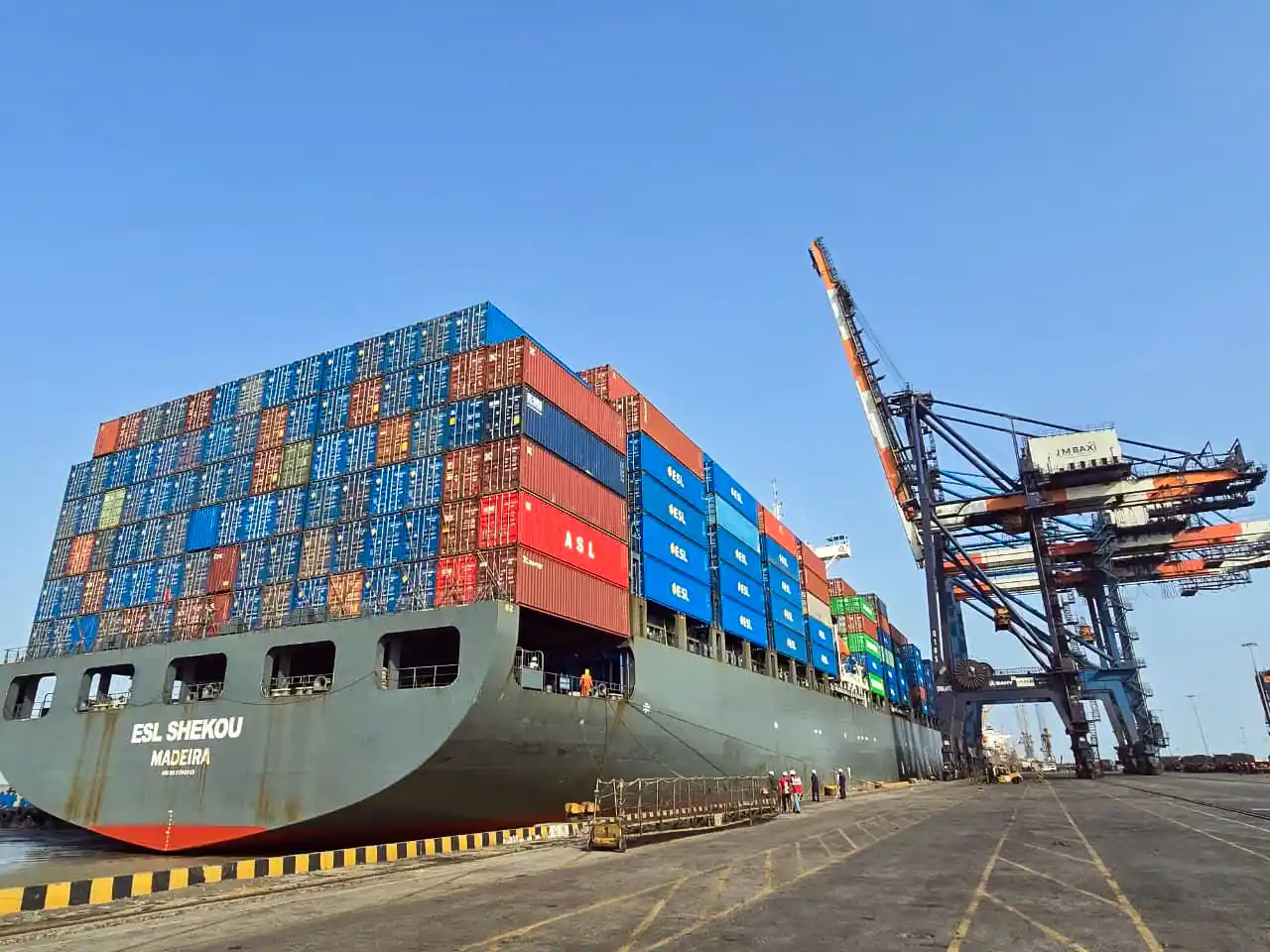
For decades, India’s maritime trade carried a quiet but costly irony. A nation with over 7,500 kilometres of coastline and some of the busiest shipping lanes passing along its southern tip was, for all practical purposes, locked out of the biggest ships in global commerce. Today, a year on from when the Modi government first signalled its intent to transform India’s major ports into international transshipment hubs, that irony is finally being corrected — and the arrival of the MSC Irina, the world’s largest container ship, at Vizhinjam Port on July 7 is proof that the correction is real, not rhetorical.
To understand why this matters, it helps to understand what transshipment actually means. Global shipping lines no longer move cargo point-to-point on modest vessels. Instead, they deploy giant “mother vessels” capable of carrying anywhere from 14,000 to over 24,000 twenty-foot equivalent units (TEUs), consolidating cargo from multiple countries onto a single voyage. This is how shipping lines achieve economies of scale and slash per-container transport costs. But these leviathans need deep water to berth — typically 16 to 20-plus metres of draft. India’s public sector Major Ports, until recently, could offer a maximum of just 14 metres.
The consequence was as simple as it was expensive. Indian export cargo had to be ferried in smaller “feeder vessels” to a foreign transshipment hub — Colombo, Singapore, Port Klang in Malaysia, or Jebel Ali — before being loaded onto a mother vessel bound for Europe, the Gulf, the Far East, or the United States. Import cargo followed the same route in reverse. The result: nearly three-quarters of India’s transshipment cargo, both containerized and dry bulk commodities like iron ore, coal, steel, and fertilizers, was effectively subsidizing foreign ports instead of Indian ones. Every extra transshipment leg added time, cost, and dependency — a toll paid quietly by Indian exporters and importers for years while successive governments treated port modernisation as a back-burner issue.
That neglect is now being addressed with a scale and urgency that matches the scale of the problem. The government’s current push involves deepening the draft at several major ports — Kamarajar Port at Ennore near Chennai, Paradeep Port in Odisha, and Deendayal Port in Kutch — from 14 to 18 metres, enabling them to handle Cape-size dry bulk vessels carrying roughly 2 lakh tonnes of dead-weight cargo. This is not cosmetic dredging; it is a structural upgrade that changes what these ports can physically accommodate.
More striking still is the pipeline of new capacity. Vadhavan Port in Maharashtra, blessed with a natural draft of 20 metres, is being built as a mega-port designed to handle 23 million TEUs — a scale that would place it among the world’s top ten container ports. In the private sector, Mundra Port in Gujarat, with a 17.5-metre draft, has already proven the concept by becoming the only Indian port shipping over 14,000 TEUs directly to the United States, cutting out the middleman hub entirely.
But it is Vizhinjam, in Kerala, that may prove to be the most consequential of all. Developed under a public-private arrangement between the Kerala government and the Adani Group, Vizhinjam boasts a natural draft of 18 metres, scalable to 20 metres through dredging. Its geography is its trump card: the port sits barely 10 nautical miles from one of the busiest east-west shipping corridors on earth, the route linking the Persian Gulf, Europe, and the Far East. A ship on that route barely has to detour to call at Vizhinjam. That the MSC Irina — a vessel of 24,346 TEU capacity, the largest container ship afloat — chose to berth there is not a symbolic gesture. Shipping lines do not send their flagship assets to unproven ports for photo opportunities; they send them where the economics work.
What makes this moment significant is not any single port or project, but the cumulative shift in strategic posture. For years, India’s absence from the transshipment map was treated as an unfortunate but fixed geographic reality. It was not. It was a policy choice — or more precisely, a policy vacuum — left unaddressed by governments that did not prioritise deep-draft infrastructure when it mattered most. The current effort to simultaneously deepen legacy ports, build greenfield mega-ports, and lean on private capital to accelerate delivery suggests a recognition that India cannot afford to keep paying rent to Colombo and Singapore for services it can provide itself.
There is real work still ahead — dredging, hinterland connectivity, customs efficiency, and sustained shipping-line confidence all matter as much as draft depth. But the direction of travel, quite literally, has changed. A country that once sent its cargo abroad to catch a ride home is now positioning itself to be the ride. That is worth noticing, and worth sustaining.