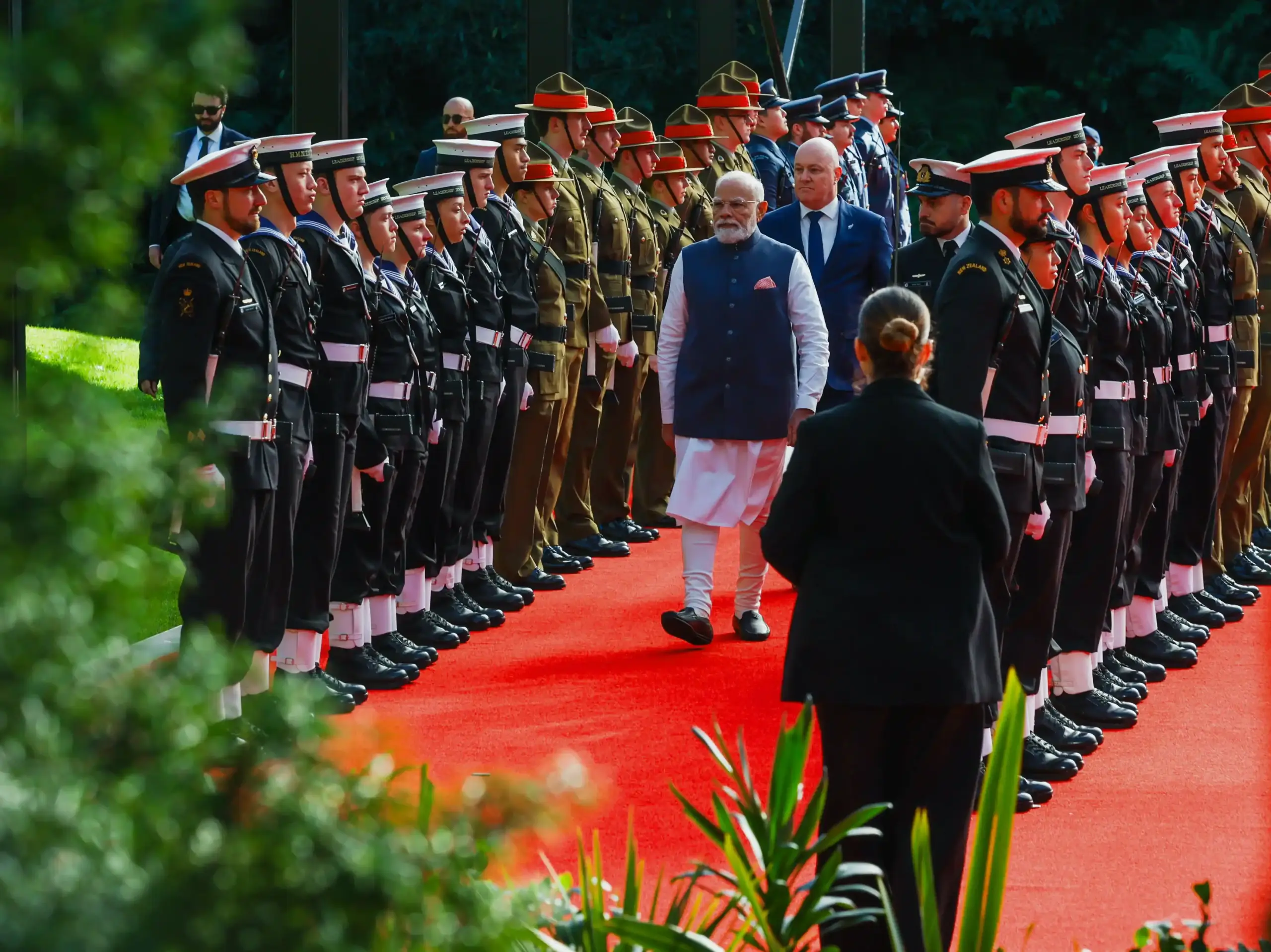
When Prime Minister Narendra Modi arrives in Wellington this week, he brings more than ceremonial goodwill. He brings the weight of a carefully negotiated free-trade agreement that, if properly implemented, could reshape how two geographically distant democracies collaborate in an era of fractured global commerce.
The India–New Zealand Free Trade Agreement, finalized in April, represents something increasingly rare: a pact between two middle powers that moves beyond tariff schedules to address the deeper anxieties of our moment. It is neither a containment strategy dressed in trade language nor a commercial arrangement masquerading as strategy. Instead, it reflects a maturing understanding between New Delhi and Wellington: that in a world defined by great-power competition and supply-chain fragmentation, smaller democracies must actively engineer their own relevance.
The Numbers Tell Part of the Story
The headline figures are compelling but hardly decisive. The agreement aims to nearly double bilateral trade to $5 billion within five years and catalyze up to $20 billion in New Zealand investment into India. For context, current trade hovers around $2.7 billion—hardly negligible, but modest given the two countries’ complementarities and the billion-plus citizens of the Indian market.
What matters more than the targets is the architecture. New Zealand will reduce tariffs on 95% of its exports to India, with agricultural products—dairy, butter, meat—receiving preferential access to a market where such goods command premium prices. India gains duty-free entry for textiles, engineering goods and marine products, sectors where it maintains genuine competitive advantage. Both sides protected sensitive agricultural interests, a pragmatic acknowledgment that political realities must bend trade theory.
The mobility provisions—5,000 annual slots for skilled Indian workers—underscore something often missed in trade analysis: labor migration is perhaps the most economically consequential element for countries at India’s wage levels. Every skilled worker who finds employment abroad sends remittances, builds networks and potentially returns with capital and expertise.
Where Strategy Intersects Commerce
Yet to focus solely on tariff lines and investment flows would miss the point entirely. This FTA arrives at a moment when India is recalibrating its entire approach to global engagement, and New Zealand is doing something subtler but perhaps more significant: quietly repositioning itself from a country that accommodates great powers to one that actively shapes regional architecture.
On China, the two nations speak different languages but share underlying concerns. New Zealand, historically reluctant to criticize Beijing directly, has begun tightening foreign-investment scrutiny and deepening security partnerships with like-minded countries. India has been far more forthright, balancing trade dependence with strategic vigilance along a contested border. Their convergence is not about containing China but about constructing alternatives—diversified supply chains, preferential partnerships, defense cooperation.
The defense component deserves emphasis. Joint exercises in the Indian Ocean, maritime domain awareness initiatives and intelligence sharing arrangements represent the tangible expression of aligned interests. For two maritime democracies separated by thousands of miles but sharing a strategic outlook, such cooperation is not ceremonial but essential.
The Democracy Dividend
Both India and New Zealand derive underutilized strength from being democracies in regions where that distinction matters. India’s tech sector, its defense manufacturing ambitions and its agricultural innovations all rest on institutions that tolerate dissent and encourage entrepreneurship. New Zealand brings environmental credentials, governance transparency and soft power that resonates across the Indo-Pacific.
There is untapped potential in joint research, educational exchanges and technology collaboration. Indian companies seeking to develop climate-resilient agriculture can learn from New Zealand’s experience. New Zealand businesses looking to scale in emerging markets can partner with Indian firms that understand local complexities. Neither nation needs to choose between economic partnership and values alignment; the agreement allows them to pursue both.
Implementation Is Everything
The cynicism required to view such agreements with complete skepticism is justified by history. Trade pacts routinely underdeliver because governments prove unwilling to absorb adjustment costs, domestic interests block promised market access and bureaucratic inertia defeats even well-intentioned rules of origin provisions.
India and New Zealand must prove exceptions. This means establishing real dispute-resolution mechanisms with teeth, fast-tracking regulatory mutual recognition and resisting the temptation to protect politically sensitive sectors through non-tariff barriers. It means annual strategic summits at the highest level, not photo opportunities that substitute for substance.
A Model for Our Time
The Modi visit represents something valuable: evidence that middle powers can build consequential partnerships without either accepting subordination to great powers or succumbing to zero-sum competition. India and New Zealand are not threatening established hierarchies; they are creating space in which to pursue their interests more effectively.
In an era when trade is simultaneously too important to abandon and too fraught to manage through existing multilateral frameworks, bilateral partnerships grounded in democratic values and mutual economic benefit offer an underappreciated path forward. The India–New Zealand agreement suggests that path is not mere aspiration but increasingly, lived reality.