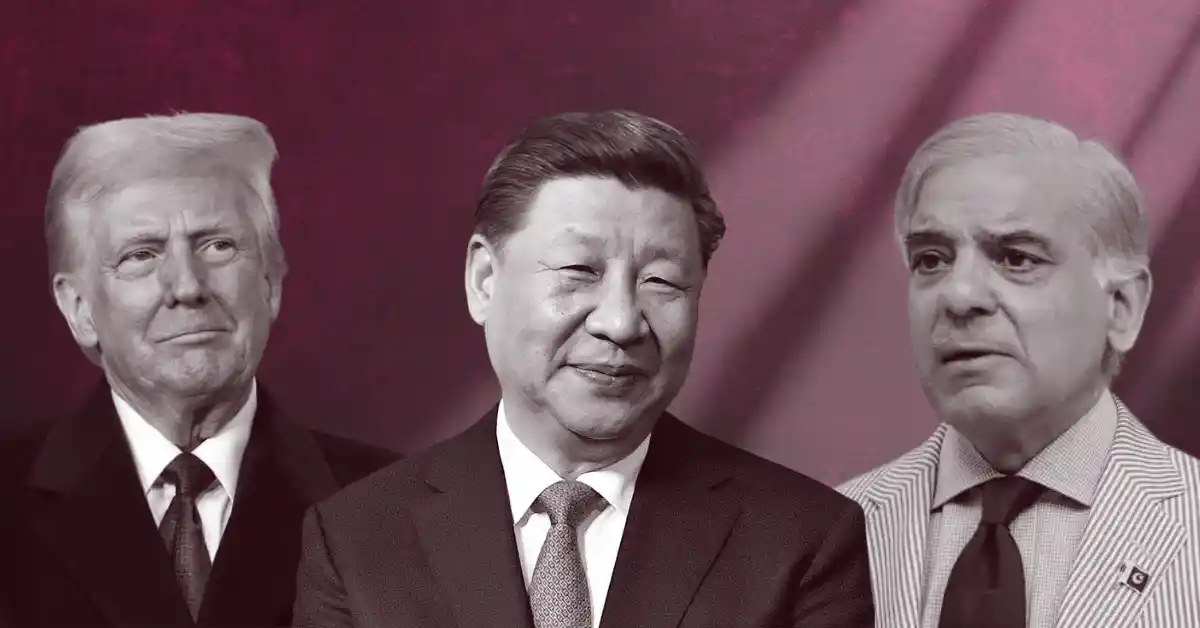
As Washington deepens tactical engagement with Pakistan, Islamabad is simultaneously aligning itself more closely with China on Taiwan, the South China Sea, CPEC and Beijing’s broader strategic vision. This growing China-Pakistan strategic convergence raises serious questions about America’s Indo-Pacific strategy and its long-term partnership with India.
The whole of America’s Indo-Pacific strategy is based on the principles of maintaining stability in the region, preserving the balance of power, ensuring freedom of navigation, and preventing any forcible change to Taiwan’s status quo. Now look at the statement that Pakistan and China issued during the visit of Trump’s so-called favourite, Field Marshal Asim Munir, and Prime Minister Shehbaz Sharif to China from May 23–26, 2026[i]. One of the key paragraphs in the joint statement reads: “Pakistan reaffirmed its strong commitment to the one-China principle, and holds the view that Taiwan is an inalienable part of the territory of the People’s Republic of China and the Taiwan question is at the core of China’s core interests[ii].”
The statement further reads: “Pakistan firmly supports all efforts by China to achieve national reunification and resolutely opposes any form of ‘Taiwan independence.’ Pakistan firmly supports China’s just stance on issues concerning Xinjiang, Xizang, Hong Kong and the South China Sea. China reiterated its unwavering support for Pakistan in defending its national sovereignty, independence, and territorial integrity, and to safeguard its national security, stability, development and prosperity.”
The implications of this statement are significant. Pakistan is firmly supporting all of China’s efforts to achieve reunification with Taiwan, including by every possible means. This is a very strong and alarming statement. On one hand, Trump repeatedly praises Pakistan’s Field Marshal and Prime Minister Shehbaz Sharif, with Asim Munir’s name often featured in his remarks, while on the other hand, Pakistan is openly undermining U.S. interests in the Indo-Pacific region by completely aligning itself with China and endorsing Beijing’s aggressive actions.[iii]
The statement also openly supports China’s stance on the South China Sea, effectively legitimising Beijing’s coercive and expansionist behaviour in the region. This is alarming not only for Taiwan but also for every country in the Indo-Pacific that believes in a rules-based international order, freedom of navigation, and the maintenance of the regional balance of power.
U.S. officials need to reassess the nature of the policy they are pursuing and the level of engagement they are extending toward Pakistan. In doing so, they are even hurting the interests of their trusted strategic partner, India. Pakistan is effectively puncturing the entire U.S. Indo-Pacific strategy by siding with China and giving legitimacy to Beijing’s aggressive actions, belligerent behaviour, and ambitions regarding Taiwan[iv].
Pakistan’s Support for China’s Global Strategic Vision
As the joint statement also reads, Pakistan supported all of China’s global strategic initiatives, such as the Global Civilisation Initiative, the Global Development Initiative and others aimed at shaping a new world order and undermining the U.S.-led global order[v]. Pakistan is constantly giving legitimacy to these initiatives and promoting them. As the joint statement states: “Pakistan attaches great importance to and supports the vision of building a Community with a Shared Future for Humanity and the Global Development Initiative (GDI), the Global Security Initiative (GSI), the Global Civilization Initiative (GCI), and the Global Governance Initiative (GGI) put forth by President Xi Jinping,” underscoring Pakistan’s continued support for China’s vision of promoting a new world order[vi].
Both sides also indirectly criticised U.S. unilateral actions and referred to them in the context of fascism and militarism. While the sentence referring to fascism and militarism is generic, it is likely that references were aimed at the US, given Beijing’s disappointment with the US on trade and Taiwan. The statement further reads: “Both sides agreed that it is essential to firmly uphold the victorious outcomes of World War II, and oppose any attempt to revive fascism and militarism[vii].” Pakistan also endorsed cooperation with China in AI, supply chains, and other strategic sectors where Beijing and Washington are increasingly locked in geopolitical and technological competition.
Similarly, Pakistan has been instrumental in promoting China’s BRI, a grand geostrategic and structural initiative aimed at reshaping the world order, with CPEC being a key part of it running through Pakistan. As the statement reads: “Pakistan commends China’s cooperation philosophy of giving people both fish and fishing skills. The two sides stand ready to launch more ‘small and beautiful’ livelihood projects in infrastructure, agriculture, education, health and other fields.” This statement has also come at a time when the BRI has faced increasing global criticism for creating debt traps, economically unviable projects and failing to generate meaningful local economic opportunities in most countries. That is why China is now trying to repackage and rebrand parts of the BRI through the language of “small and beautiful” projects, and there is a lot of geopolitics behind this language. By endorsing and promoting these initiatives, Pakistan is once again helping to legitimise China’s broader grand geostrategic agenda.
Both countries also discussed the Kashmir issue, with China backing Pakistan’s position on Kashmir. They also discussed transboundary river cooperation, which India has strongly objected to, as New Delhi considers the territory involved to be its sovereign territory and views such references as a violation of its sovereignty and territorial integrity[viii]. India’s Ministry of External Affairs categorically reiterated that Jammu & Kashmir and Ladakh “have been, are and will always remain integral and inalienable parts of India.” India also issued a strong statement on CPEC, which runs through Indian territory illegally occupied by Pakistan. As the MEA stated, “As regards the so-called China-Pakistan Economic Corridor (CPEC) projects, some of which are in India’s sovereign territory, we resolutely oppose and reject any moves by other countries to reinforce or legitimise Pakistan’s illegal and forcible occupation of these territories.”
India, America and the Indo-Pacific Strategy
Recently, during his visit to India, U.S. Secretary of State Marco Rubio repeatedly used the term “strategic alliance” across multiple engagements, including delegation-level talks, joint press briefings with External Affairs Minister S. Jaishankar, and public remarks[ix]. By repeatedly using this term, he sought to convey that India’s long-term strategic interests converge with those of the United States and that Washington views India as a long-term strategic partner, particularly in the Indo-Pacific region.
Rubio also indirectly acknowledged in his remarks that Washington’s relationship with Pakistan is more tactical in nature, stating, “We have relations, and we work at the tactical level, for example, and in many other ways with countries all over the world. So does India…But I don’t view our relation with any country in the world as coming at the expense of our strategic alliance with India[x].”
The message was clear: Washington expects India to distinguish between tactical diplomacy and strategic alignment. Rubio was effectively signalling that while the United States may engage Pakistan on specific tactical issues, such engagement should not be viewed as a shift away from India.
However, the U.S. must ensure that it is not shooting itself in the foot by undermining its own interests in the Indo-Pacific region, particularly regarding Taiwan, while at the same time weakening its partnership with India for the sake of Pakistan, whatever the reason may be.
The copyright of this article remains with the Politeia Research Foundation ©️PRF.
[i] “Xi Jinping Meets Pakistan PM Shehbaz Sharif, Hails Unbreakable Ties in Beijing,” NewsCord, May 25, 2026, https://newscord.org/article/xi-jinping-meets-pakistan-pm-shehbaz-sharif-hails-unbreakable-ties-in-beijing–Story_20260525_AfterTrumpandPutinXie048312a
[ii] “China, Pakistan Agree to Advance High-Quality Development of CPEC and Deepen All-Weather Strategic Cooperative Partnership,” The State Council of the People’s Republic of China, May 26, 2026, https://english.www.gov.cn/news/202605/26/content_WS6a155676c6d00ca5f9a0b41b.html
[iii] NDTV News Desk, “‘Very Extraordinary Men’: Trump Praises Pakistan’s Shehbaz Sharif, Asim Munir After US-Iran Talks,” NDTV, April 13, 2026, https://www.ndtv.com/world-news/donald-trump-praises-pakistans-shehbaz-sharif-asim-munir-after-us-iran-talks-calls-them-very-extraordinary-men-11348910
[iv] Refer point 2
[v] Ibid
[vi] “Pakistan and China Reach New Broad Consensus on Boosting Ties,” Al Jazeera, May 26, 2026, https://www.aljazeera.com/economy/2026/5/26/pakistan-and-china-reach-new-broad-consensus-on-boosting-ties
[vii] “China-Pakistan Friendship Demonstrates a New Type of International Relations, Says Global Times,” Global Times, May 26, 2026, https://www.globaltimes.cn/page/202605/1362182.shtml
[viii] “India Rejects ‘Unwarranted’ References to Jammu and Kashmir in China-Pakistan Joint Statement,” Scroll.in, May 27, 2026, https://scroll.in/latest/1093136/india-rejects-unwarranted-references-to-jammu-kashmir-in-china-pakistan-joint-statement
[ix] “Transcript of Joint Press Conference by EAM Dr. S. Jaishankar and U.S. Secretary of State Marco Rubio,” Ministry of External Affairs, Government of India, May 24, 2026, https://www.mea.gov.in/media-briefings?dtl/41227/Transcript_of_Joint_Press_conference_by_EAM_Dr_S_Jaishankar_and_US_Secretary_of_State_Marco_Rubio_May_24_2026
[x] Siddhant Mishra, “Rubio Hints at Tactical Ties with Pakistan, Says They Are Not at Expense of Strategic Ties with India,” ThePrint, May 24, 2026, https://theprint.in/diplomacy/rubio-hints-at-tactical-ties-with-pakistan-says-they-are-not-at-expense-of-strategic-ties-with-india/2940333/