Pakistan has administered the territory it calls Azad Jammu and Kashmir for more than seven decades under a governance model whose central contradiction has now become inescapable: Islamabad presents the region as self-governing while constitutionally guaranteeing that the most consequential decisions are made elsewhere. The protests that erupted in 2023, escalated in 2024, and resumed in 2025 are not a response to any single policy failure. They are the cumulative settlement of that contradiction — and understanding why they have intensified, why economic demands became political demands, and why the state’s response has systematically deepened rather than resolved the crisis requires interrogating the structure that produced them.
The constitutional architecture of AJK is frequently mischaracterised. Under the AJK Interim Constitution Act of 1974, the territory has a legislative assembly, a prime minister, and a cabinet. What these institutions govern is the question. The AJK Council — chaired by Pakistan’s Prime Minister, with federal ministers holding majority influence — exercises concurrent legislative authority over the most consequential policy domains. Electricity tariff-setting belongs to the National Electric Power Regulatory Authority, a federal body. Development budgets flow through federal transfers: the AJK Prime Minister told Pakistan’s Senate Standing Committee on Finance in August 2023 that the federal government provides Rs70 billion annually, a sum that can be conditional on federal preferences. Most decisively, AJK’s population holds zero seats in Pakistan’s National Assembly or Senate. They are governed by a parliament in which they cannot vote. Freedom House has rated Pakistani Kashmir “Not Free” consistently, assigning a political rights score of 6 out of 7 — the least-free category — in its 2024 assessment. Table 1 sets out the constitutional comparison against Gilgit-Baltistan and Khyber Pakhtunkhwa.
Table 1 | Constitutional Architecture: PoJK vs. Gilgit-Baltistan vs. KPK
| Domain | PoJK (AJK) | Gilgit-Baltistan (GB) | KPK (province comparator) |
| Defence & Foreign Affairs | Federal only — no AJK input | Federal only | Full sovereignty |
| Electricity tariff-setting | NEPRA / Federal — no AJK voice | NEPRA / Federal | Provincial input post-18th Amdt |
| Hydropower royalties | Water Use Charge FY23: Rs 5.44 bn (NEPRA) | Disputed; no agreed mechanism | Net Hydel Profit FY23: Rs 28.6 bn (NEPRA) |
| National Assembly seats | Zero — by constitutional design | Zero — by constitutional design | 14 seats (fully represented) |
| Development budget | Federal transfer only (Rs 70 bn FY24, AJK PM) | Federal transfer only | Own NFC divisible pool share |
| Freedom House rating (2024) | Not Free — Political rights 6/7 | Not Free — Political rights 6/7 | Partly Free |
Sources: AJK Interim Constitution Act 1974; Gilgit-Baltistan Order 2020; NEPRA State of Industry Report FY2022-23; Freedom House, Freedom in the World 2024 — Pakistani Kashmir; AJK Prime Minister statement to Senate Standing Committee on Finance, 31 August 2023 (The News). Red text denotes constitutional absence of power or representation. KPK comparator uses post-18th Amendment framework.
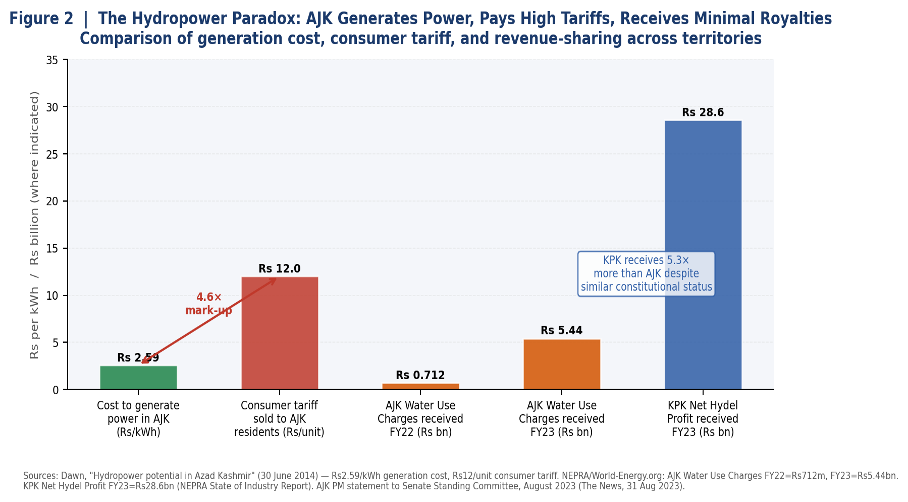
The hydropower grievance is not incidental to that architecture — it is its economic expression, verified in precise figures. The Mangla Dam, commissioned in 1967 in the Mirpur district of AJK, operates at 1,310 MW (post-refurbishment, WAPDA) and generates approximately five billion units of electricity annually for the national grid — 15.1 percent of Pakistan’s hydropower installed capacity, according to WAPDA’s own documents submitted to JICA. Yet, as Dawn reported in 2014 citing WAPDA data, the cost of generating that power in AJK was Rs2.59 per kilowatt-hour, while AJK consumers were charged Rs12 per unit — a markup exceeding four and a half times. The disparity in royalties is equally stark: in fiscal year 2023, NEPRA data shows KPK received Rs28.6 billion in net hydel profits while AJK received water use charges of Rs5.44 billion — a sixfold gap. The AJK Prime Minister stated in his August 2023 Senate appearance that the federal government had deducted Rs61 billion in outstanding dues from AJK while declining to pay an estimated Rs400 billion owed in hydropower profits. AJK generates power for Pakistan, subsidises Pakistan’s national grid at the cost of its own consumers, and receives a fraction of the resource revenues that comparable entities within Pakistan’s federal structure have secured.
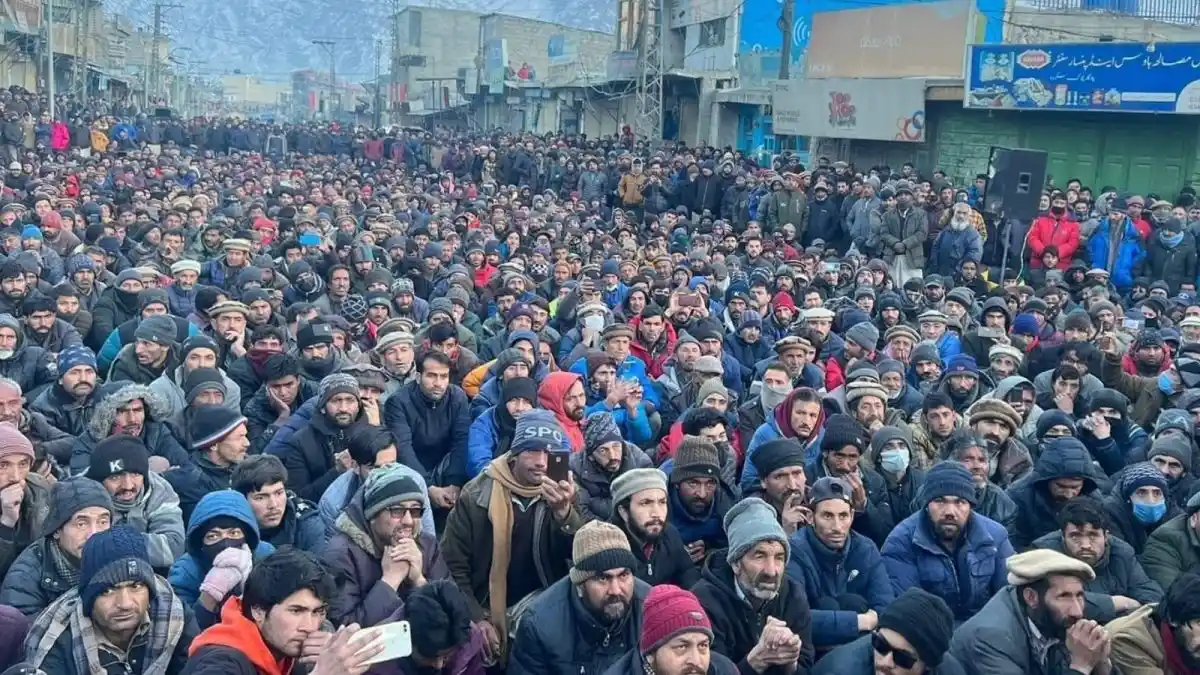
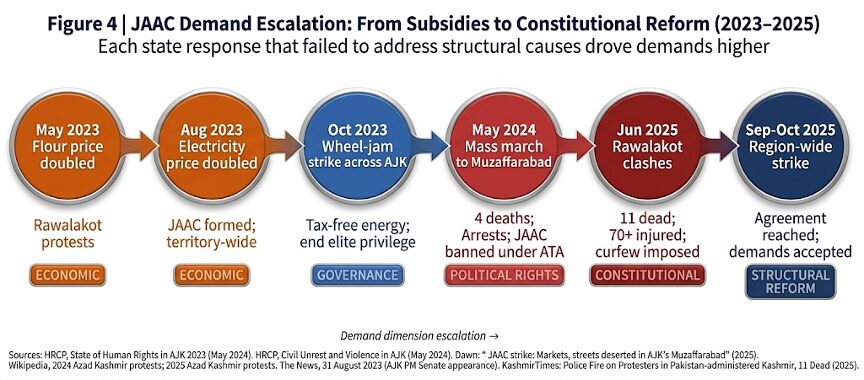
This structural exclusion is what transformed economic protests into political demands, and what made the Joint Awami Action Committee — formed in August 2023 after the government doubled electricity prices — qualitatively different from earlier episodes of unrest. The HRCP’s 2024 State of Human Rights report documents the trigger precisely: on 8 May 2023, the government suddenly doubled the price of flour, sparking protests in Rawalakot. Three months later, when electricity prices also doubled, protests resumed in Muzaffarabad and Mirpur simultaneously. What made JAAC different from prior AJK political movements was its cross-class, cross-sector character — traders, transporters, lawyers, students — and its explicit refusal of the existing political parties, which were widely perceived as transmission belts for Islamabad’s preferences rather than representatives of AJK’s population. Table 2 documents the escalation of demands from 2023 to 2025: what began as a subsidy dispute ended as a demand for constitutional reform and structural autonomy.
Table 2 | JAAC Demand Escalation: From Subsidies to Constitutional Reform (2023–2025)
| Period | Trigger | Framing | Outcome / Significance |
| May 2023 | Government doubles flour price (8 May 2023) | Cost-of-living; economic | Rawalakot protests erupt; sporadic, sectoral (HRCP 2024) |
| Aug 2023 | Electricity price doubled; subsidy removed | Household affordability | JAAC formed; territory-wide coalition of traders, lawyers, transporters (HRCP) |
| Oct 2023 | Wheel-jam strike across all major AJK towns | Governance accountability | Demands extend to elite privilege; hydropower royalties raised (HRCP) |
| May 2024 | Mass march on Muzaffarabad (11 May); govt bans JAAC under ATA | Political rights; civil liberties | 4 dead; mass arrests; HRCP fact-finding mission; JAAC proscribed (HRCP/Dawn) |
| Jun 2025 | Rawalakot clashes — police and paramilitary deployed | Constitutional accountability | 11 dead, 70+ injured (Dawn/KashmirTimes); curfew imposed; HRCP alarmed |
| Sep–Oct 2025 | Region-wide strike; long march to Muzaffarabad | Structural reform; autonomy | Agreement reached; demands “reportedly accepted” (Dawn/Wikipedia) |
Sources: HRCP, State of Human Rights in AJK in 2023 (released May 2024, hrcp-web.org); HRCP, Civil Unrest and Violence in Azad Jammu and Kashmir (fact-finding report, May 2024); Dawn, “JAAC strike: Markets, streets deserted in AJK’s Muzaffarabad” (2025); Kashmir Times, “Police Fire on Protesters in Pakistan-administered Kashmir, 11 Dead” (2025); Wikipedia, 2024 Azad Kashmir protests; 2025 Azad Kashmir protests (citing Reuters, Dawn). Framing colour: black = economic, amber = governance, red = constitutional.
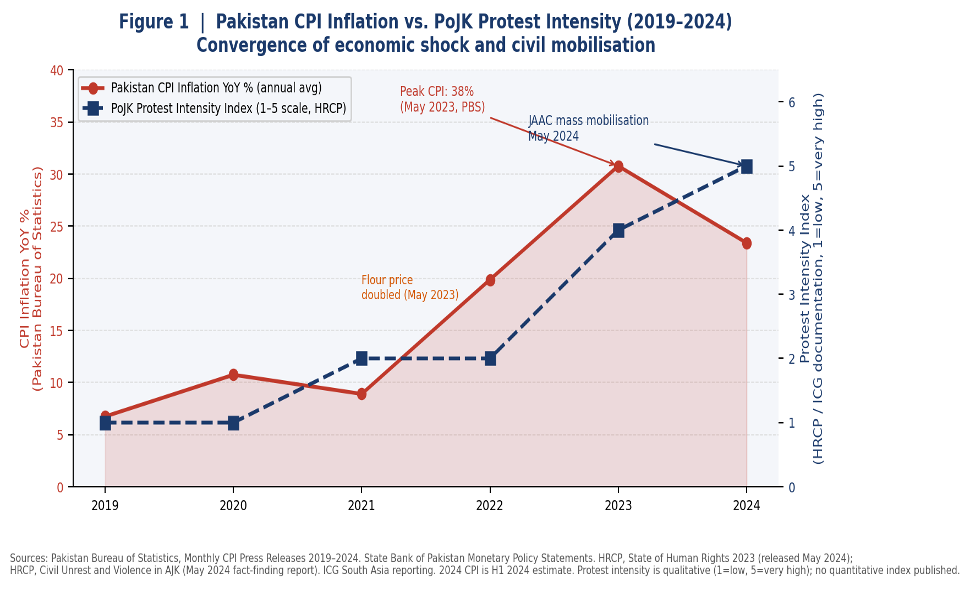
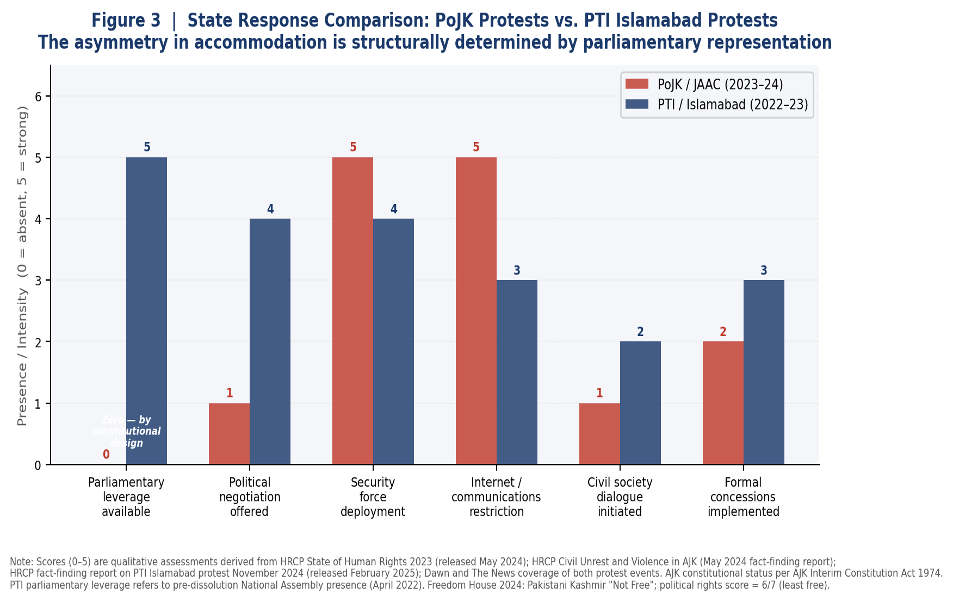
The state’s response reveals a structural logic that is clearest when compared with Pakistan’s management of PTI-led protests in Islamabad during 2022 and 2023. The HRCP’s fact-finding mission to Muzaffarabad in May 2024 documented arrests of JAAC leaders, allegations of torture of those in custody, internet and communications restrictions, and the killing of at least one young man by gunfire — the mission met his family. In May 2024, the AJK government declared JAAC a proscribed organisation under anti-terrorism legislation before the 11 May march. In the violence that followed in Rawalakot in 2025, Dawn reported at least four security personnel and seven civilians killed; Kashmir Times reported eleven dead and more than seventy injured, citing security forces opening fire. Against PTI, Pakistan negotiated, manoeuvred legally, and ultimately accommodated — partly because PTI’s parliamentary presence gave it institutional leverage: the ability to impose political costs through elections and legislative action. AJK’s population has no such mechanism. The calculus of repression versus accommodation is not a choice made on principle; it is structurally determined by whether a population can punish the government through channels the government cares about. Figure 3 maps this asymmetry directly.
Each act of repression that fails to resolve the underlying grievance deepens the alienacy and sophistication of the movement that follows. The HRCP’s 2025 statement expressed alarm at ongoing violence and called for independent inquiry — language that appeared after the 2024 cycle, the 2023 cycle, and will likely appear again. The 2025 agreement between Islamabad and JAAC — in which demands were reportedly accepted — follows the pattern of partial concession that has defined every prior cycle: enough to temporarily demobilise, insufficient to address the structural sources of grievance, and therefore a guarantee of recurrence.
The diplomatic cost accumulates in parallel. Pakistan’s position before the United Nations on the Kashmir dispute rests on UNSC Resolution 47 of 1948, which calls for a plebiscite reflecting the free political will of the territory’s population. Mass protests in which that population demands accountability from Islamabad — documented by Pakistan’s own Human Rights Commission, covered internationally, and amplified by a large British diaspora from Mirpur concentrated in Bradford, Birmingham, Manchester, and London — are strategically incompatible with that narrative. Pakistan’s diplomatic representatives cannot simultaneously invoke the people of AJK as evidence of popular support and suppress those same people when they exercise political voice. For India, the inverse applies: the most credible evidence of Pakistan’s governance failures in PoJK is produced not by Indian government assertions, which are discountable, but by HRCP reports, NEPRA data, and AJK’s own Prime Minister before Pakistan’s Senate.
The comparative picture with Gilgit-Baltistan confirms that this is a systemic pattern, not a local anomaly. The GB Order of 2020 granted formal provincial status that AJK does not possess, yet reproduced the essential governance template: zero National Assembly seats, resource assets managed primarily for national benefit including CPEC corridor land, and political expression constrained by security imperatives. The CPEC dimension raises the stakes in GB — Chinese investment creates an international stakeholder in stability, paradoxically increasing Islamabad’s vulnerability to unrest there without creating structural incentives to reform. Across both territories, and in the longer shadow of Balochistan, the pattern is consistent: Pakistan’s model for peripheral territories substitutes constitutional labelling for genuine autonomy, resource extraction for development, and security management for political accommodation.
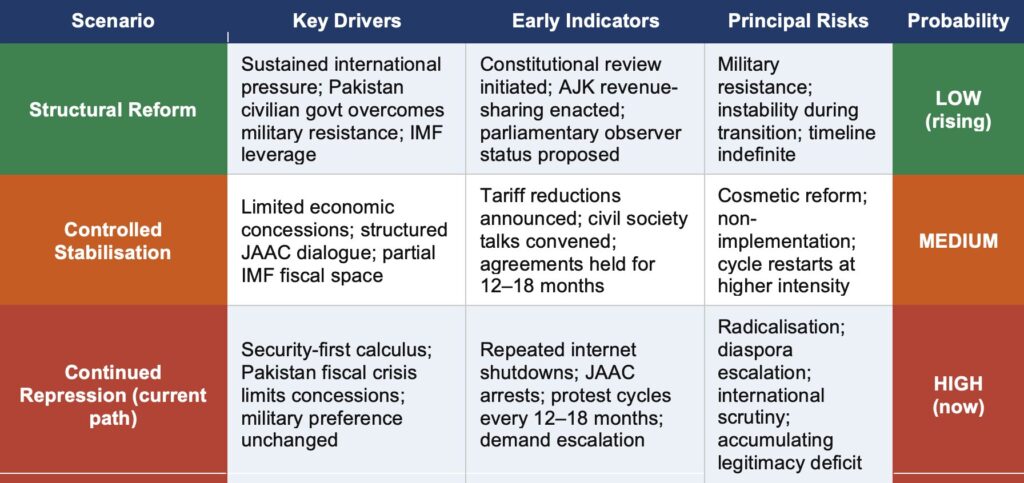
What the PoJK crisis ultimately demonstrates is that coercion can interrupt a protest cycle but cannot dissolve a structural contradiction. Pakistan administers a territory it cannot integrate and will not genuinely autonomise, and the gap between those two positions is the space in which JAAC exists and grows. The cost of structural reform — genuine revenue-sharing, meaningful political representation, security accountability — is real and politically difficult. But the cost of the alternative is now visible in HRCP reports, NEPRA data, Senate testimony, and casualty figures that Pakistan’s own institutions have placed on the record.
“Pakistan administers a territory it cannot integrate and will not genuinely autonomise. The cost of structural reform is real — but the cost of the alternative is now on the record, in HRCP reports, NEPRA data, Senate testimony, and casualty figures that Pakistan’s own institutions have documented.”