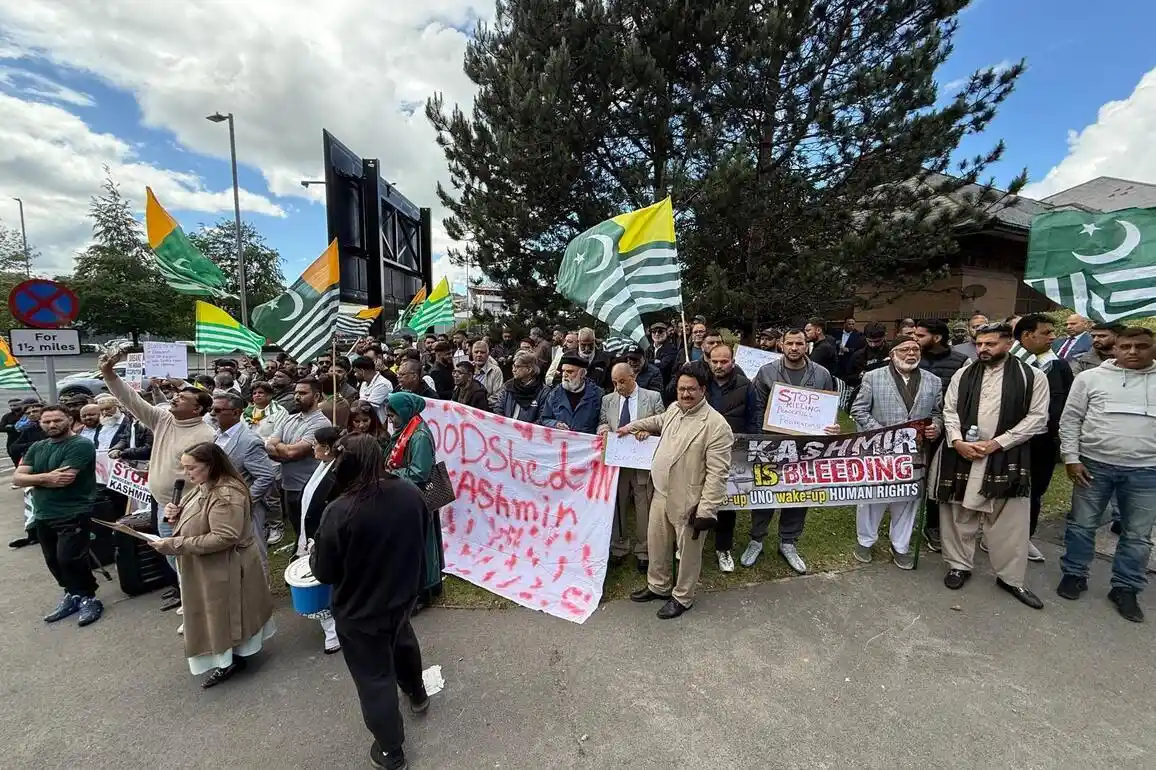
The unrest in Pakistan-occupied Jammu and Kashmir (PoJK) has entered a far more dangerous phase than earlier reported. What began as a ban on the Jammu Kashmir Joint Awami Action Committee (JAAC) and a single bloody crackdown in Rawalakot has now spiralled into a region-wide confrontation, with casualty figures rising sharply, a near-total communications blackout, and growing international attention. Far from being contained, the crisis has exposed the depth of popular anger against Islamabad’s rule over the territory, and has triggered condemnation from Indian leaders, diaspora groups, and rights activists alike. As Pakistan deploys tens of thousands of security personnel ahead of the 2026 elections, the events of the past week suggest PoJK is no longer simply protesting; it is rebelling.
At least 11 people were killed as police clashed with supporters of the outlawed JAAC in PoJK, with the violence occurring a day before a planned protest over political rights and legislative representation. But that figure proved to be only the beginning. By the following days, official accounts put the death toll at seven killed and dozens injured in Rawalakot. However, multiple media reports alleged a far higher toll of 27 dead and around 200 injured. Unverified social media claims have gone further still, with some asserting more than 500 people killed by the Pakistani Army, though these claims have not been independently verified.
The trigger for the latest round of bloodshed came from a planned long march. JAAC had organised a proposed 300-kilometre march from Bhimber in the south to Muzaffarabad in the north, the administrative centre of PoJK, scheduled for June 9, though the march eventually lost momentum after authorities moved to prevent it. Officials have presented their own version of events, alleging that armed JAAC supporters opened fire on security forces in Rawalakot and later surrounded the Combined Military Hospital, disrupting medical services, after which security forces dispersed the crowd and restored order while accusing protesters of arson and property damage.
JAAC’s leadership has rejected this framing outright. Shaukat Nawaz Mir, the group’s leader, described the violence as ‘a massacre of our people in Rawalakot,’ while the Commissioner of the Poonch sector rejected that characterisation, saying the state’s action was aimed at restoring law and order and that protesters had used automatic rifles and petrol bombs against security forces. According to police accounts to the Kashmir Times, four police officers and a passerby were killed when ‘miscreants’ opened fire, while six protesters were killed in the security response, with the Pakistan-occupied Jammu and Kashmir Inspector General of Police confirming that 23 security officials and 50 protesters were among the injured.
The blackout, described as a precautionary measure, has now become a defining feature of the crisis. Pakistan decided to shut down internet and mobile services across PoJK from June 8 through June 12, ahead of the JAAC’s planned June 9 protest and long march. To quash the protests, authorities mobilised approximately 14,000 security personnel, though alternative accounts suggest a larger force of over 20,000, comprising the Pakistan Rangers, local police units, and the Frontier Constabulary.
By midweek, monitoring groups confirmed the blackout was holding firm. As the digital shutdown commenced, the PoJK Home Department issued a formal notification outlawing the JAAC. This move, which invoked the first schedule of the Anti-Terrorism Act, 2014, coincided with reports from NetBlocks’sX account that web access in PoJK remained strictly limited for a third day. While the restrictions were felt most heavily in Muzaffarabad, activists and local groups reported that the blackout spanned the Neelum Valley, Mirpur, Poonch, Rawalakot, and Muzaffarabad, effectively severing mobile and internet communications throughout these regions.
Human rights defenders argue the purpose is straightforward: to prevent the outside world from seeing what is happening on the ground. Tasleema Akhter, presiding over the Association of Terror Victims in Kashmir, pointed out that modern technology makes it impossible to conceal the truth, which in turn prevents the global community from ignoring instances of state-sponsored violence.
The crackdown has also drawn condemnation from diaspora and separatist political groups operating outside Pakistan. Sohail Abro, the chairman of the Jeay Sindh Freedom Movement, issued a forceful condemnation of Pakistan’s violent suppression of peaceful demonstrators in PoJK. Demanding an immediate cessation of force, Abro insisted that Kashmiris be allowed their right to self-determination and offered his sympathies to the families of those who lost their lives in Muzaffarabad and Rawalakot. Furthermore, he highlighted a profound disconnect between Pakistan’s global positioning as a champion of self-determination and its domestic reality of crushing dissent within the territories it administers.
In a separate development, there have been formal demands for Pakistan to set free political prisoners, drop cases that appear politically driven, and reinstate civil rights. Additionally, there are calls for a neutral probe into the documented fatalities. These initiatives are accompanied by petitions to the United Nations, the European Union, and the British Parliament, urging these bodies to advocate for a referendum on the region’s political future under UN supervision.
Conversely, Pakistani authorities have maintained a steady narrative, asserting that the enforcement measures are aimed at the restoration of order rather than the suppression of lawful protest. According to the commissioner of Pakistani Poonch, the JAAC leadership has mischaracterised the situation as a massacre to deceive the public; he maintained that the state intervened solely to re-establish law and order.
Beyond immediate policing concerns, the crisis’s foundations are fundamentally structural. A judicial decision preceding the violence effectively blocked legal avenues for those contesting PoJK’s political status quo, thereby fueling the JAAC’s calls for demonstration. At the heart of this enduring unrest is the controversial system of 12 assembly seats reserved for refugees residing in mainland Pakistan. These seats remain off-limits to PoJK residents, even those with refugee status, serving as the primary catalyst for demands for systemic legislative reform.
As of mid-June 2026, a comprehensive communications blackout continues to obscure the ground reality in PoJK, leaving a massive discrepancy between state-issued casualty counts and the significantly higher figures reported via social media. Despite the scarcity of verified data, it is evident that the region has suffered its most violent period of state-driven unrest since the civil demonstrations began in 2023. This escalation has brought the territory’s relationship with Islamabad to a critical juncture, inviting unprecedented international focus on a region typically shielded from global view.
To avert a complete systemic collapse before the legislative elections on July 27, 2026, Islamabad must pivot from a strategy of military containment toward meaningful institutional change by addressing these three pivotal issues:
- Ending the proscription of the JAAC: The government should lift the ban on the Joint Awami Action Committee. Categorising a grassroots movement focused on basic economic rights and fair pricing as a terrorist entity serves primarily to justify forceful suppression. Reinstating the group’s legal status is a necessary step to demonstrate that Islamabad views local grievances as political rather than existential security threats.
- Reform of the Refugee seat allocation: The legitimacy of the upcoming July 27 polls depends on reforming the 12 assembly seats reserved for refugees living in mainland Pakistan. This system is widely criticised as a mechanism for federal parties to circumvent the local electorate and install compliant administrations in Muzaffarabad. Failure to reform this structure will signal that the state prioritises political dominance over the welfare of the local population.
- Accountability for violence. The state’s narrative regarding the Rawalakot incidents must be tested by an autonomous and transparent commission of inquiry. Such an investigation is essential to clarify the actual death toll, scrutinise the rules of engagement utilised by security forces, and ensure accountability for those who authorised the use of lethal force against non-combatant protesters.
The regional trajectory will ultimately depend on how Islamabad addresses these institutional flashpoints, restores digital connectivity, and permits independent oversight. Persisting with a policy of isolation and force risks rendering the July 27 elections a futile exercise for a population that already perceives the democratic process as fundamentally compromised.