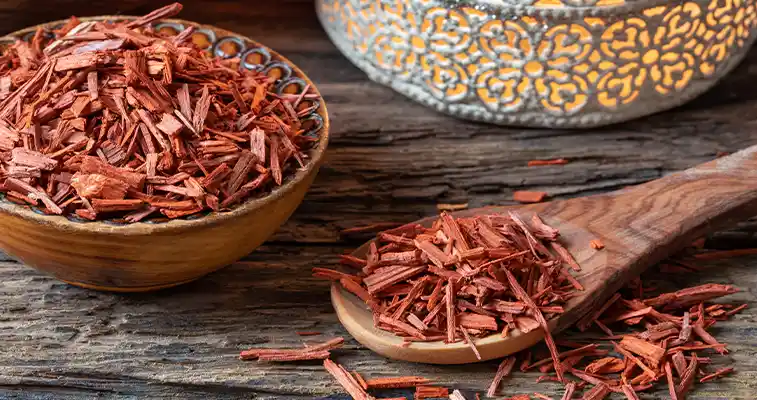
Kalidas, the great Sanskrit poet, composed his lyric poem Ritusamharam celebrating seasons circa the 5th century CE. The opening canto lists things that are cool to the touch and bring relief in scorching summer heat. Chandan, which means sandalwood in English, tops the list and is mentioned alongside pools of cold water, pearls, and rays of the moon. The images evoked are of amply blossomed beauties who apply sandal paste awaiting their lovers. The remedy to beat the heat not only imbued them with enticing fragrance but also made their bodies pleasantly cold to touch!
More than a thousand years later, another gifted poet whom we know as Jaidev penned Gita Govind, describing the celestial romance between Radha and SriKrishna. One of his mesmerizing ashtapadi (arrangement of couplets in sets of eight) that has inspired countless generations of Odissi dancers is: Chandan charchit, Neel kalevar, peet vasan Banmali. The dark-hued Krishna, attired in yellow, applies Chandan to his body as he prepares for a tryst. The refrain dheer sameere Yamuna tere vasati bane Banmali evokes the landscape and frolics of the adolescent lovers come alive.
By the time two centuries passed, sandalwood had become a spiritual metaphor. Raidas belonged to the socially stigmatized outcaste community; a contemporary of the legendary iconoclastic weaver poet Kabir wrote the memorable lines expressing the devotional spirit of surrender: Prabhuji tum Chandan hum paani jaaki ang ang baas sammani. This translates as ‘My Lord, you are the sublime sandalwood, and I am mere water that is made fragrant by association! Another saint poet, the rebel princes Meera, has also talked of this sacred wood. The famous bhajan has been sung by classical musicians like Pandit Onkarnath Thakur and Mallikarjun Mansoor as well as Juthika Roy and Lata Mangeshkar in films. The opening line is a wail: Jogi mat ja mat ja! Then unfolds the tale of unrequited love, renunciation and shouldering embers of residual desire. Agaru Chandan ki chita lagai,chapane haath jala ja jogi, jal bhai bhasm ki dheri apne ang laga ja! Jogi mat ja mat ja!
(Do not go away, Oh Jogi; I have set up my pyre with sandalwood, light it with your hands and when I am reduced to ashes smear it on your body), To the devout, this song expresses the yearning of the individual soul restless to merge with the divine beloved.
There is something special about Chandan. A small piece of wood goes a long way. Cedar may have earned the epithet Devdaru, the timber of gods, but it is sandalwood that is part of everyday life in Hindu households. Incense sticks made with it perfume the place where worshipped deities are installed, and the faithful apply it as a tika on the forehead.
What about taste? Thandai, the quintessential summer coolant, incorporates a pinch of sandalwood powder along with almond paste, green cardamom, melon seeds, rose petals, raisins, and peppercorns. Chandan enhances the allure of many sweet-and-sour recipes. There is the intriguing riddle of sandali murgh, which doesn’t mention Chandan as an ingredient yet insists on using the prefix! Among the traditional sherbets, Chandan used to rank highly until the bottled sodas, with their fizz, pushed it off center stage. Minuscule quantities of edible sandalwood powder or just a drop of Chandan oil are enough to add a complex layer of flavor to baked dishes, halwa, kheer, or even kebabs and korma. It doesn’t overpower its companions nor does it allow them to taint its sublime, subtle presence. An aphoristic folk saying underlines this unique quality- chnandan vish vyape nahin lipte rahen bhujang! (Venomous snakes girdle the tree but the sandalwood doesn’t become poisonous.) As the oft-quoted Sanskrit reminds us, this is no ordinary wood- chandanam nahi vane vane! (Not all forests have sandalwood trees.)
There was a time not very long ago when India was the largest exporter of sandalwood. In past decades, Australia has taken the top spot in terms of volume. However, the quality of Indian produce remains unmatched. For a short while, sandalwood smugglers like the notorious brigand Veerappan have ravaged the sandalwood forests in Karnataka, but after his demise, the threat of depletion of this rich resource has receded.
Come distressing summer, we can still touch and taste the fragrance that never fades and is an integral part of our cultural identity.