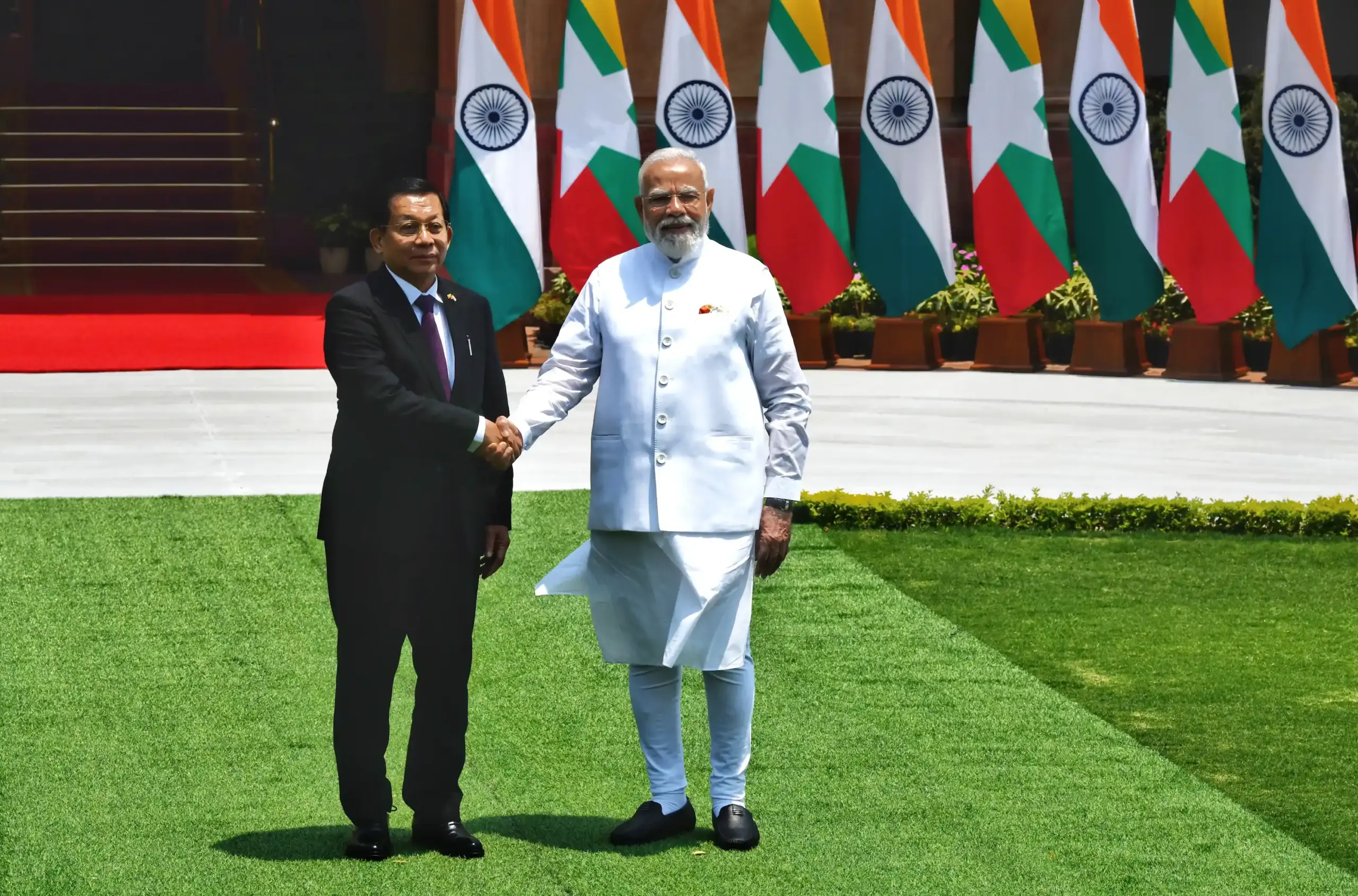
In a move that underscores India’s pragmatic approach to foreign policy, Myanmar President Min Aung Hlaing chose India for his first foreign trip as president, arriving in late May 2026 for a five-day state visit. Beginning his journey at Bodh Gaya—a site of profound Buddhist significance shared by both nations—the Myanmar leader met with Prime Minister Narendra Modi and President Droupadi Murmu to discuss deepening bilateral cooperation across trade, security, connectivity, and border management. The discussions culminated in a comprehensive joint statement that signalled New Delhi’s sustained engagement with its eastern neighbour despite Myanmar’s prolonged political crisis. This visit marks a critical juncture in India-Myanmar relations, reflecting both the strategic imperatives driving New Delhi’s engagement and the ethical dilemmas it raises.
Myanmar occupies a uniquely vital position in India’s foreign policy architecture. Sharing a 1,643-kilometer border with India’s northeastern states—including conflict-affected Manipur and Nagaland—Myanmar is central to India’s “Neighbourhood First,” “Act East,” and Indo-Pacific policies. Prime Minister Modi explicitly positioned Myanmar as a critical node at the confluence of these three strategic frameworks. The two countries have long cooperated on border security and intelligence sharing to combat insurgent groups operating from Myanmar’s territory.
In what is likely to be one of the most closely watched portions of the joint statement, President Min Aung Hlaing reiterated Myanmar’s assurance that its territory would not be used against India’s security interests. PM Modi, in turn, reaffirmed India’s commitment to Myanmar’s sovereignty and territorial integrity—a carefully worded endorsement at a time when the Myanmar military government faces active armed resistance across large stretches of its territory.
For India, engaging Min Aung Hlaing represents a calculated effort to dilute China’s outsized influence in Myanmar. Beijing has cultivated deep ties with Myanmar’s military, investing heavily in infrastructure projects and securing strategic access to the Indian Ocean through Myanmar’s ports. By strengthening ties with Yangon, New Delhi seeks to maintain a strategic balance in the region and prevent Myanmar from becoming a Chinese satellite state.
The visit placed border management at the forefront of bilateral discussions. Both sides stressed the importance of preventing misuse of sovereign territory for activities threatening either country’s security—language that reflects New Delhi’s long-standing concern about insurgent groups operating along the porous India-Myanmar border. The discussions underscored the importance of strengthening bilateral cooperation in defence and security, border management, and combating transnational crimes. India has maintained ties with Myanmar’s military-backed administrations despite Western sanctions, prioritizing national security and regional stability over ideological considerations.
A cornerstone of the India-Myanmar relationship is enhanced connectivity. In what marks a significant development, both sides revived emphasis on two long-delayed flagship projects: the Kaladan Multi-Modal Transit Transport project and the India-Myanmar-Thailand Trilateral Highway, both of which have faced significant delays due to funding, security and administrative hurdles. PM Modi underlined that completing these corridors was essential for fostering regional prosperity.
On the economic front, trade facilitation featured prominently. Both governments expressed support for the Rupee-Kyat bilateral settlement mechanism, which was operationalised in May 2024, noting steady growth in transaction volumes since its launch. Priority sectors for investment were identified as agro-processing, petroleum, energy, and mining. The discussions covered deepening cooperation in trade, rare earths, healthcare, connectivity, heritage restoration, and capacity building. Maritime security and cybersecurity also featured prominently in the talks, reflecting shared concerns about regional stability.
The significance of Myanmar’s head-of-state visit to India lies in its reflection of India’s realist foreign policy philosophy. In an increasingly competitive Indo-Pacific, where China’s influence continues to expand, India cannot afford to cede strategic space based on ideological considerations alone.
The joint statement represents a comprehensive roadmap for bilateral cooperation, covering trade and economic ties, defence and security, border management, development assistance, and cultural exchanges. PM Modi described the visit as “a significant milestone in the history of bilateral relations” that “marks a new chapter of cooperation and regional prosperity”.
India’s engagement strategy prioritizes national security, regional stability, and long-term strategic interests. Min Aung Hlaing is scheduled to travel to Mumbai on June 2-3 for meetings with Maharashtra’s Governor and Chief Minister, alongside further business engagements—rounding off a visit that New Delhi has clearly choreographed to send a signal of normalcy and partnership. This visit represents not just a diplomatic event but a strategic calculation that will shape India-Myanmar relations—and the broader Indo-Pacific balance of power—for years to come.