Indoctrination
Pakistan’s education crisis extends beyond underfunded schools, deteriorating infrastructure, and low literacy rates. At its core, it reflects deliberate ideological engineering: a curriculum partially designed to shape citizens who define national identity through religious exclusion, perceive neighbouring India as a perpetual civilisational adversary, and are exposed from childhood to extremist narratives. These concerns were articulated by Diamirta Staikou in EUtoday. Additionally, Mr Jan Figel, former EU Special Envoy on Freedom of Religion or Belief, has raised similar issues.
For years, human rights advocates, minority representatives, and education reformers have raised these concerns with limited public attention. Recently, European institutions and policymakers have begun to address the issue more prominently.
The 2024 report titled ‘Pakistan, Education System, Curriculum and EU Funding’, published by the Sallux/ECPM Foundation and supported by members of the European Parliament, documented over 40 pages of excerpts and photographs from Pakistani textbooks to argue a single, scathing thesis: the content of Pakistan’s official curriculum is not compatible with the values enshrined in the EU Charter of Fundamental Rights. Among the report’s most striking findings, a study cited within it revealed that Muslim religious ideas or texts appear in 7.7 per cent of books covering mathematics, social studies, science, general knowledge, English, and Urdu. Additionally, 7.47 per cent of all non-religious books contain references to Islam, while just 0.27 per cent mention other religions at all.
This is not coincidental. It is institutional. Education specialists and human rights advocates swiftly denounced the 2021 Single National Curriculum (SNC) following its implementation in Pakistan’s state schools. Critics argued that by integrating Islamic doctrines into foundational subjects, the curriculum effectively marginalised non-Muslim pupils and fostered an underlying narrative of religious dominance. Textbooks and classroom materials routinely present religious minorities as peripheral to the national story, frame India as a permanent hostile presence, and fuse patriotism with religious identity in ways that make dissent or nuance feel like disloyalty.
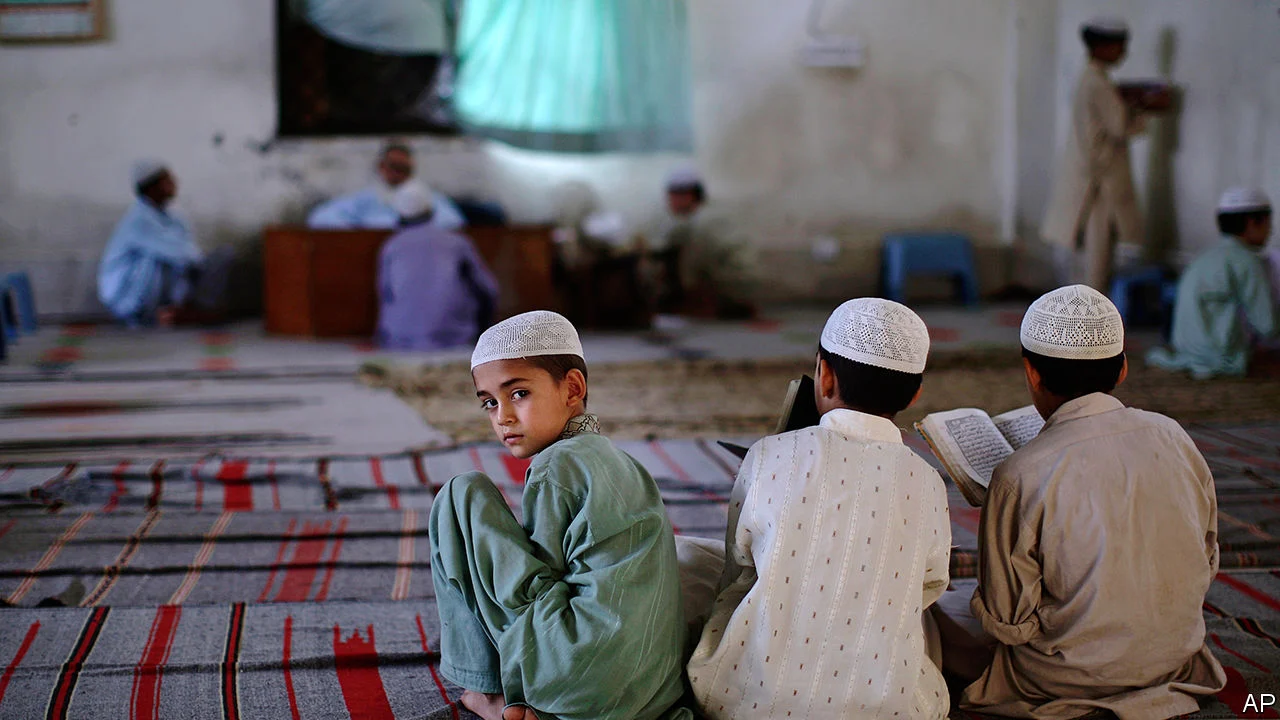
The proliferation of the madrassa system significantly intensifies this crisis. Data from the Pakistan Institution of Education indicates that religious schools now comprise 14 per cent of educational institutions, while government schools account for 73 per cent. At a significant Geneva conference in October 2025, Barbara Bonte, a Member of the European Parliament, highlighted that what was once a network of a few hundred madrassas has surged to over 30,000 institutions. This massive expansion has been fueled by the sustained patronage of consecutive governments and religious organisations funded by the Gulf. These schools, many adhering to the Deobandi interpretation of Islam, the same theological tradition embraced by the Taliban, produce graduates with limited secular knowledge but deeply ingrained extremist worldviews. Leaders of the Afghan Taliban were recruited from these institutions. Perpetrators of terror attacks in Europe have passed through their gates.
Europe’s Blind Spot and Its Wallet
The financial involvement of European institutions makes this crisis a direct concern for Europe.
Between 2016 and 2024, the European Union directly invested between 94 million and 150 million euros in Pakistani education projects, according to various reports and parliamentary inquiries. In August 2022 alone, the EU disbursed €10 million to the Government of Sindh Province for ‘strengthening provincial education policies. A 2024 parliamentary inquiry confirmed that EU taxpayers’ money had been funnelled to religious seminaries in Pakistan, institutions that, by numerous accounts, serve as incubators of the very extremism Europe claims to be combating.
Dutch MEP Ruissen, following his inquiry to the European Commission, stated that ‘the EU must integrate these concerns into the upcoming GSP+ review. We cannot subsidise hate and exclusion.’ This sentiment has been echoed throughout the European Parliament, although decisive action has been slow to materialise.
The GSP+, or the Generalised Scheme of Preferences Plus, is the EU’s flagship trade arrangement for developing countries, granting Pakistan duty-free or reduced-tariff access to European markets. Pakistan has benefited from the scheme since 2014, and the arrangement was extended by the EU’s INTA Committee in September 2023 for a further 4 years until 2027. In exchange, beneficiary countries are formally required to implement 27 international conventions covering human rights, labour rights, environmental protection, and good governance, including the International Covenant on Civil and Political Rights and the Convention Against Torture.
Greek lawyer and journalist Dimitra Staikou observed in EU Today (May 2026) that Pakistan’s classroom content ‘has a direct bearing on how Europe assesses Pakistan’s long-term direction, its treatment of minorities and its willingness to confront extremism at its roots’. The GSP+ arrangement is not solely a trade agreement; it is a values-based compact, which Pakistan’s education system systematically violates. The European Union’s reluctance to take decisive action—relying on periodic reviews and diplomatic recommendations instead of invoking Article 15 proceedings for temporary withdrawal—has attracted significant criticism from human rights organisations. In September 2025, the investigative documentary ‘GSP+: EU’s Silent Compromise’ premiered at the Parliamentary Assembly of the Council of Europe, highlighting the contradiction in European trade policy: Europe claims a commitment to human rights while financially supporting a state that institutionalises intolerance in its educational system.
The EU is monitoring a mission that visited Pakistan in 2025 for a formal review, focusing on freedom of expression, judicial reforms, prevention of torture, women’s and minority rights, and civic space. The findings are unlikely to produce a favourable reading.
Poverty, Unemployment, and the Militant Marketplace
The classroom is not the only pipeline. Pakistan’s structural economic failure has created conditions in which extremism becomes, for many young men with no other prospects, a rational career choice.
Pakistan’s GDP growth is estimated at approximately 3 per cent for 2025, downgraded by the IMF from an earlier, already modest forecast. Youth unemployment has reached 11.1 per cent, significantly above the national average, and the ILO projects the total number of unemployed workers to reach 5.6 million by 2025, up from 4 million just four years ago. Official figures, however, mask a far grimmer reality. Much of Pakistan’s economy is informal, underemployment is endemic, and the female unemployment rate sits at 14.4 per cent, more than four percentage points above the male rate.
A challenging security environment, persistent electricity shortages, and an unfavourable investment climate have collectively deterred foreign capital. Pakistan’s export base remains dangerously narrow, with textiles and apparel accounting for more than half of export earnings. This concentration leaves the economy vulnerable to demand shocks, energy crises, and climate disasters, such as the catastrophic 2022 floods that devastated nearly a third of the country. Pakistan has repeatedly sought emergency bailouts from the IMF, and government debt servicing consumes a substantial portion of public revenue, rendering meaningful investment in education, healthcare, or job creation structurally unfeasible.
Into this vacuum steps the militant ecosystem. With few legitimate economic opportunities, many young men, educated in madrassas, ideologically primed, and economically desperate, find purpose, income, community, and identity in extremist networks. The Pakistani Taliban (TTP), Lashkar-e-Taiba, and a constellation of smaller jihadist outfits have long exploited this convergence of ideological readiness and economic desperation. The result is a terror recruitment pipeline that is self-replenishing: the education system primes the ideology, poverty removes the alternatives, and extremist networks provide the infrastructure.
Two Nations, Two Destinies: India vs. Pakistan
The contrast with India, the country carved from the same colonial partition in 1947, is now so stark as to be historically instructive. At independence, both nations were roughly comparable in economic scale. India’s GDP is approximately $4.1 trillion, more than ten times Pakistan’s $410 billion. India’s GDP growth rate of 6.6 to 7 per cent per annum is more than double Pakistan’s.
The divergence is not merely quantitative; it is structural. India has built a diversified economy anchored in IT services, pharmaceuticals, manufacturing, and space technology. Over the last decade, India’s GDP per capita has surged by 74 per cent, while Pakistan’s economic progress has remained muted and uneven. Pakistan, by contrast, has repeatedly turned to external bailouts and relied on its geostrategic value, its nuclear arsenal, and its proximity to Afghanistan as a substitute for genuine reform. Some analysts have argued that Pakistan’s state apparatus, particularly its military establishment, has at times used cross-border terrorism as a tool to deflect both domestic discontent and international scrutiny, a strategy that has isolated the country diplomatically while costing it enormously in investment and development potential.
This divergence serves as a cautionary example of the consequences when a state prioritises ideological control at the expense of human capital development.
Policy Prescriptions
The path out of this crisis requires action on several fronts at once.
Education reform must be both immediate and structural. The Single National Curriculum must be overhauled to eliminate content that promotes religious supremacy, marginalises minorities, and reinforces hostility toward neighbours. Secular subjects must be taught without a religious overlay. Madrassa regulation must move from rhetorical commitment to enforceable law. Schools that cannot demonstrate basic literacy outcomes and pluralistic content should lose state recognition and funding. Adequately funded teacher training programmes must prioritise critical pedagogy over rote religious instruction.
Employment and economic reform must accompany education change, or radicalism will fill the vacuum regardless of what classrooms teach. Pakistan must reduce its dependence on IMF rescue packages through structural fiscal reform, broadening the tax base (only about 3 million Pakistanis out of a population of over 240 million file income taxes), cutting military expenditure as a share of GDP, and redirecting savings toward public infrastructure and vocational training. Special economic zones, if shielded from bureaucratic rent-seeking, could attract manufacturing capital. Agricultural modernisation, with over 37 per cent of the labour force in farming, could raise rural incomes and reduce the economic desperation that feeds militant recruitment.
Counter-extremism policy must be decoupled from military and intelligence imperatives. For decades, elements of Pakistan’s security establishment have maintained strategic relationships with militant groups as instruments of regional policy. This must end. The international community must be willing to use trade and financial leverage, not merely diplomatic language, to make that demand credible.
Europe’s role is both moral and practical. The EU must rigorously and transparently enforce its GSP+ conditionality. The EU monitoring mission’s 2025 review should set clear benchmarks, not vague aspirations, with explicit timelines. Should Pakistan fail to demonstrate measurable progress on curriculum reform, madrassa regulation, minority protections, and blasphemy law reform, the EU should initiate Article 15 proceedings and suspend GSP+ access. At the same time, Europe should redirect its education funding through strictly audited civil society channels rather than government conduits, ensuring that European taxpayers’ euros reach secular schools and girls’ education programmes, not extremist seminaries. The EU-funded ‘Educational Pathways to Peace’ project, launched in December 2025 in partnership with UNODC and Pakistan’s National Counter Terrorism Authority, is a constructive step, but it must be accompanied by binding conditionality, not goodwill alone.
Europe’s trade interests are inextricably linked to its security interests. Extremists trained in Pakistani madrassas operate transnationally, recruiting and conducting attacks beyond Pakistan’s borders. Supporting the development of a more just, literate, and pluralistic Pakistan is not an act of charity; it is a matter of European self-defence.
Conclusion
Pakistan stands at a crossroads that is visible to the entire world, and most urgently to Europe. Its education system, by design or by neglect, has become a factory of exclusion, producing generations primed for extremism. Its economy, strangled by debt, misgovernance, and underinvestment in human capital, ensures that alternatives to militancy are scarce. And its political class, caught between military dominance and theological populism, has proven unwilling or unable to confront either pathology honestly.
The European Union, which has spent over a hundred million euros on Pakistani education while watching madrassa numbers balloon to over 30,000, can no longer plead ignorance. The GSP+ framework offers Europe real leverage. Leverage it has, so far, been reluctant to use. But the evidence is now overwhelming; the reports have been published; the documentaries have premiered in European parliament buildings; and the political pressure is building.
The impact of Pakistan’s classroom content extends beyond its borders, influencing graduates, diasporic communities, and digital networks that disseminate extremist ideologies globally. Europe’s responsibility is not to intervene as a rescuer, but to cease subsidising the systemic issues that perpetuate this cycle.
Sources:
- Pakistan, Education System, Curriculum and EU Funding (Sallux/ECPM Report)Sabrang India Mar 2025Link
- EU Funds Islamist Indoctrination in Pakistani Schools. The European Conservative, May 2025. Link
- Misuse of EU Taxpayers’ Money to Finance Dubious School Programs, Human Rights Without Frontiers, Mar 2025 Link
- EU Funding Radicalisation in Pakistan? European Times Jul 2025Link
- The EU’s Silent Compromise: GSP+ and Pakistan EU Reporter Oct 2025Link
- Study Calls for Urgent Education Reforms to Counter Violent Extremism. The Nation (Pakistan)Dec 2025Link
- India vs Pakistan: A Data-Driven Comparison, StatsPanda, Mar 2026, Link
- IMF Downgrades Pakistan’s GDP Growth Outlook Business Standard Dec 2025 Link
- The EU Needs to Rethink Pakistan’s GSP+ Status ORF Online Jan 2025Link