When the Blundell Hunter dropped anchor at Old Harbour Bay in 1845, its cargo was not sugar or spice — it was people. Indian indentured labourers, uprooted by circumstance and carried across oceans under the most gruelling conditions, stepped onto Jamaican soil and began quietly weaving one of history’s more remarkable cross-cultural tapestries. Nearly two centuries later, that first voyage remains the emotional cornerstone of a relationship that has grown far beyond its origins in hardship.
That history was powerfully reaffirmed recently, with External Affairs Minister Dr. S. Jaishankar making his first-ever visit to Jamaica as part of a three-nation Caribbean tour. He visited Old Harbour — the historic site where the first Indians arrived in Jamaica over 180 years ago — and interacted with members of the Indian diaspora, witnessing how they have preserved their culture, traditions, and identity across generations. It was a moment of rare diplomatic poetry: India’s top diplomat standing at the very spot where his country’s connection to Jamaica was born, reaffirming that the relationship is rooted not in transactional interest, but in something far more durable.
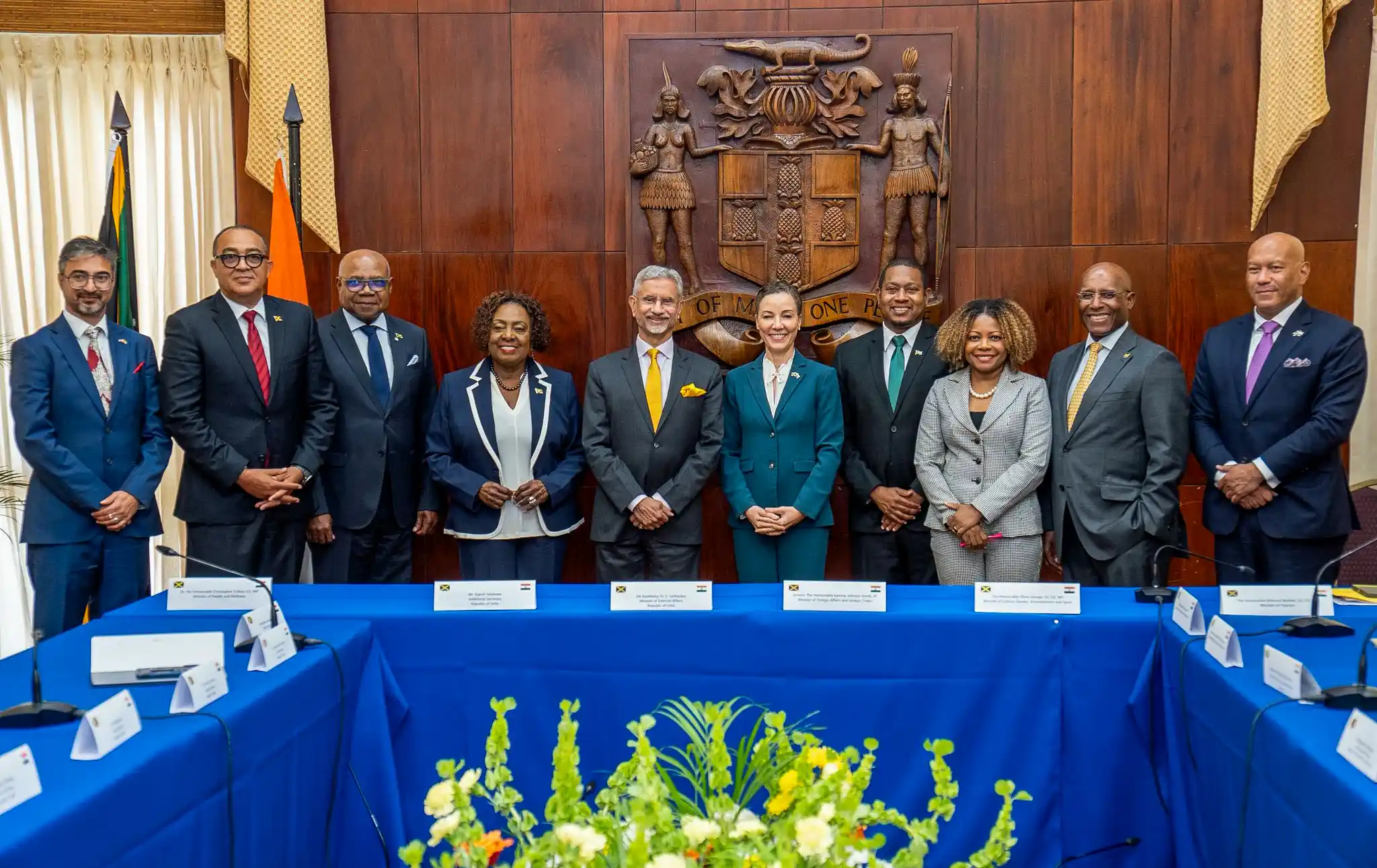
During the visit, Dr. Jaishankar met Foreign Minister Kamina Johnson Smith, along with other Cabinet ministers, reviewing the full spectrum of the bilateral partnership. Discussions ranged across education, health, agriculture, digital tourism, sports, entertainment, infrastructure, and multilateral issues — a breadth that signals a relationship coming of age. He also engaged Jamaica’s industry and business leaders, making the case that as countries across the globe seek reliable partners in an era of supply chain realignments and geopolitical uncertainty, deepening India-Jamaica economic ties is not merely desirable — it is imperative.
Today, approximately 70,000 Jamaicans of Indian origin stand as a living bridge between two nations that, on the surface, could not appear more different — one a vast subcontinental power reshaping the global economic order, the other a small island state whose influence far exceeds its size. Yet the India-Jamaica relationship is proof that geography and population numbers are poor measures of genuine affinity.
The foundations run deep. Both nations are pluralistic democracies, forged in the crucible of colonialism and shaped by the conviction that freedom, once lost, must never be taken for granted. Jamaica’s motto — Out of Many, One People — could serve as an apt description of India itself. Curry and roti have long graced Jamaican tables. Diwali, Phagwa, and Hosay are celebrated in the Caribbean sunshine. These are not mere curiosities — they are evidence of a synthesis that happened organically, through human contact and mutual respect, long before any formal treaty was signed.
The relationship has been tested and deepened by crisis. During the COVID-19 pandemic, India supplied vaccines to Jamaica at a moment of acute global scarcity. Foreign Minister Johnson Smith captured the emotional resonance of that gesture when she said she carried “a little bit of India” inside her — a remark that no trade agreement could ever replicate. When Hurricane Melissa struck, India dispatched trauma treatment units, medicines, solar lamps, generators, and shelter support almost immediately, following up with fishing boats and haemodialysis units.
The architecture of cooperation has also been thoughtfully reinforced at the symbolic level. During Jamaican Prime Minister Andrew Holness’s visit to India in October 2024, Prime Minister Modi announced that a road in front of the Jamaica High Commission in New Delhi has been named “Jamaica Marg” — a quiet but meaningful gesture of respect. High-level momentum has been sustained with purpose, and Dr Jaishankar’s Kingston visit this week is the latest expression of that commitment.
Yet perhaps the most exciting chapter of this relationship remains unwritten. Bilateral trade has crossed $100 million, but both sides acknowledge this barely scratches the surface. India’s pharmaceutical, technology, and engineering sectors are natural complements to Jamaica’s ambitions as a logistics and connectivity hub in the Caribbean. The visit is expected to sustain the momentum of India’s political engagement and further strengthen longstanding ties, reflecting a shared commitment to South-South cooperation and development.
The India-Jamaica story is ultimately one of resilience transformed into relationship. Two peoples who survived colonialism, who built vibrant democracies against considerable odds, and who found in each other an unlikely but enduring kinship. The Blundell Hunter carried people who had no choice. Their descendants — and the diplomats now walking in their footsteps at Old Harbour Bay — choose to strengthen what that voyage began. And that choice speaks louder than any communiqué.