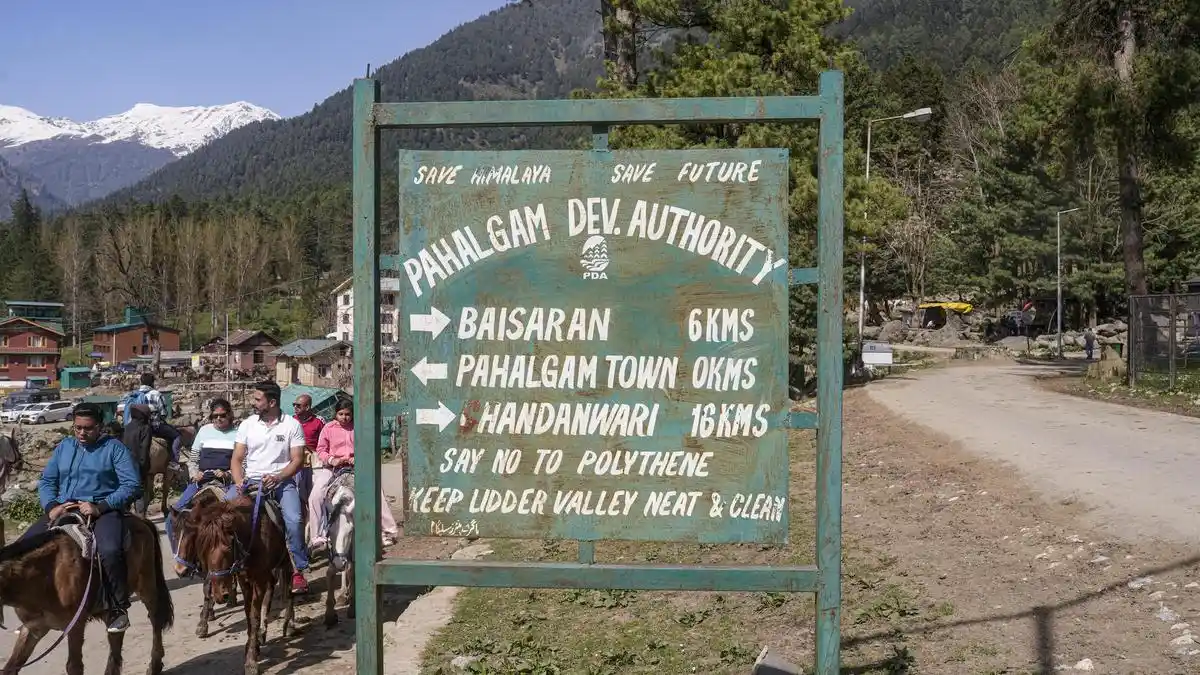
On 22 April 2025, violence struck the peaceful meadows of Baisaran Valley near Pahalgam in Jammu and Kashmir. Militants linked to The Resistance Front, an offshoot of Pakistan’s Lashkar-e-Taiba, attacked a group of tourists, separated men from women and children, demanded proof of religion, and killed 26 people. Twenty-five victims were Indian nationals, and one was from Nepal. The attack happened so quickly that the victims had little time to react. A year later, the pain remains. However, India’s response to this tragedy has been remarkable.
The Pahalgam massacre had several intended goals.
· One aim was to disrupt Kashmir’s growing tourism industry.
· Another goal was to stir up communal tensions.
· Aimed to show that militants supported by Pakistan could still carry out attacks inside India without fear of consequences.
While tourism quickly rebounded, India’s response to communal and cross-border provocation was unprecedented. For the first time since independence, India took clear and decisive action rather than just issuing condemnations or protests.
In the early hours of 7 May 2025, the Indian Armed Forces began Operation Sindoor, a fast and carefully planned military campaign against key terror sites in Pakistan. In the first few hours, they struck nine major facilities. The attacks were precise and direct. The headquarters of Jaish-e-Mohammed in Bahawalpur and Lashkar-e-Taiba’s main training centre in Muridke were destroyed, causing heavy losses in both personnel and leadership. Both groups have long been labelled as terrorist organisations by India, the United Nations, and the US. Between 8 and 10 May, further strikes disabled eleven Pakistani airbases and greatly reduced the Pakistan Air Force’s abilities. India’s Akashteer air defence system, working alongside the S-400, demonstrated strong performance, intercepting multiple Pakistani drones and missiles. The 88-hour operation marked the biggest rise in India-Pakistan tensions since the 1999 Kargil conflict.
Operation Sindoor stood out not just for its size, but also for its new approach. Prime Minister Modi explained this change in a televised speech, saying that ‘any act of cross-border terror would henceforth be treated as an act of war’. The period of ‘strategic restraint’ had ended. India changed its rules for responding to threats, shifting from a defensive stance to a more proactive, deterrent approach. This marks India’s biggest change in military policy in decades.
India’s military action was matched by a major policy change. On 23 February 2026, the Ministry of Home Affairs introduced PRAHAAR, the country’s first comprehensive National Counter-Terrorism Policy and Strategy. The name means ‘strike’ in Sanskrit and shows clear intent. PRAHAAR stands for its seven main areas: Prevention, Response, Aggregation of capacities, Human rights and the rule of law, Attenuation of radicalisation, Alignment with global efforts, and Recovery. This approach brings together years of separate counter-terrorism efforts into a single, clear strategy.
PRAHAAR is unequivocal in its zero-tolerance stance: no distinction is drawn between ‘good’ and ‘bad’ terrorists, no justification based on religion, caste, nationality, or political motive is entertained, and state-sponsored terrorism is explicitly named and targeted. PRAHAAR takes a clear zero-tolerance approach: it makes no distinction between ‘good’ and ‘bad’ terrorists, does not accept any justification based on religion, caste, nationality, or politics, and directly targets state-sponsored terrorism. With this strong framework, the National Investigation Agency now has a conviction rate of about 92 per cent. The policy brings together intelligence-based prevention, inter-agency cooperation, cybersecurity, de-radicalisation, and international partnerships. India has also suspended the Indus Waters Treaty and closed the Attari-Wagah border, making it clear that diplomatic and economic actions will follow military ones. The report recorded 1,045 terrorist incidents on Pakistani soil in 2025 alone, resulting in 1,139 deaths and 1,595 injuries. These figures mark the highest levels of domestic terrorist violence in Pakistan since 2013. Strikingly, this deterioration has occurred at a moment when global terrorism is in overall decline, deaths worldwide fell by 28 per cent and incidents by 22 per cent. Pakistan, it seems, is swimming against the current of history.
Pakistan is also facing serious economic problems. The country has relied on IMF bailouts and continues to struggle with ongoing financial crises. It has not attracted much foreign investment, and its debt-to-GDP ratio is among the highest in Asia. In contrast, India is one of the fastest-growing economies and is expected to become the third largest by the early 2030s. India has seen record investment, grown its manufacturing sector, and become a key player in global supply chains as companies look beyond China.
The difference between the two countries is clear. India’s 2023 G20 leadership confirmed its important role in global affairs. Its space program landed a craft on the lunar south pole. India’s digital systems, such as UPI, Aadhaar, and its open digital commerce network, are now models for financial inclusion worldwide. Tourism in Kashmir, which was briefly affected by the Pahalgam attack, has recovered as security improved after Operation Sindoor and the removal of major terror networks. New Delhi’s message is clear: India’s progress will not be stopped by violence.
At the United Nations, India champions the Comprehensive Convention on International Terrorism, while through the financial action task force (FATF) and a growing network of mutual legal assistance treaties, we are ruthlessly severing the financial lifelines of terror networks. The formal recognition by FATF of India’s substantial effectiveness in countering terror financing is not a diplomatic gesture; it is a certification of serious security resolve.
This resolve is consistently demonstrated in multilateral forums. The categorical Quad condemnation of the Pahalgam attack and our Defence Minister’s diplomatic steel in refusing to sign an SCO joint statement that sought to airbrush the massacre from the record sent a clear message: India will not compromise accountability for terror. This culminated in the formal US designation of The Resistance Front (TRF), the perpetrators of the Pahalgam tragedy, as a foreign terrorist organisation.
Crucially, this security stance is matched by an extraordinary economic and diplomatic ascent. The recent landmark Free Trade Agreements with the European Union and the United States underscore a global strategic reorientation, with major democracies choosing India as their partner of choice. UNCTAD now ranks India third among Global South economies for the diversity of its trade partnerships, surpassing every country in the Global North.
A year after the tragic loss of life in the Baisaran Valley, the picture that emerges is of a nation choosing to be defined by its response, not its wounds. Through the precision of Operation Sindoor, the institutional depth of PRAHAAR, and a determined diplomatic offensive, India has demonstrated that the world’s largest democracy will not absorb acts of terror with passive sorrow. It responds with memory, determination, and profound consequence. India does not forget, and the world is now following our lead.