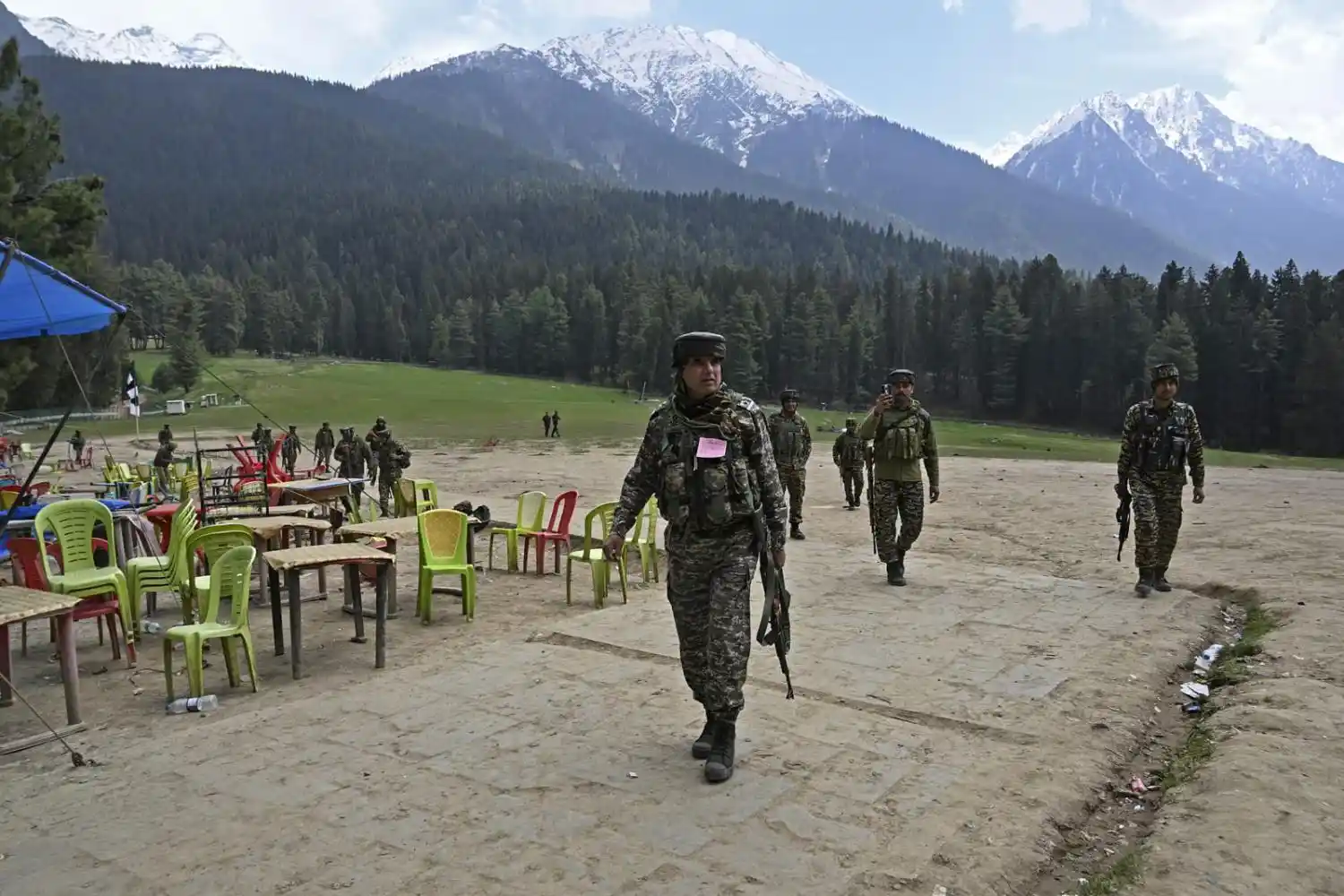
One year after the horrific Pahalgam attack in Jammu & Kashmir—also the deadliest terror attack in a decade—Pakistan’s JeM-backed TRF terrorists killed 26 civilians and tourists on April 22 last year. The brutal massacre shattered the counter-terror grid in J&K. Intelligence, strategic deployment, and counter-terror thinking were all put to the test. Over the past year, lessons have been learned, but much remains to be done to make J&K’s terror grid more robust and capable of delivering the right strategic response to an evolving counter-terror landscape.
The Learnings
There are visible signs of change in security thinking in J&K, and these are direct lessons from the Pahalgam attack. These can be broadly categorised into three areas: strategic visibility, strategic response, and security thinking.
There has been increased strategic visibility, with forces more effectively deployed and surveillance systems strengthened. The recent decision to establish Forward Operating Bases ensures an adequate presence of forces to respond swiftly and decisively.
The strategic response has also improved. Operation Mahadev, in which the perpetrators of the Pahalgam attack were neutralised, demonstrated effective coordination and an intelligence-led, in-depth response. Similarly, in the Red Fort blast case, the police response was swift and largely appropriate.
In terms of security thinking, there is now a clearer recognition of evolving terror patterns and the growing capabilities of terror outfits. This has led to calls for a comprehensive overhaul, reflected in India’s counter-terror doctrine released this year, PRAHHAR.
However, there remains a need for a multi-spectrum strategy that focuses not only on pre-emption but also on prevention, rather than fragmented and reactive responses. Realisations on paper, without meaningful execution on the ground, hold little value in counter-terror strategy.
Even in the Red Fort case, there were serious lapses. Reports suggest that weeks before the Delhi blast, a key Kashmiri terror module member, Muzaffar Ahmad Rather—a 33-year-old paediatrician from Srinagar—fled India for Afghanistan. He was reportedly tasked with liaising between the Kashmir terror cell and Afghanistan-based jihadists for training in bomb-making and assault techniques. This was a clear intelligence failure, indicating that while pre-emptive strategy is acknowledged at a conceptual level, implementation remains reactive and inconsistent.
Reactive Response and Changing Terror Patterns
A real victory lies in effective ground-level execution. As current patterns indicate, terror designations and policy-level recognition do little to deter Pakistan-funded terrorism in Jammu and Kashmir. Weak strategic responses inevitably lead to ineffective tactical outcomes.
The counter-terror landscape is evolving rapidly, with more battle-hardened, technologically equipped terrorists emerging—as seen with TRF. This requires more than just pre-emptive or tactical responses.
Robust terror organisations tend to endure due to three structural advantages:
1. Safe Havens and Porous Borders:
Regions with weak governance—such as parts of Africa or early-2000s Afghanistan—provide physical bases for training, recruitment, and planning. Designations are ineffective without cooperation from host governments. After 9/11, Al-Qaeda shifted to Pakistan’s tribal areas, while LeT went underground with ISI support after the 26/11 attacks.
2. Decentralised Operations:
Cell-based, decentralised structures allow groups to survive leadership losses. LeT used IM and TRF as fronts, while Al-Qaeda relied on regional branches like AQI and AQAP.
3. Alternative Funding Sources:
Non-traditional funding mechanisms such as hawala networks, charitable fronts, and sympathetic donors allow groups to bypass sanctions. For example, Al-Qaeda used such channels to finance 9/11, while LeT sustained itself through Jamaat-ud-Dawa.
The White-Collar Terror Threat
The Red Fort blast marked a disturbing shift in India’s terror landscape, with the involvement of educated, white-collar individuals. This reflects a hybrid model of inspired and indirect terrorism, where online propaganda drives self-radicalised individuals—often lone wolves—to carry out attacks.
The involvement of professionals, including doctors, indicates a model that blends self-radicalisation with limited external facilitation. This creates plausible deniability while maintaining operational effectiveness.
The greatest concern is the emergence of a lone-wolf precedent, with J&K remaining a high-value target.
The Real Work: A Multi-Spectrum Counter-Terror Grid
Effective counter-terrorism requires coordinated, multidimensional, intelligence-led strategies focused on dismantling networks.
A network-centric approach—combining targeted strikes with intelligence operations—has proven effective in the past. Leadership elimination, financial tracking, and disruption of decentralised cells have contributed to successes such as the decline of the Indian Mujahideen (IM).
TRF shares operational similarities with IM, particularly in creating maximum impact with minimal attribution. However, TRF operates with greater sophistication, targeting high-symbolic-value locations with precision.
Recruitment strategies are also similar, exploiting local grievances and communal narratives. TRF has intensified this through targeted propaganda, especially among Kashmiri youth.
Despite being relatively small, TRF’s adaptability makes it difficult to counter through traditional methods. Key challenges include:
- Limited penetration of decentralised cells due to gaps in human intelligence
- Reliance on overground workers and newly radicalised individuals outside watchlists
- Rapid tactical evolution, including encrypted communication, satellite data use, and advanced weaponry
Addressing these challenges requires a shift towards advanced network-centric operations supported by integrated intelligence systems. This includes combining HUMINT, OSINT, cyber forensics, drone surveillance, and satellite imaging.
Such capabilities must be embedded within a broader multi-spectrum counter-terror framework—one that integrates targeted strikes, search-and-destroy missions, and financial disruption strategies.
A less reactive and more pre-emptive, preventive approach is essential to building a resilient counter-terror grid. As the threat landscape continues to evolve, J&K requires a strategy that is not only adaptive but also deeply rooted in ground-level execution and intelligence integration.