Asim Munir may be happy as a gopher in soft dirt, anointing himself as the de facto ruler of Pakistan, but he should be bewailing this apparent misadventure. His country is now encountering a fork on the road situation over the unfolding West Asia war over Iran reaching Saudi Arabia, its latest ‘strategic defence’ treaty partner, while the latest border-conflict with the Taliban is an added headache. Taliban, whose 2021 victory Pakistan’s establishment had celebrated euphorically, has turned into the albatross around its neck today. Pakistan feels betrayed as its Defence Minister Khawaj Asif alleges that the Taliban continued its war against Pakistan since it seized power in 2021. Indeed, the current Af-Pak relation has reached a nadir over suppression of the militant faction Tehrik-i-Taliban Pakistan (TTP), the reasons behind this ‘open war’, however, are far deeper.
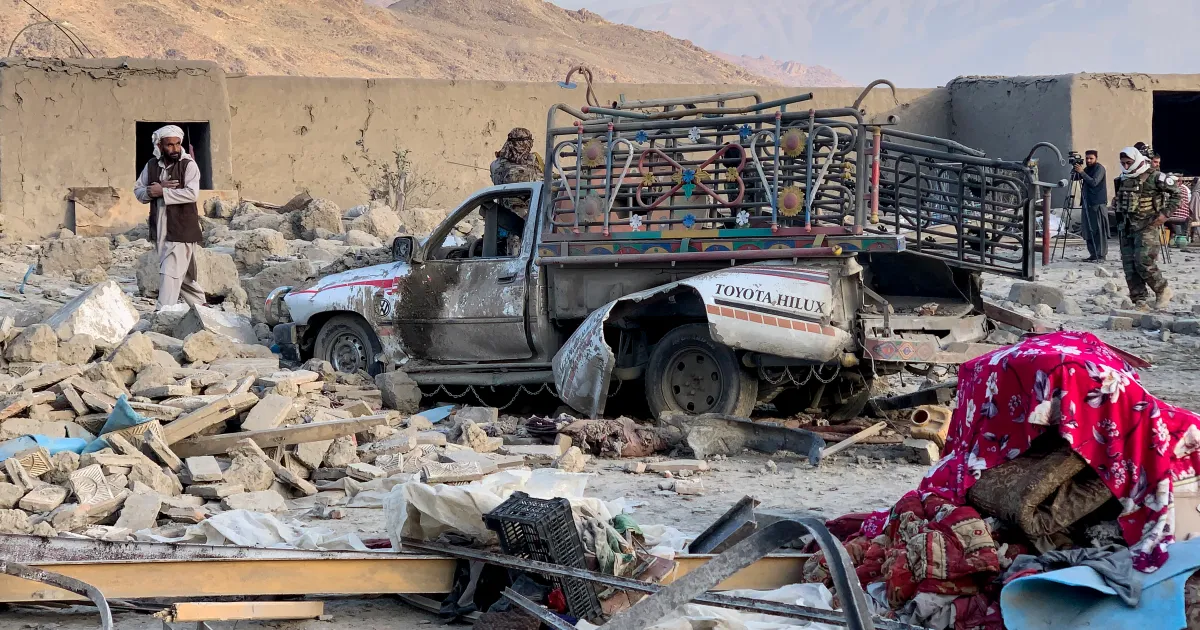
Apparently, Pakistan is narked with the Taliban over the latter’s refusal to suppress the TTP, instead allegedly harbouring it. TTP is termed by the UN Security Council as an alliance of formerly disparate militant groups that came together in 2007 following Pakistan military operations against Al-Qaida-related militants in the Federally Administered Tribal Areas (renamed Khyber Pakhtunkhwa) with an objective to overthrow the elected government of Pakistan in order to establish an Islamic emirate. The group is active in the border areas of the Khyber Pakhtunkhwa province of Pakistan. The latest conflict erupted following Pakistan’s bombing of areas in Afghanistan late February this year, after the Afghan Taliban earlier announced a major offensive against Pakistani military posts near the Af-Pak border. Declaring ‘open war’ on Afghanistan, Pakistan bombed major cities in Afghanistan, including the capital, Kabul. There had been initiatives to de-escalate tension, but they failed since the Taliban refused to give a written commitment to Pakistan to take action against TTP.
The Taliban has repeatedly and very rightly insisted that the TTP is not under its control. As this author had argued in one article previously, the actual problem lies in a severe trust deficit in state-tribal relations, where the Pakistani state is suspected by the tribal communities of the frontier provinces as an intruder, which is worsened further by foolhardy military action to crush the resultant rebellion. Conversely, Taliban and TTP share comradeship as fellow revolutionary brothers who fought against the foreign occupation of both the Soviets and the Americans in Afghanistan. The Pakistani establishment is well aware that controlling the TTP is tantamount to chasing the chimera, given its experience of futile anti-Taliban operations in the tribal areas post 9/11. The Pakistani army found it impossible to sustain its morale amidst the operations, as it was losing every day. Then why does Pakistan not understand the problem of the Taliban rulers? Pakistan understands the difficulty of the Taliban very well. The reasons seem to lie somewhere else.
Sometimes, external conflict helps a ruler salvage his position, shaking internally. The aerial conflict with India in May 2025 had helped the Pakistani army restore its prestige, which it had lost in the public eye following the ousting and arrest of former Prime Minister Imran Khan, while his party supporters and activists accused the military of its complicity in the whole affair. Soon jittered Asim Munir amended the constitution via his puppet civilian government to confiscate power. However, the army, which considers Khan as a canary in the coal mine, is still fighting hard to push him to obscurity, which seems to be adding to his popularity. The news of the deteriorating health of the cricket legend triggering international reactions disconcerted the quasi-civilian government, with incensed opposition accusing it of handling the matter recklessly. Meanwhile, the protests erupting in Pakistan-occupied-Kashmir in October 2025 over a range of issues hit a nerve with the occupying state, which was further embarrassed by the International Monetary Fund report highlighting rampant corruption with public policy being manipulated for the benefit of political and business elites, while the government’s claim of economic progress was challenged. Thus, the de facto rule of Asim Munir fails to manage the scene internally. Therefore, magnifying the border conflict into a war-like scenario is the viable option to divert attention and legitimize Munir’s consolidation of power.
Another issue worrying the Pakistani establishment is the growing closeness between India and the Taliban regime. Shedding off her previous shunning approach towards the 1996-2001 Taliban 1.0 regime, India has recalibrated its Taliban policy since 2021, giving diplomacy a chance. Meanwhile, the gesture is reciprocated by the Taliban with pleasure, which rankles the Pakistani establishment. Echoing the frustration of the army, Defence Minister Khwaja Asif leveled accusations against the Taliban of turning Afghanistan into an ‘Indian colony’ amid the border clashes. The fact is that Pakistan’s standard policy of using Afghanistan as a tool to export terrorism to India with the Taliban’s help looks unattainable this time. In 2021, Euphoric Pakistan expected the Taliban’s ascendance to power would help create a new bloc. However, what the jubilant Pak rulers did not realize is that the Taliban 2.0 regime’s focus will be to earn as much international credibility as possible. Besides, the Taliban 2.0 regime understands the value of external assistance pouring in since 2003 and thus insists on its continuation. Tagging along with Pak’s diabolical mission will not help them. The Taliban 2.0 regime is inclined to augment trade and consultative mechanisms with India rather than harbouring Pak-sponsored terror outfits like Jaish and Lashkar. Besides, the Afghan Taliban has reason to feel cheated by Pakistan for siding with the USA, which dethroned them in 2003. Notably, following the US airstrike in Kabul in 2022, the Taliban accused Pakistan of allowing US drones to use its airspace for launching the attack.
That the Taliban today rejects Pakistan’s peremptory directions frustrates the Pakistani establishment, underlining its failure to bend it to its will. Pakistan was the patron saint of the Taliban regime of the 1990s and used Afghanistan as a hedge against India. That dynamic is altered with the Taliban 2.0 regime recalibrating its policy. Indeed, its alleged inaction against TTP is wreaking havoc in Pakistan, but even the Pakistani military was herding cats in the unruly tribal areas during its US-directed anti-Taliban operations in the post 9/11 era. Therefore, this ‘open war’ with the Taliban is more to do with glossing over Asim Munir’s de facto rule’s failure internally and to punish the Taliban ‘arrogance’ than to crush the TTP, which is practically unattainable.