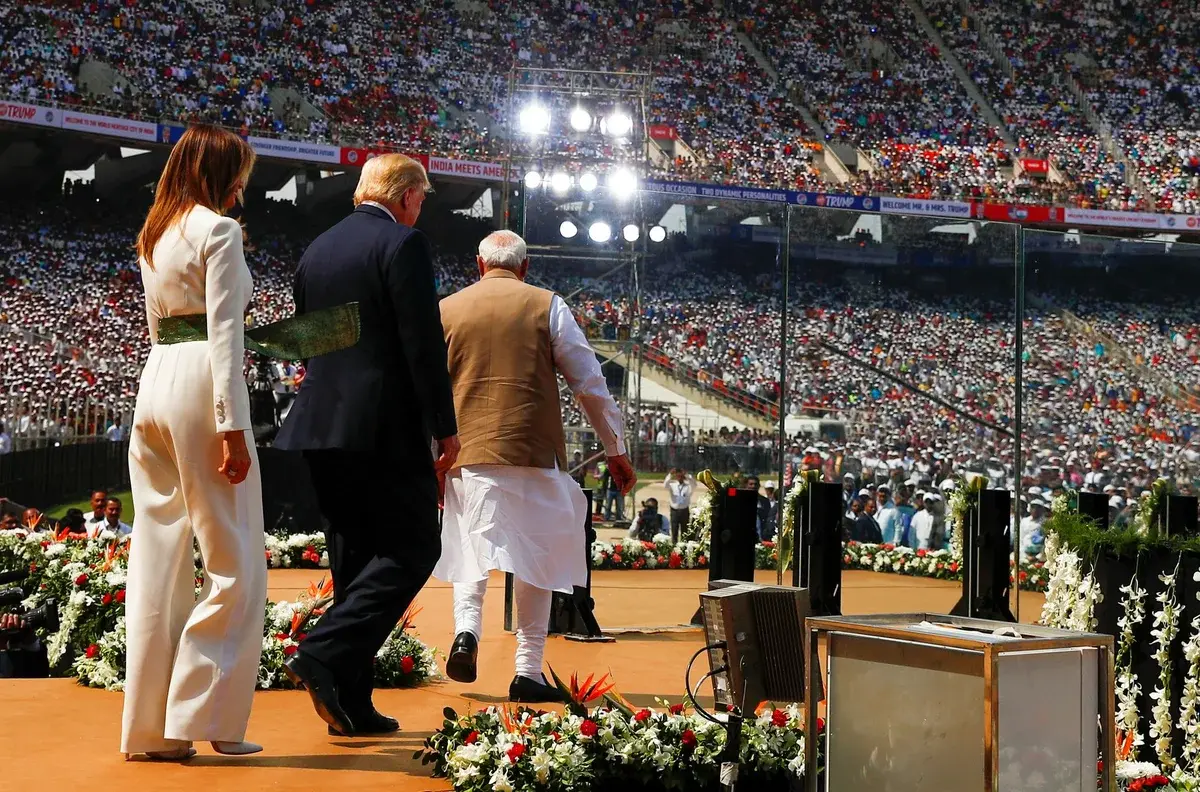
For much of the past two decades, India’s relationship with the United States was framed in language that bordered on the romantic. The two countries were described as natural allies, bound by democratic values and converging strategic interests. The partnership between Washington and New Delhi would become one of the defining relationships of the twenty-first century.
That language no longer tells the whole story.
In the second year of Donald Trump’s second presidency, the American approach to India has become noticeably harder, more transactional, and less insulated by the rhetoric of partnership that characterised earlier phases of the relationship. Tariffs, visa restrictions, market-access demands, and technology controls now sit alongside defence cooperation and Indo-Pacific coordination as central features of the bilateral agenda.
This shift is not simply a reflection of Trump’s personal negotiating style. It reflects a deeper transformation in how American elites increasingly think about global power. In Washington today, influence is shaped by a worldview that sees technological leadership, industrial capacity, and geopolitical rivalry as the defining forces of international politics. That worldview is often associated with figures such as the technology investor Peter Thiel, but it extends far beyond any single individual.
Running parallel to the strategic courtship is a harder and more transactional policy track. Reciprocal tariffs have become a governing principle of trade policy. Skilled-visa pathways affecting Indian professionals have tightened. Digital-trade rules, export controls, and investment screening have emerged as central negotiating issues.
A revealing moment illustrating this new posture came in March 2026 at the Raisina Dialogue in New Delhi. U.S. Deputy Secretary of State Christopher Landau spoke with unusual candour about Washington’s approach to India. The United States, he said, would not repeat what it now sees as the mistake it made with China two decades ago: opening its markets and technology ecosystem too freely only to discover that it had helped nurture a formidable commercial rival. While acknowledging that the twenty-first century would inevitably see the rise of India, Landau emphasised that any trade relationship must remain fair to American workers and accountable to American voters.
What is implied here is that India is welcome as a strategic partner, but the terms of that partnership will be carefully managed. Economic concessions will be scrutinised, technology cooperation hedged by security controls, and trade arrangements framed through reciprocity rather than goodwill.
This instinct aligns closely with a harder intellectual mood visible in parts of the American policy establishment. In a 2023 interview with the conservative broadcaster Hugh Hewitt, Peter Thiel offered a strikingly blunt assessment of India’s prospects as a strategic partner. Responding to a question about India’s role in balancing China, Thiel described it as “a very, very messed up place” and suggested that the United States might ultimately rely more heavily on allies such as Japan or Australia in confronting Beijing.
Those remarks do not represent official policy. But they reveal the scepticism about India’s institutional reliability and economic environment that exists in some influential American circles. For thinkers like Thiel, geopolitical partnerships are judged less by democratic affinity than by technological capability, industrial depth, and the ease with which businesses can operate within a partner economy.
Trump’s second-term policies toward India and Peter Thiel’s worldview both come from the same shift in American thinking about globalization, technology, and hierarchy in global power.
Let us tighten the analytical spine behind the Trump–Thiel comparison. What emerges from the evidence is not a direct policy pipeline but a shared intellectual climate in the United States. Trump’s second-term policies toward India and Peter Thiel’s worldview both come from the same shift in American thinking .
First, consider the technological lens that dominates Thiel’s thinking. For years he has argued that the world has experienced a broader slowdown in transformative technological progress. In interviews and essays he describes modern innovation as concentrated largely in computing and software while areas like energy, transport, and manufacturing have stagnated. In a recent discussion he said that without advances such as artificial intelligence, “there’s just nothing going on” in terms of major technological breakthroughs.
This view produces a very specific hierarchy of nations. Countries are judged less by their population or market size and more by whether they generate frontier innovation. Thiel repeatedly praises firms that build technological monopolies and foundational infrastructure—semiconductors, AI platforms, and defence technology—because these create decisive strategic advantages.
In that framework India’s role appears ambiguous. India has a large technology workforce, a dynamic startup ecosystem, and major digital public infrastructure. Yet much of its global reputation rests on services and incremental innovation rather than on the sort of deep technological breakthroughs that Silicon Valley celebrates. That perception—fair or not—matters in elite American circles where technological capability is increasingly seen as the foundation of geopolitical power.
Now place that mindset beside the policy behaviour of the Trump administration in its second term.
Trump’s approach to India since 2025 has been noticeably transactional. Tariffs on Indian exports, pressure for reciprocal trade concessions, and demands linked to energy purchases and supply-chain alignment have defined the relationship. The tone is no longer that of a sentimental strategic partnership. It resembles a negotiation over market access and economic leverage.
The intellectual overlap with Thiel becomes clearer here.
Thiel’s worldview assumes that nations compete in a technological hierarchy. Trump’s policy assumes that relationships should be judged by immediate strategic and economic advantage. Both perspectives strip away the idealistic language that once surrounded U.S.–India ties.
The earlier narrative—dominant during the Bush, Obama, and early Modi years—described India and the United States as “natural allies.” Their democratic values and shared concerns about China would supposedly create an almost automatic partnership.
That narrative is fading.
The new American discourse, especially in technology and national-security circles, is colder and more pragmatic. Countries are evaluated by what they contribute to the balance of power—technologically, economically, and militarily. Partnerships still exist, but they are conditional.
Another dimension of Thiel’s thinking reinforces this shift: the idea that the world is entering an era of civilizational competition driven by technology. Venture capitalists like Thiel have invested heavily in companies that blur the line between technology and national security—Palantir is the most obvious example. In this worldview the frontier of power lies in artificial intelligence, advanced computing, and defence technology.
That emphasis echoes the growing American obsession with technological rivalry against China. It also reshapes how Washington evaluates other major countries, including India.
India is still seen as a critical actor in the Indo-Pacific balance. Its geography, demographic scale, and military potential make it an indispensable strategic partner. Yet the relationship now operates within a harsher framework: how quickly can India build advanced manufacturing? Can it become a centre of semiconductor production? Will it align with U.S. technology export controls?
These are the questions that increasingly dominate the conversation.
Seen in that light, the Trump administration’s own rhetoric sometimes reveals the sharp edge of this transactional worldview. In July 2025, during a tariff dispute linked partly to India’s continued economic engagement with Russia, Trump dismissed India and Russia together as “dead economies.” The remark provoked outrage in India, but it also exposed the underlying logic of Trump’s diplomacy: even strategic partners can quickly become economic targets when trade disputes arise.
The episode demonstrated how easily the language of partnership can give way to the language of leverage.
Taken together, the comments by Landau, the scepticism expressed by Thiel, and Trump’s own rhetoric illustrate the contours of a new American gaze on India. The United States still sees India as strategically important, but it no longer treats the relationship as insulated from economic rivalry or technological competition.
India is valued—but it is also priced.
For India, the implications are significant. The assumption that geopolitical alignment with Washington will automatically translate into economic accommodation is no longer safe. Trade friction is likely to become a structural feature of the relationship rather than an episodic irritant.
Equally important is the growing centrality of technology. Artificial intelligence infrastructure, semiconductor supply chains, critical minerals, data governance, and export-control regimes are becoming the main arenas of strategic negotiation. Partnerships will increasingly be judged by how well they support national technological ecosystems.
India’s challenge is therefore not simply diplomatic.
There is another dimension to this changing American gaze that India has been slow to recognise. In New Delhi’s public discourse, the country’s global profile is often described with a certain swagger. India is portrayed as the indispensable power of the Indo-Pacific, the world’s fastest-growing major economy, the natural voice of the Global South, and an emerging technological powerhouse. The language of “Vishwaguru,” “Amrit Kaal,” and civilisational resurgence reinforces a sense that India’s rise is now widely acknowledged and even celebrated abroad.
But the signals coming from Washington suggest a more complicated reality. The intellectual atmosphere around Trump—figures like Thiel, JD Vance, and parts of the tech-nationalist right—views global power through the prism of technology, sovereignty, and civilizational competition. In that framework India is respected, but not automatically elevated. The technology question becomes central. If Thiel’s critique is that India has not produced frontier technology at scale, and Trump’s policies emphasise economic reciprocity rather than strategic partnership, the implication is uncomfortable. India risks being treated as a market and manufacturing node rather than a technological pole.
Therefore, in the strategic thinking that now shapes American policy—visible in Trump’s transactional trade posture, in Christopher Landau’s warning at the Raisina Dialogue in March 2026 that the United States will not repeat the “China mistake,” and in the blunt scepticism expressed by Peter Thiel about India’s institutional reliability—the country is viewed less as a triumphant new pole of power than as a large but still uncertain partner.
In other words, while India increasingly speaks of itself with confidence bordering on swagger, the world’s most powerful country is quietly subjecting that rise to a much harder audit.
The contrast is striking. Indian political discourse often assumes that the country’s global stature is now self-evident. Washington, by contrast, appears to be asking a more probing set of questions: Can India deliver technological breakthroughs? Can it build manufacturing depth at scale? Can it align strategically without hedging? Can it become a trusted hub in the new architecture of supply chains and advanced technology?
Until those questions are answered convincingly, India’s global image in Washington may remain more provisional than New Delhi’s rhetoric sometimes suggests.
The emerging American gaze therefore carries a quiet warning. Respect in the coming international order will not flow from civilisational narratives or rhetorical confidence. It will come from demonstrable capability—technological, industrial, and institutional. As India approaches the centenary of independence in 2047, these are questions it must confront.