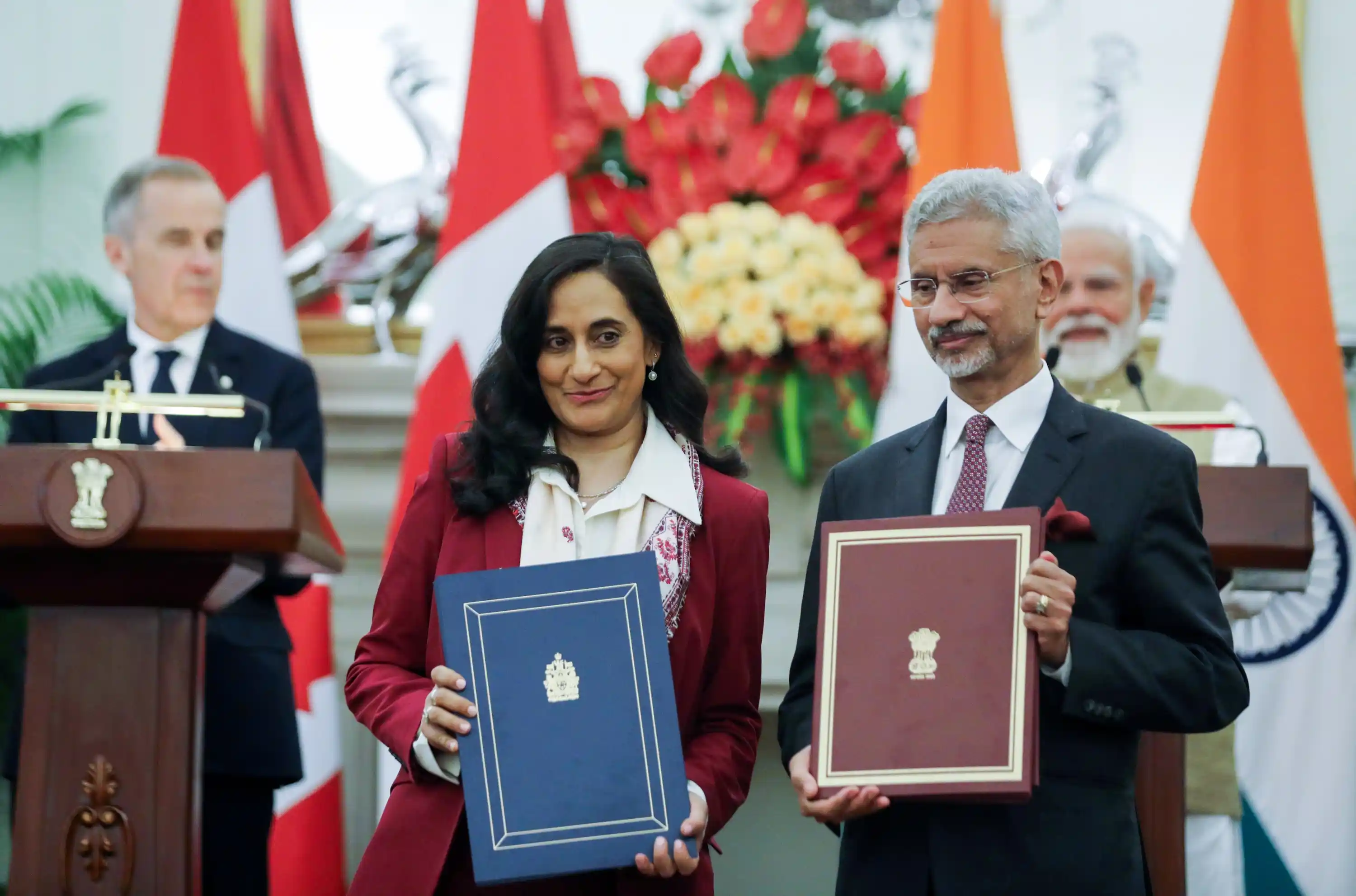
Prime Minister Mark Carney’s visit to India from 27 February to 2 March 2026 was significant not merely because it reopened a relationship that had gone badly off course, but because it indicated Ottawa’s recognition that ties with New Delhi cannot remain hostage to episodic political crises. It was Carney’s first visit to India as Prime Minister and the first bilateral visit to India by a Canadian Prime Minister since 2018. The two sides deliberately described the outcome as a “renewed India–Canada Strategic Partnership”. The choice of words was important. It suggested that Canada was not merely repairing diplomatic damage following the tensions of 2023–24, but attempting to place the relationship on a wider and more durable strategic foundation.
Yet, any serious analysis of this development must move beyond a narrow bilateral perspective. Canada’s diplomacy in Asia is undergoing a broader recalibration. Even as Ottawa seeks to stabilise and rebuild ties with India, it is simultaneously widening its engagement with Pakistan and sustaining a cautious, interest-based relationship with China. The real analytical question, therefore, is not whether Canada is “returning” to India, but how Ottawa now ranks and differentiates its relationships with India, Pakistan and China. On present evidence, the hierarchy appears clear. Pakistan is being engaged more actively at a functional level; China remains too large and consequential to ignore but too difficult to trust; and India is the country Canada increasingly seeks to elevate into a major strategic pillar of its Indo-Pacific and global outlook.
This hierarchy reflects the very different roles that these three countries occupy in Canada’s foreign-policy thinking. India is increasingly seen in Ottawa as a partner in trade diversification, supply-chain resilience, clean energy transition, critical minerals, advanced technology cooperation and Indo-Pacific stability. Canada’s official descriptions of the bilateral relationship emphasise India’s importance in reducing economic dependence on traditional partners and expanding Canada’s footprint in emerging markets. The March 2026 leaders’ statement outlined cooperation across energy, critical minerals, technology, artificial intelligence, talent mobility, culture and defence cooperation. In effect, Ottawa sees India as part of its long-term economic and geopolitical strategy.
Pakistan, by contrast, is not being approached as a peer strategic pole. Canada’s own description of Canada–Pakistan relations places emphasis on diplomatic ties, diaspora links, development cooperation, governance support, human rights dialogue, regional security, and selective commercial opportunity. The relationship has breadth, but not depth. It is essentially pragmatic and issue-specific rather than strategically transformative.
China occupies a third and distinct category in Canada’s Asian diplomacy. Economically, it remains enormously important. Yet politically and strategically, it is increasingly viewed with caution. Canada’s Indo-Pacific Strategy describes China as an “increasingly disruptive global power”, while subsequent implementation updates emphasise the need for resilience, risk management, and protection against coercive economic practices. Ottawa’s language towards Beijing, therefore, reflects a mixture of engagement and guarded strategic scepticism.
Seen in this light, the notion that Canada is tilting strategically towards Pakistan does not stand up to careful scrutiny. What is visible is a more active and business-like Canadian engagement with Islamabad. In late 2025, the two countries agreed to facilitate exports of Canadian canola to Pakistan and welcomed negotiations towards a Foreign Investment Promotion and Protection Agreement. They also identified energy security and critical minerals as possible new areas of cooperation. In February 2026, the sixth round of bilateral political consultations held in Islamabad referred to “steady growth” in ties and identified trade and investment, agri-technology, mining, energy, climate change, artificial intelligence, education and tourism as areas of potential cooperation.
These developments are not insignificant. They suggest continuity in diplomatic engagement and an attempt to expand the economic component of the relationship. Yet the overall scale of the Canada–Pakistan economic relationship remains modest. Canada’s two-way merchandise trade with Pakistan in 2025 is estimated at around C$1 billion, which is roughly ₹6,750 crore. Pakistan’s exports to Canada consist mainly of apparel, textiles, leather goods and other light manufactured products, while Canada exports agricultural commodities such as pulses and fertilisers. The commercial relationship therefore remains relatively narrow in scope.
Canada may thus be broadening its engagement with Pakistan through trade facilitation, political consultations and limited sectoral openings, but the relationship lacks the strategic depth, economic scale and institutional density that Ottawa increasingly associates with India. The contrast between the two relationships becomes clear when one examines the trade figures.
Canada’s merchandise trade with India in 2025 is estimated at roughly C$14 billion, equivalent to about ₹94,500 crore. Canada’s services exports to India, covering education, financial services, technology and professional services, are even larger, estimated at approximately C$17 billion, or around ₹1.15 lakh crore. When combined, the overall economic relationship approaches C$31 billion, which is approximately ₹2.09 lakh crore. These figures underline the structural asymmetry between India and Pakistan in Canada’s Asian economic engagement.
From an Indian perspective, however, one major obstacle still stands in the way of a durable reset in relations: the trust deficit arising from extremist politics on Canadian soil. The relationship cannot stabilise meaningfully unless anti-India Khalistani extremism operating from within Canada is treated as a serious security concern. For New Delhi, this issue goes beyond domestic political debate in Canada and touches directly upon India’s national security concerns.
This is where Pakistan enters the picture indirectly. Indian assessments have long held that extremist ecosystems rarely exist in isolation. They often intersect with wider regional geopolitical networks. For this reason, even if Canada views its Pakistan policy as compartmentalised and functional, India will continue to urge Canadian authorities to examine the broader ecosystem within which Khalistani extremism has flourished. This includes the suspected role of Pakistan-based actors and agencies in providing ideological, financial and propaganda support to such networks. Any attempt to construct a genuine “new normal” in India–Canada relations will therefore require candid and sustained cooperation on security issues.
If one now turns to China, the comparative picture becomes even sharper. China remains economically enormous for Canada and occupies a scale in Canada’s external trade that neither India nor Pakistan can presently match. Canadian government background papers released in early 2026 indicated that bilateral merchandise and services trade between Canada and China reached approximately C$130.9 billion in 2024, which translates to roughly ₹8.8 lakh crore. China is therefore Canada’s second-largest trading partner after the United States.
At the same time, the tone of Canada’s policy towards China has shifted markedly over the past decade. Canadian official documents increasingly emphasise economic security, supply-chain resilience and protection against foreign interference. While Canada continues to engage China in trade, climate cooperation and cultural exchanges, the relationship is now framed within a broader context of strategic caution.
The contrast between Canada’s language towards India and its language towards China is revealing. In relation to India, Ottawa speaks of renewing, deepening and expanding cooperation. In relation to China, the emphasis is on managing risk, protecting national interests and countering coercive behaviour. India is thus being invited into Canada’s preferred strategic future, while China is being handled as a powerful but difficult interlocutor whose economic importance must be balanced against political distrust.
Public opinion in Canada increasingly reflects these complexities. Recent surveys conducted by the Asia Pacific Foundation of Canada in partnership with the Angus Reid Institute indicate that allegations of foreign interference have affected Canadian perceptions of both India and China, though in different ways. Favourable Canadian views of India declined significantly following the diplomatic tensions of the past two years. At the same time, Canadian attitudes towards China remain deeply sceptical, shaped by a longer history of strategic mistrust and geopolitical rivalry. The key implication is that the trust deficit now extends beyond diplomatic circles and has entered the Canadian public sphere, shaping the political space within which any reset in relations must operate.
From India’s perspective, therefore, Prime Minister Carney’s visit should be understood not as the conclusion of a difficult episode but as the beginning of a revised equilibrium. The earlier phase of India–Canada relations relied heavily on diaspora goodwill and informal political comfort. That model proved fragile when confronted with a serious political and security crisis. The emerging relationship is likely to be more transactional, more interest-driven and more carefully structured.
In this sense, the phrase “building a new normal” captures the moment more accurately than simply “rebuilding ties”. Repairing trust is the immediate challenge. Constructing a stronger and more institutionalised strategic partnership is the larger objective. Within Canada’s evolving Asian diplomacy, India increasingly appears to be the country with which Ottawa wishes to build that long-term strategic compact.