In a determined push to transform the Union Territory’s connectivity landscape, the central government has stepped up work on a series of mega rail, airport, and road projects in Jammu and Kashmir
With a cumulative capital investment exceeding Rs 4 lakh crore, the initiatives aim to strengthen communication networks, boost trade and tourism, and integrate the region more closely with the national growth story.
“The large-scale infrastructure drive is expected to not only bridge geographical barriers but also provide fresh paths to economic opportunity and sustainable development across Jammu and Kashmir, which had earlier suffered setbacks on multiple fronts in the pre-2019 era,” admits a retired IAS officer, who has served at key positions in the state.
The UT is currently witnessing the execution and completion of several new railway, airport, and road expansion projects, designed to benefit the people of the strategically important border state that needs robust connectivity to promote key engines of economic growth.
Data available with the India Narrative suggests that more than 60 infrastructure projects of the central government are currently underway across Jammu and Kashmir, spanning the railways, highways, tunnels, and airport sectors.
Only a few days back, towards the end of February 2026, the Cabinet Committee on Economic Affairs, chaired by Prime Minister Narendra Modi, approved the development of the Civil Enclave at Srinagar International Airport, proposed at an estimated cost of Rs. 1,677 crore.
The project will mark a major milestone in strengthening aviation infrastructure and connectivity in the Kashmir Valley.
Major components of the projects comprise the construction of barracks for security personnel.
The new Civil Enclave project, spread over 73.18 acres, will feature a state-of-the-art terminal building spanning 71,500 square meters (including 20,659 square meters of existing structure), designed to serve 2,900 passengers during peak hours and an annual capacity of 10 million passengers per annum (MPPA).
Further, the expanded apron will accommodate 15 aircraft parking bays, including 1 widebody (Code E) (9 existing and 6 proposed), while the 3,658 m x 45 m runway continues to be operated by the IAF. The project will also include the construction of a multi-level car parking facility for 1,000 cars.
Architecturally, the new terminal will reflect a harmonious blend of modern design and the rich cultural heritage of Kashmir, incorporating traditional elements such as intricate woodwork and locally inspired craftsmanship while maintaining operational efficiency through streamlined passenger processing areas, spacious lounges, and advanced security and check-in facilities.
The proposed and ongoing infrastructure projects divide their key pillars into four parts, with rail and road connectivity being one of them. The landmark 272-km USBRL (Udhampur–Srinagar–Baramulla Rail Link ) project connects Kashmir to the national rail network, featuring the Chenab Bridge and Anji Khad Bridge.
The cost of the project is estimated to be roughly Rs 37,000–Rs 43,000 crore with a network of 36–38 tunnels of 119 km length and 900 bridges.
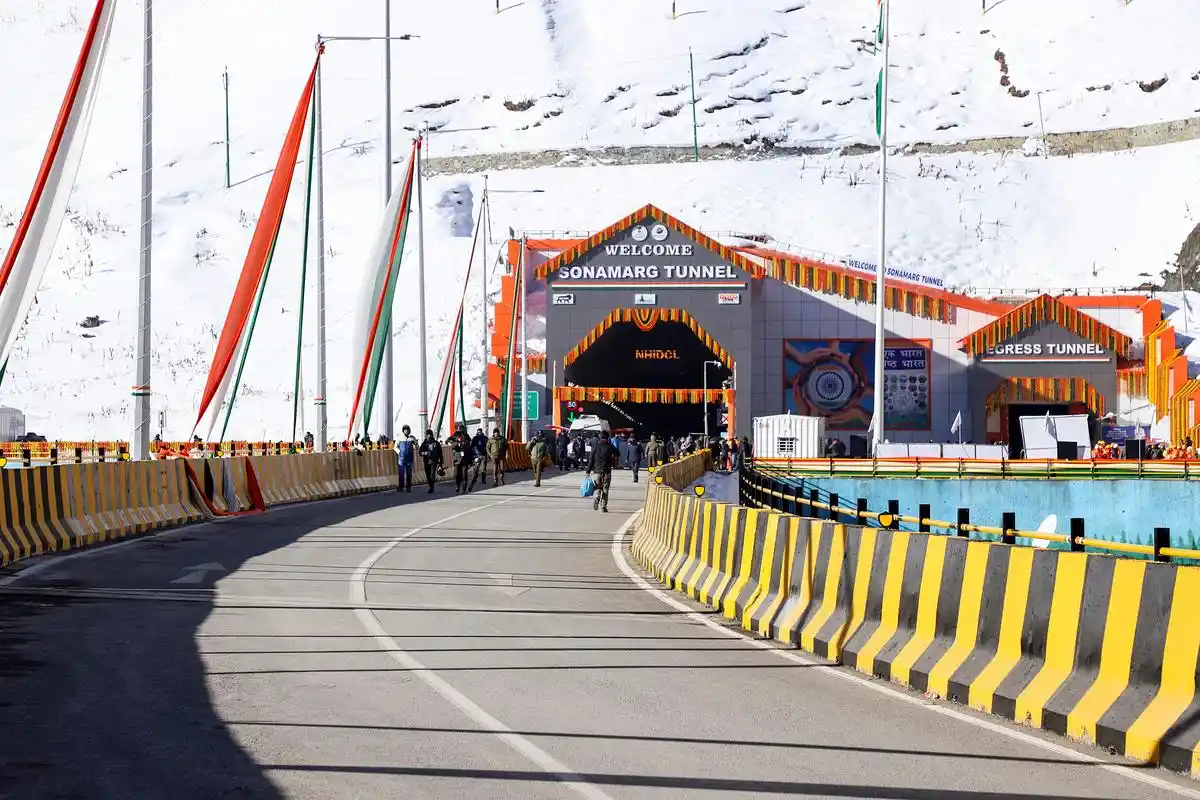
Development of the Srinagar Ring Road (Phase-IIA) and several tunnels will mark an improvement in all-weather connectivity to the valley. The project is expected to significantly boost tourism and economic growth by improving connectivity to iconic attractions, including Dal Lake, Shankaracharya Temple, and the Mughal Gardens.
Even in the power sectors, the Union Territory (UT) will be witnessing fast-tracking progress of the 1,000 megawatt (MW) Pakal Dul, 624 megawatt (MW) Kiru, and 850 megawatt (MW) Rattle projects, say officials in Kashmir.
Earlier than this, the UT witnessed the commissioning of the landmark Chenab Bridge in June 2025.
To cut down travel time between Delhi and Jammu by up to six hours, the central government has completed new expressways, national highways, ring roads, tunnels, and bridges.
The newly completed Delhi–Amritsar–Katra Expressway intends to reduce travel time from Delhi to Jammu to about six hours and to Katra to around seven hours. With the four-laning of National Highway-44, travel time between Srinagar and Jammu has been reduced from 7–12 hours to about 4.5 hours.
The Jammu and Kashmir government, last week, informed the state assembly that connectivity has remained a top priority, resulting in the completion and execution of major road infrastructure projects that have significantly improved access and reduced travel time across the Union Territory.