The decision by India and the Gulf Cooperation Council (GCC) to formally restart negotiations on a Free Trade Agreement (FTA) after nearly fifteen years represents a significant geoeconomic inflection point between India and the GCC states. It underscores how trade diplomacy is emerging as a primary instrument of India’s strategic positioning in the West Asian region. Collectively, the GCC accounts for nearly $180 billion in trade with India, positioning it as India’s largest trading bloc partner. Beyond trade, the GCC states host over 9 million Indian expatriates and supplies the bulk of India’s hydrocarbon imports. Yet what is notable about this resumption of FTA negotiations is that the relationship is no longer energy-driven and is now driven by geoeconomic realignments.
The Gulf states are undergoing structural transformation. Mega projects, sovereign wealth investments, and non-oil industrial expansion are redefining their economic models. Manufacturing, logistics, hydrogen energy, fintech, and advanced infrastructure have become central pillars of Gulf growth strategies. These shifts require deep integration with high-growth Asian markets, and India, with its labour force and technological capabilities, becomes indispensable. At the same time, New Delhi is also redefining its economic strategy. It is aggressively pursuing trade agreements to secure market access and integrate into resilient supply chains. Recent trade pacts, such as CEPA and FTAs, have demonstrated India’s willingness to engage in tariff rationalisation and regulatory alignment when strategic benefits outweigh protectionist concerns. The revival of these FTA discussions therefore reflects structural convergence.
The earlier negotiations were stalled in 2008 amid disagreements over tariffs, petrochemical access, services mobility, and standards. But the geopolitical and economic context is vastly different at present. Global supply chains are being reconfigured amid great-power competition, trade barriers, and technological decoupling. Regional middle powers are responding by expanding economic partnerships across multiple poles. The Gulf states have adopted multi-vector economic diplomacy, i.e., deepening ties simultaneously with China, the United States, Europe, and Asia. India fits naturally into this strategy as a stable growth market with complementary economic strengths.
In the case of India, this FTA could significantly enhance export competitiveness in pharmaceuticals, agro-products, textiles, machinery, and IT services. Reduced tariffs and harmonized standards would lower barriers in a region where regulatory fragmentation previously constrained expansion. For the GCC nations, access to India’s consumer market and industrial base offers diversification leverage. Gulf sovereign wealth funds have already invested billions in Indian infrastructure, renewable energy, and start-ups. An FTA framework would institutionalize and protect such flows.
The agreement also intersects with India’s connectivity ambitions. The proposed India–Middle East–Europe corridor (IMEC) signals a shared interest in trade corridors linking South Asia to Europe via West Asia. In this scenario, this FTA could provide the legal and regulatory architecture underpinning these transport and logistics networks. Critically, this trade reset comes amid a broader regional recalibration. West Asia has seen a gradual de-escalation, diplomatic normalisation, and pragmatic engagement among rival nations. Amid all of this, economic interdependence through FTAs is increasingly viewed as a stabilizing instrument. Further, this FTA indicates that economic priorities are outweighing older political hesitations.
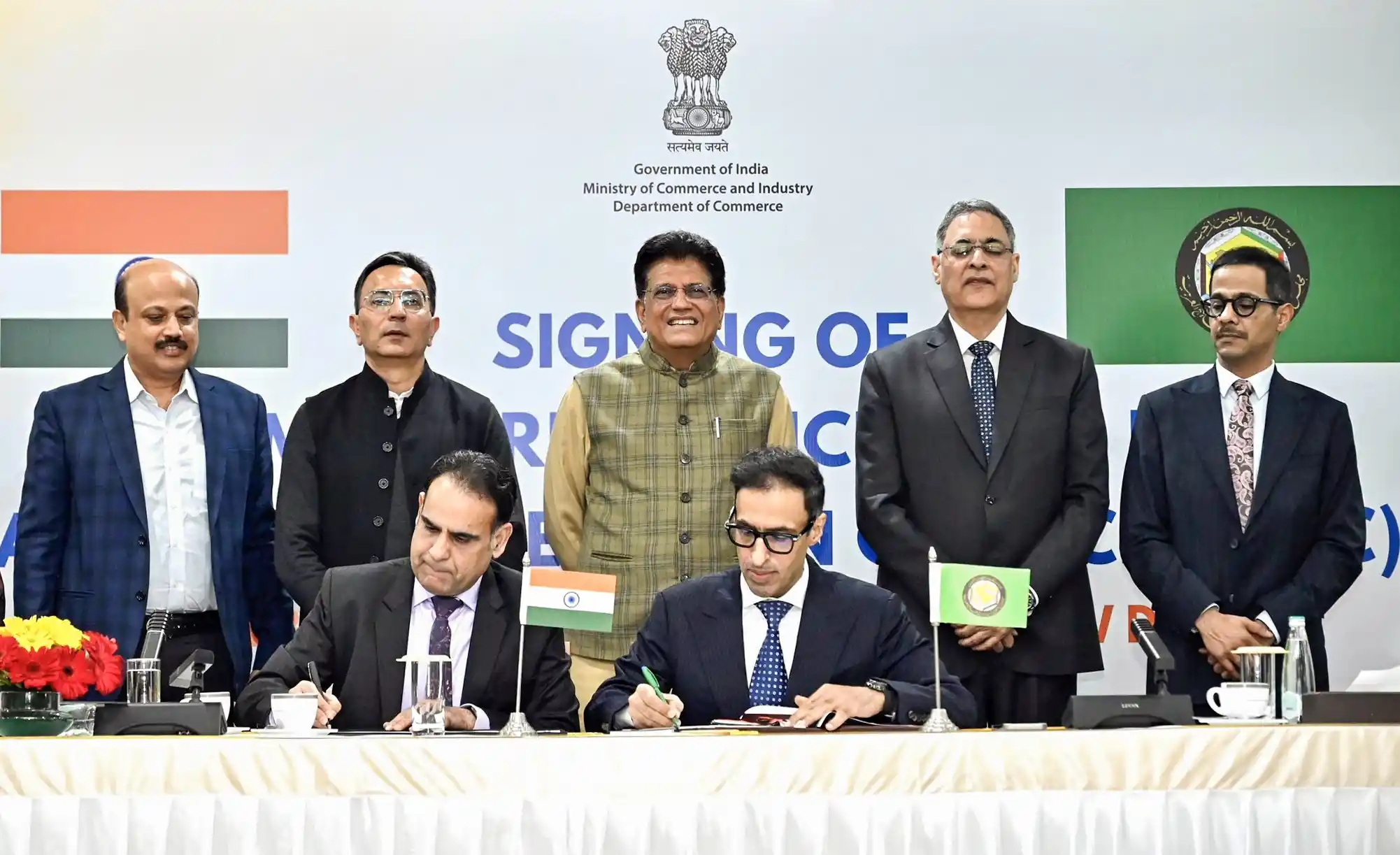
However, negotiations will not be straightforward. Sensitive sectors such as agriculture, petrochemicals, and labour mobility may generate friction. What is required is that India must balance domestic industry concerns with export ambitions. Gulf states may push for liberalized investment regimes and enhanced labour access provisions. In the case of GCC, it negotiates as a bloc, which can introduce internal coordination complexities. Variations in economic structure among member states could affect tariff alignment and regulatory harmonization. Yet the political momentum appears stronger than in the past. The signing of fresh Terms of Reference (ToR) in February 2026 provides a structured roadmap and timeline, suggesting the seriousness of intent.
Ultimately, the revival of India–GCC FTA negotiations is not merely a trade event—it is a strategic signal. It reflects how West Asian nations are responding to a fragmented global order by expanding geoeconomic partnerships. In a region historically shaped by security alignments, economic architecture is increasingly determining long-term influence. When the FTA would embed India more firmly within the GCC’s diversification agenda and anchor it more deeply in India’s growth trajectory. In doing so, it would mark a decisive shift from transactional energy interdependence to structured economic integration. In West Asia today, trade diplomacy is becoming a tool of strategic stability. The India–GCC FTA reset is a clear illustration of this transition.