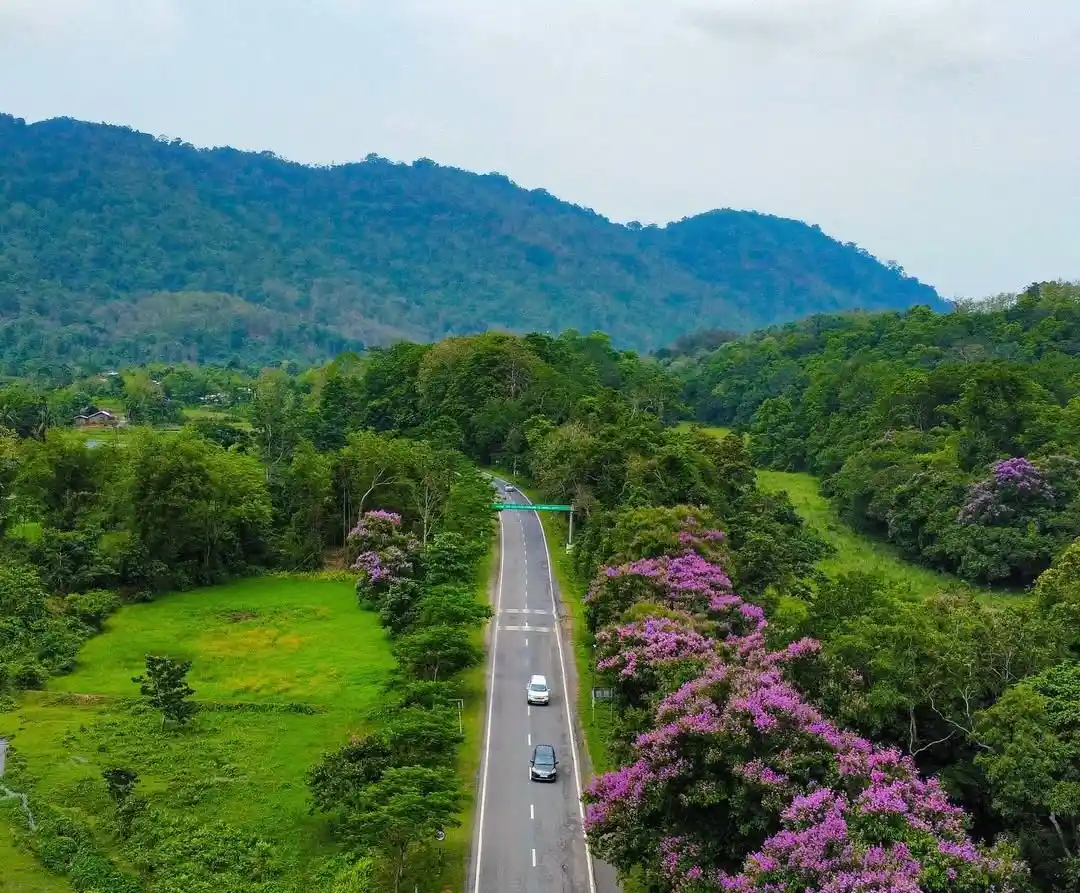
Nestled in the floodplains of Assam’s Brahmaputra River, Kaziranga National Park is a UNESCO World Heritage Site and a biodiversity hotspot. Home to two-thirds of the world’s one-horned rhinoceroses, over 1700 elephants, and one of the highest tiger densities in India, the park spans 884 square kilometers across Golaghat and Nagaon districts. However, seasonal flooding forces animals to migrate southward to the Karbi Anglong hills, crossing National Highway 715 (formerly NH-37). Annually, animals move southwards from the Brahmaputra floodplains to the Karbi Anglong hills, and roads, railways, and settlements that obstruct this movement convert seasonal migration into fatal conflict, aggravating human-wildlife conflict and threatening species survival.
India’s judiciary has consistently treated wildlife corridors not as optional conservation add-ons but as constitutional obligations. Article 48A of the Constitution obliges the State to safeguard wildlife, while the jurisprudence of Article 21 has expanded the right to life to include ecological integrity. The judiciary’s interpretation in the 2019 T.N. Godavarman Thirumulpad vs. Union of India case led to the ban of all mining and new constructions in Kaziranga’s nine identified animal corridors (Panbari, Haldibari, Bagori, Harmati, Kanchanjuri, Hatidandi, Deosur, Chirang, and Amguri), citing threats to ecological integrity. The court further restrained activities in catchment areas of rivers flowing into Kaziranga National Park, directing the administration to halt illegal mining transport. The SC also upheld the National Green Tribunal’s (NGT) order to demolish Numaligarh Refinery’s 2.2-km boundary wall, which obstructed elephant corridors, noting that “elephants have the first right on the forest”. Broader SC rulings, like the 2023 Centre for Environment Law vs. Union of India, underscore precautionary principles for Eco Sensitive Zones around parks, mandating 10 km buffers to avert irreversible damage. In a 2025 judgment, the SC warned that unchecked human-wildlife conflict could lead to forest extinction, leading to animal suffering. In effect, the law has already accepted the premise that development must bend where ecological survival is at stake. Supreme Court and National Green Tribunal interventions in the Kaziranga-Karbi Anglong landscape have banned mining in the Karbi Anglong hills to protect animal movement, ordered traffic regulation along the highway abutting Kaziranga, and directed demolition of man-made obstructions in elephant corridors.
Conservation debates in India highlight the fault line between infrastructure expansion and ecological survival, as is the case surrounding Kaziranga National Park. In response to such debates, the Assam Government has decided to construct the Kaziranga Elevated Corridor, a ₹6,950 crore project that promises to redefine conservation by allowing uninterrupted animal movement below the corridor while improving human connectivity above. The project is a part of an 86-kilometer upgrade of NH-715 from Kaliabor to Numaligarh and includes a 35 km elevated wildlife corridor through Kaziranga National Park, 21 km bypasses at Jakhalabandha and Bokakhat, and widening 30 km of existing road to four lanes. Designed under the Engineering, Procurement, and Construction (EPC) mode. The corridor is the translation of the Supreme Court’s legal philosophy, in its sustained engagement to prevent human-wildlife conflict.
The Kaziranga Elevated Corridor cannot just be considered as an infrastructural experiment, but it represents a structural shift in how the government imagines mobility, intermixing it with ecological continuity and development planning. India has already pioneered similar structures in other states, yielding successes. In Madhya Pradesh and Maharashtra, the 12 km elevated stretch on NH-44 through Pench Tiger Reserve, India’s first dedicated wildlife overpass, includes five overpasses and a 1.2 km underpass. This infrastructure reduced roadkills by over 90% for species like tigers, leopards, and deer, while facilitating gene flow in the Kanha-Pench corridor. The Sanjay Gandhi National Park in Maharashtra is building India’s first urban wildlife overpass, linking it to Tungareshwar Wildlife Sanctuary, safeguarding 150 leopards amidst Mumbai’s developmental expansion. In Uttarakhand, the Rajaji Corbett corridor uses underpasses to protect elephants and tigers, cutting conflicts in the Terai Arc Landscape spanning India and Nepal. These efforts have boosted wildlife populations as tiger numbers in Pench rose 20% post construction, demonstrating the role of such corridors in averting inbreeding and localized extinctions.
In fact, international accounts demonstrate the effectiveness of such wildlife corridors. The World Bank’s work on “corridors of coexistence” highlights how ecological connectivity infrastructure simultaneously protects wildlife, reduces economic loss from accidents, and enhances road safety for humans. Studies documented by National Geographic highlight that wildlife overpasses and underpasses in the United States and Canada reduce animal vehicle collisions by 80-96% in some regions. The wildlife crossings in the Banff National Park of Canada are one of the world’s most cited conservation engineering interventions. It has recorded over 200,000 safe animal crossings across species ranging from elk to bears. The Netherlands’ ecoducts, like those in Veluwe, have slashed deer collisions by 85%. In Singapore, the 75m Eco-Link@BKE overpass links Bukit Timah and Central Catchment reserves, aiding endangered Sunda pangolins and civets. Bhutan’s plan on wildlife crossings on new highways mirrors Kaziranga’s approach, reducing human-wildlife conflicts in Asian ecological hotspots. In the United States, Wisconsin’s turtle tunnels and Florida’s Key deer underpasses have saved thousands, with U.S. wildlife collisions dropping significantly where they have been implemented. Similarly, from Costa Rica’s biological corridors to France’s green bridges, elevated or subterranean corridors have proven that conservation and connectivity need not be adversaries.
The National Highway passing through the Kaziranga National Park lies directly between the floodplains and the Karbi Anglong hills, which are the movement corridors of the animals. The already implemented initiatives, like speed limits, barricades, and warning signs, have been useful to a certain extent, but these are often reactive tools that mitigate damage but hardly balance ecological flow. As such, the Kaziranga elevated corridor may change this equation permanently. By lifting traffic above ground level, it returns the land below to animals, enabling unbroken movement during floods and dry seasons alike. This is not merely about preventing the animals from being killed but more so about restoring ecological functionality. Additionally, during flood seasons, Kaziranga experiences not only animal deaths but also severe traffic congestion for commuters and tourists. The elevated corridor, therefore, can reduce the unfortunate accidents, sudden slowdowns, panic braking, and nighttime collisions, making it as much a public safety investment as an environmental one. This dual benefit is the sole reason the World Bank increasingly treats wildlife corridors as infrastructure risk reduction tools, and not just infrastructural development.
Human wildlife conflict is often framed as a conservation issue alone, but the data highlights a broader story that India’s wildlife and vehicle collisions have surged over the years, with 21 endangered species at risk. In Kaziranga alone, floods displace a significant number of animals annually, leading to many roadkills.
Alongside the ecological adversaries, the social part of the human wildlife conflicts also needs to be taken into account. Kaziranga has long been a shared living space of the local communities like the Mishings and the Karbis, coexisting with the wildlife that follows the established migrational routes. Over time, the highway passing through this area has become a major source of accidents and disruption, affecting both animal movement and human safety. The elevated corridor addresses this issue through a clear and functional approach. The removal of the old surface road further supports ecological continuity. At the same time, the planned infrastructure ensures that local villages remain connected without interfering with animal movement. It reduces the need for animals to cross traffic and helps restore natural corridors between Kaziranga National Park and the southern hills. The project also offers direct benefits to residents and commuters. Traffic congestion in nearby towns such as Bokakhat is expected to reduce, travel time will improve, economic connectivity shall be boosted in Upper Assam, linking districts like Dibrugarh and Tinsukia and road safety risks will decline. A dedicated corpus fund, supported by a fixed share of the project budget, has been created to address human wildlife conflict and to support long-term conservation and community needs. Overall, the elevated corridor represents a balanced infrastructure intervention that improves transportation efficiency while responding to ecological and social concerns in the Kaziranga region.
The Kaziranga Elevated Corridor is not about choosing wildlife over development. It is about choosing intelligent development over irreversible loss. Around the world, nations are discovering that when infrastructure is designed with ecosystems rather than against them, both nature and people win. In that sense, Kaziranga is not just testing an engineering solution. It is testing India’s civilisational maturity whether the country can build roads that move vehicles forward without pushing nature backward. If executed with scientific rigour and legal sensitivity, the Kaziranga Elevated Corridor could become India’s first globally benchmarked wildlife-inclusive highway model that would mark a conceptual transition, from compensatory conservation to structural coexistence.