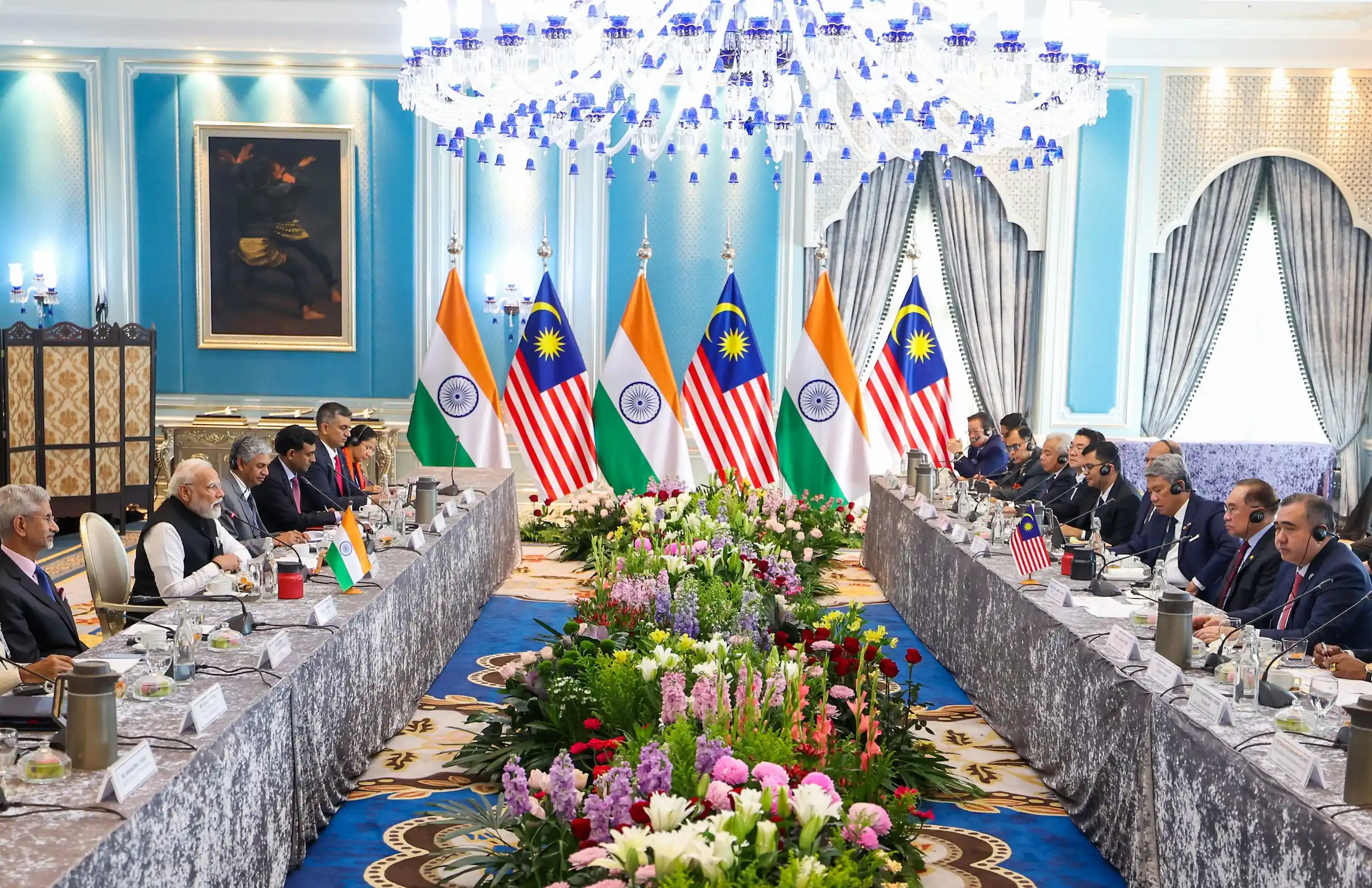
Prime Minister Narendra Modi’s official visit to Malaysia on February 7-8, 2026, marks a pivotal moment in bilateral ties, elevating the Comprehensive Strategic Partnership (CSP) established in August 2024. This two-day engagement, hosted by Malaysian Prime Minister Anwar Ibrahim, underscores India’s Act East Policy amid Indo-Pacific flux, blending economic pragmatism with security imperatives.
India and Malaysia share millennia-old civilizational links, from ancient maritime trade to shared Buddhist and Hindu heritage, formalized diplomatically in 1957. The relationship evolved through the Malaysia-India Comprehensive Economic Cooperation Agreement (MICECA) in 2011, fostering trade growth despite occasional frictions like palm oil disputes. Recent high-level exchanges, including Anwar’s 2024 India visit and Modi’s 2025 BRICS sidelines meeting with him, have injected momentum into reviewing ties amid regional security concerns.
Key Outcomes of the 2026 Visit
The leaders’ bilateral meetings covered a vast agenda, witnessing six key pacts: MoUs on corruption combat, disaster management, social security for Indian workers, audio-visual co-production, plus exchanges on semiconductors, healthcare, security, and vocational training. They reaffirmed platforms like Foreign Office Consultations and Joint Commission Meetings for sustained dialogue. Modi highlighted cultural bonds, including Tamil heritage, while Anwar hosted an official luncheon, symbolizing warmth.
Bilateral trade has surged, with Malaysia viewing India as a vital partner in semiconductors, digital economy, and renewables. The 10th India-Malaysia CEO Forum on February 7 convened in Kuala Lumpur, pushing investments in infrastructure, AI, fintech, and green tech; Indian firms create high-skilled jobs in Malaysia, reciprocated by Malaysian inflows via PETRONAS and Gentari into India’s solar and hydrogen sectors. Local currency settlement (INR-MYR) via RBI-Bank Negara ties eases trade, alongside MICECA utilization and accelerated ASEAN-India FTA review for balanced gains. Palm oil cooperation emphasizes sustainable supply chains, resolving market access via structured talks.
Defence ties expanded via the 13th Malaysia-India Defence Cooperation Committee (MIDCOM) in February 2025, focusing on AI, cyber, Su-30 maintenance, and a Strategic Affairs Working Group. The fifth Harimau Shakti exercise (December 2025) and naval visits like INS Sahyadri bolster interoperability; both co-chair ADMM-Plus counter-terrorism (2024-2027), condemning cross-border terror. Maritime focus addresses non-traditional threats in the Straits of Malacca, vital for 40% global trade.
In the Indo-Pacific, both uphold UNCLOS for navigation freedoms, urging peaceful South China Sea dispute resolution—key given Malaysia’s claims. India backs ASEAN centrality; Malaysia supports India’s UNSC bid and BRICS role, aspiring to full membership itself. Aligning ASEAN Outlook on Indo-Pacific (AOIP) with India’s IPOI advances peace and prosperity, positioning India as a non-hegemonic alternative to China and US poles.
Modi’s visit signals India’s astute recalibration in Southeast Asia, leveraging Malaysia’s Malacca Straits geography and ASEAN heft to counterbalance China’s BRI dominance without alienating a key palm oil supplier. Economically, semiconductor and digital pacts tap Malaysia’s strengths while exporting India’s DPI and fintech models, fostering resilient supply chains amid global fragmentation. Defence deepening, from joint exercises to tech sharing, enhances interoperability against hybrid threats, vital for India’s SAGAR vision.
Yet challenges persist: trade imbalances favor ASEAN, Zakir Naik extradition lingers unresolved, and palm oil sensitivities demand careful navigation. Malaysia’s BRICS aspirations align with India’s multipolar push, but Anwar’s government must balance US ties. India’s democracy and development model appeals to ASEAN’s desire for a “third way,” avoiding binary superpower choices.
This CSP upgrade is transformative, potentially doubling trade to $30 billion by 2030 via FTAs and investments. For India, it secures energy routes and diaspora leverage (2.5 million strong); for Malaysia, Indian capital fuels Madani vision. Success hinges on implementation—expediting AITIGA review, air connectivity boosts, and student exchanges under ITEC/MTCP. In a volatile Indo-Pacific, this “special relationship” exemplifies pragmatic diplomacy, yielding mutual prosperity over rhetoric.
Ultimately, Modi-Anwar chemistry—evident in personal airport welcomes and cultural nods—heralds a mature partnership. As India chairs BRICS 2026, Malaysia’s integration could reshape Global South dynamics, proving bilateral bridges build regional resilience. Bold execution will define if this is diplomacy’s high tide or ebb.