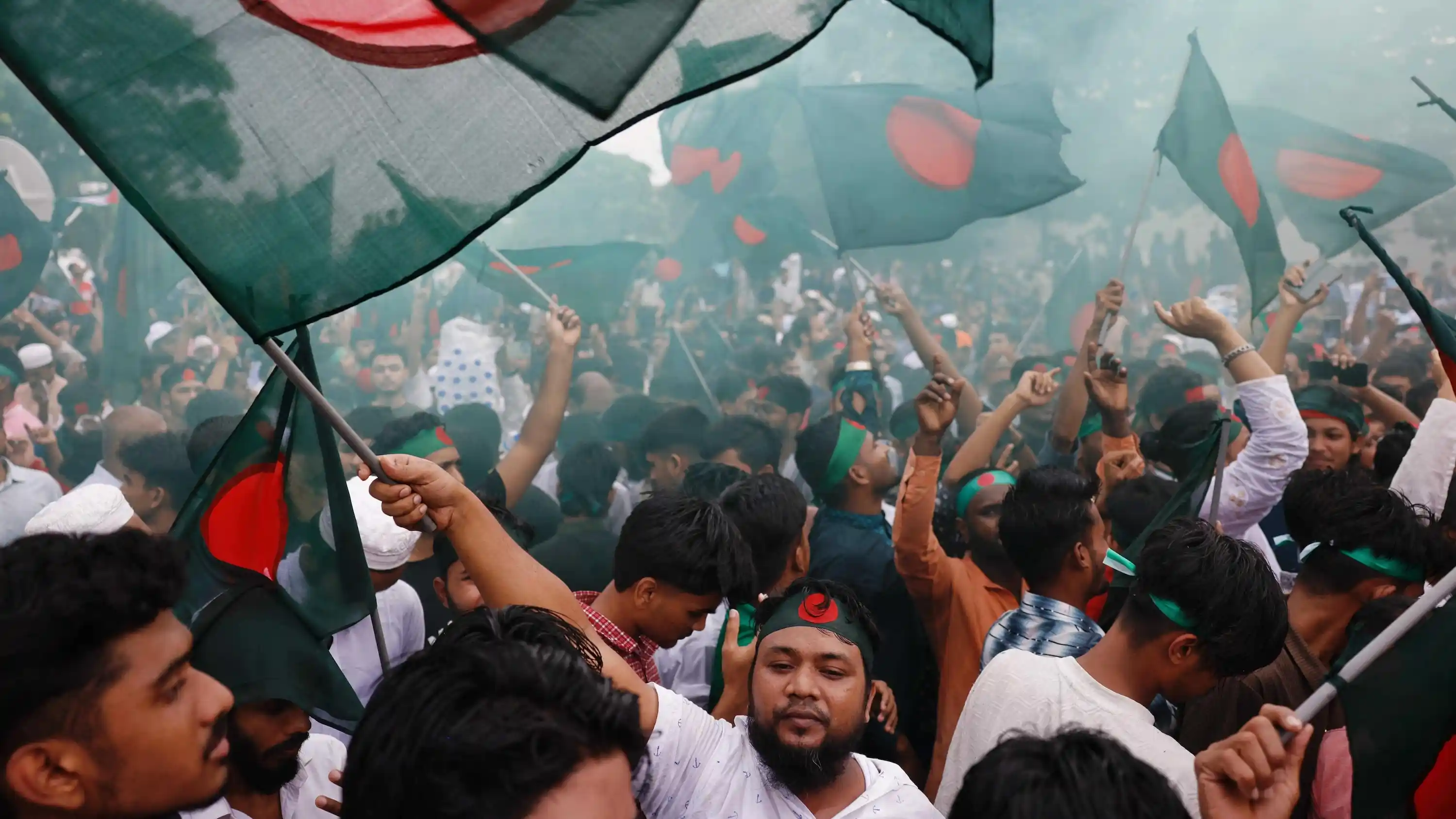
After almost losing decades of strategic depth in Afghanistan, Pakistan has now shifted its attention to cultivating a second phase of strategic depth—Bangladesh. Perhaps following the 2024 revolution in Bangladesh that ousted Sheikh Hasina, the recent violence and Islamist uproar in Dhaka have been reported, with US security agencies suggesting a fresh threat of violence as elections are only weeks away. These incidents are not only revealing rapidly growing anti-India sentiments but also showing how Pakistan is desperately pushing its long-drawn psychological operations capabilities in Bangladesh before the elections.
Pakistan’s Beginning of Depth
The depth of Pakistan’s crisis was glaringly apparent when, after four years of the 1971 war, Bangladesh saw a bloody coup. A group of Bangladesh Army officers, led by Major Dalim, stormed Sheikh Mujib’s residence in Dhaka and successfully staged a coup. The Bangladeshi Army killed Mujib and his family members. Almost two hundred people were killed on the day of the coup, including Mujib’s supporters who resisted the coup and those who protested the Bangladeshi Army’s move. This led to the rise of Islamist forces beginning in Pakistan’s depth in Bangladesh and the first wave of decline of New Delhi’s influence in Bangladesh.
The Revolution In 2024 And Pakistan Tilt
The same rise that Bangladesh saw in the 1970s was revived during the 2024 revolution, when Islamist forces stormed the streets, shifted the balance of power significantly after decades, and led to the ouster of Sheikh Hasina. Ever since Hasina was ousted, the Yunus government has maintained surface-level relations with New Delhi while continuing to counter India’s influence on the ground and cultivating deeper ties with Pakistan. There are several instances in which the Yunus regime sought to strain Bangladesh’s long-standing ties with India. First, it allowed Pakistan to deepen its presence in Bangladesh by letting Islamabad establish its intelligence relationship and hold high-level military talks.
In 2025, there were four high-level visits by Pakistani military and intelligence officials. The most recent was General Sahir Shamshad Mirza, then Chairman of Pakistan’s Joint Chiefs of Staff Committee (CJCSC), who visited Dhaka and met with Chief Adviser Muhammad Yunus to discuss defense cooperation.
At the economic and strategic fronts, the shift was gradually becoming visible. The government eased trade barriers, including a 2024 notification exempting Pakistani shipments from mandatory 100% physical inspections and removing special security clearances for Pakistani nationals. Direct flights and maritime trade between Dhaka and Karachi resumed in late 2025. Similarly, at the strategic front, Bangladesh participated in Pakistan’s AMAN-25 naval exercises for the first time in over a decade and has reportedly discussed acquiring Pakistani JF-17 Thunder fighter jets. At the regional level, the Yunus regime sought to advance Pakistan’s regional agenda, including the revival of SAARC, and attributed its failure to India. The tilt in Bangladesh towards Pakistan signals Islamabad’s deepening of its strategic presence at the political and diplomatic levels.
India’s Strategy in the Yunus Regime
Since the 2024 revolution, New Delhi has sought to maintain a functional relationship with the Yunus regime, despite the limited influence that affords it some space to manage Dhaka-Delhi ties. In the changed context of limited influence in Dhaka, especially at the political level, India appears to have recalibrated its approach, adopting a functional yet pragmatic strategy in which New Delhi leverages key dimensions of the Indo-Bangladesh relationship to maintain its hold over the Yunus regime.
First came the economic dimension, and second came the traditional Bangla ties. On the economic front, trade between Delhi and Dhaka under the Yunus regime, despite diplomatic headwinds, registered unexpected growth, reflecting more of India’s imports than exports.
Similarly, Bangladesh is dependent on India for energy, with the country relying on India for approximately 2,000 MW of electricity and high-speed diesel via the India-Bangladesh Friendship Pipeline. Bangladesh remains India’s largest trading partner in South Asia, and the two countries renewed the Protocol on Inland Water Transit and Trade (PIWTT) in 2025, which includes a 5-year automatic-renewal clause.
Second, maintaining traditional Bangla ties is essential to ensure that cultural influence remains intact. Bangladeshi intellectuals, academics, and journalists continue to sustain and protest against the Yunus regime. Major cultural organisations, including Udichi Shilpigoshthi and Chhayanaut, held massive protest rallies in Dhaka against cultural oppression and attempts at the systemic erasure of 1971 war memories.
Prominent academics have publicly accused the Yunus administration of turning universities into “laboratories of fascism”. Protests have erupted at major public universities, including Dhaka University. Media outlets, including the Daily Star, have also voiced opposition to the Yunus regime.
Pakistan’s Desperation
India’s carefully crafted diplomatic manoeuvres have centred on condemning political and cultural oppression, including opposition to the political ban on the Awami League and multiple acts of violence. Among these actions, one remains a notable firm stance regarding Sheikh Hasina’s extradition demands. By emphasising strategic necessities within the relationship under the umbrella of economic and traditional ties, India has been able to sustain its limited influence that could affect the upcoming elections in 2026. Soft diplomatic pressure and the brewing among Bangla intellectuals and activists against Yunus Pakistan might have been set in motion to ensure that nothing is risked that could give India a favourable political and diplomatic opening in the electorally charged environment of Bangladesh.
Renewing Anti-India Wave: Refreshing 2001
During the run-up to the 2001 elections in Bangladesh, Dhaka witnessed pre-election violence by supporters of the BNP-Jammat alliance, which triggered widespread violence against Hindus and Awami League party workers. This incident created an anti-Awami League wave in the 2001 electoral environment, indirectly setting the stage for an anti-India wave as well. The tone was almost set, and Sheikh Hasina was voted out of power, while the Islamic elements-backed party, BNP, came into power. In 2001, the Jammati-E Islammi party, sharing a deep ideological relationship with Pakistan, played an active role in inciting mob and targeted violence against Hindus and the Awami League. A report submitted by the Judicial Commission in 2011 also noted that top Jammat-e-Islami leadership was involved in the 2001 violence.
During the BNP regime, especially post-elections, the violence continued, mainly in the southeastern region of Dhaka, targeting Hindus. Most notably, after the BNP takeover of power, ULFA-1 activities in the North East also saw a noticeable increase, as the BNP government allowed ULFA-1 to operate from the Bangaldesh borders and even gave them safe havens. The infamous Chittangong Arms Haul in 2004 showed how Bangaldesh was effectively creating a breeding environment for anti-India activities.
Wave Before Elections
The recent anti-India wave and Islamist forces, especially the Jammatis storming the streets, targeting media institutions, Hindus, and Awami League offices, occurred in the three months leading up to the elections, mirroring 2001 tactics. This time, instead of being indirect, the anti-India wave was more hard and direct. Even so, the pre-electoral violence also seems to have been indirectly orchestrated by Pakistan. There is a strong possibility that Pakistan’s intelligence agency, ISI, might have sponsored or carried out the assassination of student leader Osin Hadid in Singapore. To further complicate the security scenario for India, Pakistan is planning to rehabilitate ULFA-I Chief Paresh Baruah in Bangladesh, if some reports are to be believed.
There are two reasons for it—first, it would incite Islamist forces and create an anti-Awami League environment, thereby strengthening Yunus’s political power before the elections, as it did with the BNP in 2001. Second, it provides an opportunity to create an anti-India wave by blaming Hasina for the assassination, who is currently in exile in India. Charging the Bangladeshi environment with a new revolutionary-like wave is not an accident but deliberate tactics to ensure Yunus’s victory in the upcoming elections.
India’s All Options And Realism In Neighbourhood
Budget 2026 sends soft signals that India is gradually adopting a more realistic approach to its neighbourhood-first policy, significantly reducing and recalibrating its regional assistance to Bangladesh, Myanmar and the Maldives, while increasing aid to Afghanistan, Sri Lanka, Nepal and Bhutan. This reallocation reflects India’s realistic reassessment of its neighbourhood-first policy, marking a subtle departure from the liberal and willful ignorance disguised as a big-brother policy (Gujral Doctrine) that largely failed to foster strategic trust or provide a counterbalance to China and Pakistan.
As the Bangladesh elections approach, India must be prepared for all options and ensure it can foster strategic trust and counter adverse influence in Dhaka, with the broader strategic aim of making Yunus’s leadership recognise the heavy costs of ignoring New Delhi. This means India must remain open to all scenarios, as room to operate is gradually shrinking, especially after the new wave of violence. If Yunus wins the elections and gains legitimacy, India must prepare for broader engagement, particularly in security, both overt and covert, to secure its missions and foil anti-India activities. If there is a fractured mandate, it may slightly favour Delhi, helping to tighten its grip in Dhaka. Whatever the case, India must prepare for both scenarios without delay and without adopting a restrained approach; it risked staying low last year, but this time it must also remember that there will be high strategic costs for New Delhi if it loses Dhaka in the coming period.