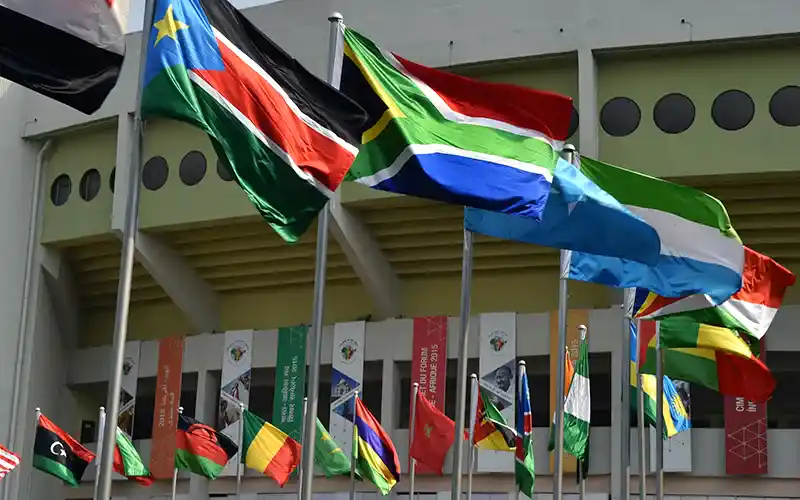
The forthcoming India–Africa Forum Summit (IAFS) 2026, likely to be held mid-year, will represent more than a routine diplomatic engagement; it will serve as a strategic inflection point in aligning two transformative visions—Africa’s Agenda 2063 and India’s Viksit Bharat 2047. Both frameworks are fundamentally about structural transition: shift from input-driven growth models toward higher value production and industrial upgrading, from resource dependence to technology-enabled productivity, and from peripheral participation in global systems to agenda-setting influence. IAFS 2026 therefore arrives at a moment when India and Africa are simultaneously redefining their development trajectories and global roles. The summit provides an opportunity to shift the partnership narrative from project-based cooperation toward ecosystem-level co-development, where industrial capacity, digital transformation, human capital formation, and institutional strengthening are pursued in parallel. If structured correctly, IAFS 2026 can become the bridge that translates shared long-term aspirations into implementable medium-term partnerships anchored in measurable outcomes.
Unlike earlier cycles of the partnership, the current phase is unfolding within a rapidly evolving and increasingly fluid multi-aligned global system, with stronger African negotiating agency, greater Indian economic and technological weight, and global production networks increasingly searching for alternatives to historically dominant manufacturing centres.
India–Africa relations are thus entering a phase where ambition must be matched by strategic clarity and disciplined execution. The convergence between Africa’s continental development aspirations and India’s own long-term trajectory toward advanced economic, technological, and institutional capacity creates a historically significant opportunity. Yet, the global environment within which this partnership is unfolding is crowded, competitive, and increasingly transactional.
An effective policy approach for India must therefore be anchored in strategic autonomy while maintaining acute awareness of other external actors operating across Africa. India’s strategy should focus on identifying distinct value propositions, avoiding zero-sum competition where structural disadvantages exist, and actively pursuing collaboration where partner strengths are complementary.
‘India-First’ Strategic Framework
An India-centric approach does not imply strategic isolation. Instead, it requires clarity about where India possesses durable comparative advantage. India’s strengths lie in scalable digital public infrastructure, affordable healthcare and pharmaceutical manufacturing, large-scale skill development ecosystems, democratic institutional capacity building, and cost-effective engineering and services integration. These capabilities allow India to operate effectively in sectors where development outcomes depend on system design, human capital development, and technology diffusion rather than purely on capital scale.
The strategic risk for India is attempting to compete directly in sectors where other partners possess structural advantages, particularly in ultra-large infrastructure financing or legacy extraction-linked mineral asset ownership. Instead, India’s most effective positioning lies in building development ecosystems that integrate technology, human capital, and institutional strengthening.
Decoding External Actors
China will continue to operate as Africa’s largest infrastructure financier and a major player across logistics, mining, and industrial park development. India should not frame its engagement as counterbalancing China but rather as offering a differentiated model. In infrastructure, this means focusing on mid-scale, high-impact connectivity projects, digital infrastructure overlays, and urban systems rather than mega-project financing. In mining and resource sectors, the focus should be on downstream processing, technology support, and supply chain diversification rather than competing for legacy upstream ownership positions.
The European Union’s influence will increasingly shape regulatory and sustainability frameworks governing African industrialisation and green transition pathways. Rather than resisting these frameworks, India should selectively align where such alignment unlocks financing and technology access while preserving operational flexibility. In climate technology, green hydrogen, and sustainable supply chains, collaboration with European financing platforms can significantly amplify project viability.
The United States will remain influential in digital governance standards, cybersecurity architecture, and high-end technology ecosystems. India’s open architecture digital public infrastructure approach is inherently compatible with global interoperability norms and can reduce strategic friction. India should emphasise digital sovereignty partnerships that support African data ownership while ensuring technical compatibility with global systems.
Gulf states will continue expanding capital deployment across logistics, ports, and food security supply chains. India should view Gulf capital as a potential multiplier rather than a competitor. Joint investment frameworks linking Gulf financing with Indian technology and African market access could produce high-impact development corridors, particularly in agri-logistics and maritime trade infrastructure.
Japan represents perhaps the most natural strategic collaborator for India within Africa’s external partnership ecosystem. Japan’s focus on quality infrastructure, industrial ecosystem formation, and human capital development aligns strongly with India’s own strengths. Rather than competing directly in infrastructure financing or industrial zone positioning, India should actively pursue structured triangular cooperation models. Japan’s financing discipline and advanced manufacturing technologies can complement India’s digital infrastructure, pharmaceutical manufacturing, and skill development capabilities. Such collaboration could produce integrated development packages uniquely suited to African industrial transformation priorities.
Navigating African Structural Realities
Africa’s internal development landscape presents structural realities that must be factored into partnership design. Political transition cycles, regulatory variability, and institutional capacity constraints can affect project continuity. India’s approach should therefore emphasise institutional embedding of flagship initiatives within continental and regional frameworks wherever possible. Such anchoring reduces vulnerability to domestic political transitions.
Debt sustainability considerations will shape African government borrowing decisions over the coming decade. India should prioritise financing models that reduce sovereign debt burdens, including blended finance, revenue-generating infrastructure, and public–private partnership structures. Financing innovation rather than financing volume will increasingly determine partnership attractiveness.
Institutional capacity constraints, particularly in project preparation and procurement frameworks, remain major bottlenecks across multiple African economies. India’s ability to support project preparation, technical advisory support, and implementation capacity building could become a major differentiator. Building institutional capability creates long-term strategic partnership resilience.
Managing India’s Internal Delivery Risks
India’s credibility in Africa will depend heavily on execution discipline. Political announcements must be supported by realistic implementation pipelines. Large multi-country initiatives should be phased, beginning with demonstration projects capable of producing early success outcomes. Visible early results create political and market confidence.
Indian private sector participation remains constrained by persistent risk perception gaps. Government-backed risk insurance mechanisms, rapid dispute resolution frameworks, and initial anchor investments by public sector enterprises can help catalyse private sector entry. Over time, successful pilot projects will naturally reduce perceived market risk.
India must also accept structural financing constraints relative to some external actors. Attempting to match capital volume would dilute India’s comparative advantages. Instead, India should focus on targeted public financing structured to mobilise larger pools of private and multilateral investment while concentrating Indian resources in technology-intensive and human capital-intensive sectors.
Past experience also underlines the importance of synchronising political commitments with project preparation timelines, financing approvals, and on-ground implementation capacity, particularly in multi-country development initiatives.
Sectoral Pathways
These sectoral priorities are not independent verticals but mutually reinforcing pillars of long-term development ecosystem building.
In digital infrastructure, India should prioritise digital public infrastructure partnerships built around open architecture, local data hosting, and sovereign digital governance frameworks. These features directly address African policy concerns around digital sovereignty while differentiating India from closed digital ecosystem models.
In critical minerals, India should focus on downstream processing, refining technology, and workforce training rather than upstream resource acquisition. This approach aligns with African industrialisation goals while reducing exposure to resource nationalism risk.
In healthcare and pharmaceuticals, India already holds structural advantage. Expanding joint manufacturing, regulatory harmonisation, and telemedicine networks offers high-impact partnership potential with immediate citizen-level benefits.
In skill development and higher education, India’s large-scale training ecosystem offers unique partnership opportunities. Long-term workforce development partnerships produce compounding strategic influence that extends far beyond individual projects.
Strategic Narrative
Africa’s political narrative environment is increasingly sensitive to partnership equality and local value creation. India’s development experience—particularly its emphasis on inclusive growth, affordable technology, and human capital expansion—aligns naturally with African policy priorities. The most important reputational risk is not competition from other external actors but the possibility of over-promising and under-delivering.
India’s narrative should emphasise partnership co-creation, local job creation, technology transfer, and institutional strengthening. Development partnerships are judged over decades, and early implementation credibility will shape long-term perception.
External shocks remain possible, including sovereign debt crises, political instability in key partner states, commodity price volatility affecting resource projects, and technological disruption altering global resource demand patterns. India’s best protection against such risks lies in diversified project portfolios and modular implementation design.
If executed effectively, India can emerge not merely as another development partner but as a system-level transformation partner aligned with Africa’s long-term development trajectory. The next phase of India–Africa engagement will ultimately be defined by operational credibility. Strategic autonomy, combined with partnership intelligence, offers India its strongest pathway to sustained influence and shared development success.
The test of India–Africa partnership will no longer be intent or alignment, but the ability to co-build systems that outlast political cycles and market shocks.