
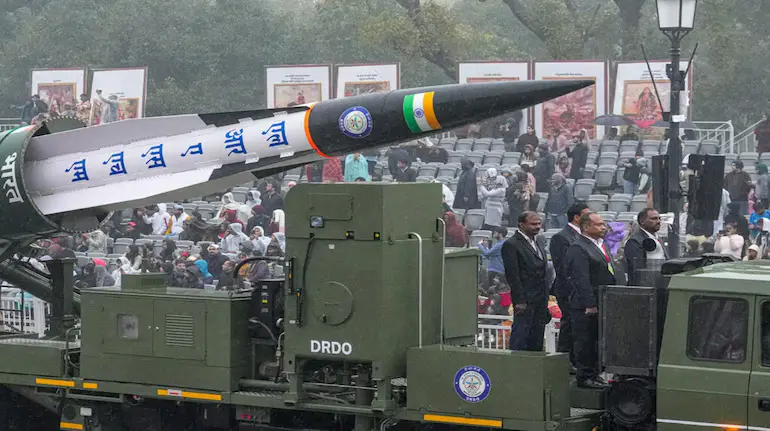
India’s 77th Republic Day Parade prominently featured indigenous defence technologies and innovations, underscoring the nation’s strides toward self-reliance under the Atmanirbhar Bharat initiative.
The displays on Kartavya Path, combined with the DRDO tableau at Bharat Parv, highlighted cutting-edge systems from missiles and tanks to advanced submarine technologies. These exhibits, alongside new formations like the phased battle array and tri-service “Operation Sindoor” tableau, showcased operational integration and combat readiness.
Key Indigenous Systems Displayed on Kartavya Path
Missiles took center stage, reflecting India’s advancements in precision strike and air defence:
- Long Range Anti-Ship Hypersonic Missile (LR-AShM): A DRDO-developed hypersonic glide vehicle making its notable public display. It reaches Mach 10 peaks (average Mach 5 via multiple skips), follows a quasi-ballistic/low-altitude trajectory for radar evasion, and engages static/moving targets with high accuracy using indigenous avionics, sensor packages (including terminal-phase sensors), and a two-stage solid-propellant system. Configured for Indian Navy coastal battery roles with various payloads, it exemplifies stealth, manoeuvrability, and lethality in maritime denial.
- Akash Surface-to-Air Missile (SAM) system: Fully indigenous DRDO-developed short-to-medium range air defence system, proven in layered protection roles.
- BrahMos supersonic cruise missile: From the Indo-Russian JV (with substantial Indian production and upgrades), showcased as a key precision strike asset.
- Nag Missile System (NAMIS-II / Tracked Mk-2): Indigenous third-generation anti-tank guided missile (ATGM) for armoured threats.
- Universal Rocket Launcher System (URLS) ‘Suryastra’: Indigenous surface-to-surface rocket launcher (up to 300 km range), debuting in the parade.
- MRSAM (Medium Range SAM) and other ATGMs were also displayed.
Armoured and Artillery Systems emphasized land warfare self-reliance:
- Arjun Main Battle Tank (MBT): India’s indigenous third-generation tank, featuring advanced armour, firepower, and mobility (DRDO-led).
- Advanced Towed Artillery Gun System (ATAGS): DRDO-developed 155mm/52-calibre towed gun with superior range, accuracy, and rate of fire.
- Dhanush artillery gun: Indigenous 155mm howitzer.
- Armoured Light Specialist Vehicle (ALSV) and high-mobility reconnaissance vehicles (indigenous designs).
Other notable elements included static drone displays, Battlefield Surveillance Radar, and the debut of the Shaktiban Regiment (new artillery unit equipped with drones, counter-drone systems, and loitering munitions). The phased battle array—displayed for the first time—presented tactical, sequenced combat formations integrating infantry, mechanised units (e.g., BMP-II, Arjun, T-90), artillery/missiles, and aerial assets to mirror real battlefield deployment.
The tri-services “Operation Sindoor: Victory Through Jointness” tableau highlighted integrated ops, often symbolically featuring systems like BrahMos.
DRDO Tableau at Bharat Parv: Naval Technologies for Combat Submarines
The theme-focused tableau displayed force multipliers for the Indian Navy’s conventional submarines, developed collaboratively by multiple DRDO labs with ~150 industry partners and MSMEs:
- Integrated Combat Suite (ICS): A “system of systems” offering unparalleled situational awareness, threat assessment, tactical decision-making, weapon selection, launch, and guidance for underwater warfare/anti-submarine ops.
- Wire Guided Heavy Weight Torpedo (WGHWT): State-of-the-art indigenous submarine-launched torpedo for anti-ship and anti-submarine roles, with high speed/endurance to counter modern threats.
- Air Independent Propulsion (AIP): Modular system using indigenous phosphoric acid fuel cells and onboard hydrogen generator for silent, extended underwater endurance and stealth (without snorkelling/snorting). It conditions power for submarine systems, enhancing blue-water capabilities.
Aerial displays featured indigenous Dhruv Advanced Light Helicopter (ALH) and its armed Rudra variant in formations (e.g., Prahar), alongside mixed assets in the “Sindoor” flypast.
India’s Growing Defence Prowess
These displays vividly illustrate India’s transformation from a major arms importer to a self-reliant innovator and emerging exporter. The LR-AShM places India among an elite group (alongside the US, Russia, and China) with operational hypersonic capabilities, providing asymmetric advantages in the Indian Ocean Region through speed, manoeuvrability, and low observability—critical for sea denial against peer adversaries.
Submarine technologies like AIP and ICS address key vulnerabilities in diesel-electric fleets (limited endurance/stealth), enabling prolonged silent patrols and supporting fleet expansion. This reflects mastery of complex domains involving fuel cells, integrated sensors, and systems engineering, with heavy industry/MSME participation building a robust defence ecosystem.
Land systems such as Arjun, ATAGS, Akash, and Nag demonstrate mature indigenous R&D in armoured vehicles, artillery, air defence, and ATGMs, reducing foreign dependence and enabling customisation to India’s terrain and threats. Debuts like Suryastra and integrated units (Shaktiban) signal rapid modernisation, while the phased battle array showcases doctrinal evolution toward network-centric, combined-arms warfare.
Under Atmanirbhar Bharat, these achievements correlate with rising indigenous content in procurements (often >70-80% in key platforms), successful exports (Akash systems, BrahMos interest), and private sector growth. The parade not only projects deterrence and readiness but also national pride in technological sovereignty, positioning India as a net security provider and key player in global defence tech.
In essence, the 77th Republic Day Parade transformed Kartavya Path into a powerful statement of India’s defence maturity—blending proven platforms with frontier innovations to affirm its status as a rising power capable of designing, developing, and deploying world-class systems independently. This momentum promises further advancements in hypersonics, AI-enabled systems, and multi-domain operations in the years ahead.

