The op-ed article titled It Is Over, authored by U.S based Pakistani PhD scholar Zorain Nizamani, published on 1st January this year but removed within hours of its publication in Express Tribune, hurled scornful attacks on the ‘ageing power structure’ of Pakistan, asserting its time is over. The rebellious article ranted at the worthlessness of the civil-military collaborative administration of Pakistan, which still seems oblivious to this gathering storm, craving to turn the country into a major global arms seller. This was reflected in Pakistan’s Defence Minister Khwaja Asif’s recent claim that his country will not need financial assistance from the International Monetary Fund (IMF) soon, given the ‘surge’ in aircraft orders. He presumably looks convinced that the solution to all his country’s agony lies in a defence export mission.
Since the 5-day aerial combat with India in May 2025, Pakistan has been on a mission to capitalize on the ‘performance’ of some of its weapon systems to pitchfork its luck as an arms exporter. Operation Sindoor represents perhaps the most significant and daring military strikes by India, since the war of 1971, on Pakistani terror infrastructure. This punitive action was taken to avenge the heinous terror attack in Kashmir’s Pahalgam in April 2025. However, the Operation made its impact far beyond the battlefield. During the conflict, Pakistan military sources claimed the ‘successful’ downing of Indian Rafale jets by Chinese-origin JF-17s and J-10Cs. This propaganda stirred the global arms market with claims of Chinese fighters shooting down French Rafale jets, an unprecedented event that weighed on market sentiment. However, when India debunked the claims, Rafale manufacturer Dassault’s continuous rise in shares in the arms market after India’s rebuttal underlined such claims as exaggerated. This whole propaganda about shooting down Rafale jets by Chinese-made fighter aircraft was indeed meant to promote the credibility of Chinese arms in the global market by discrediting the Western arms manufacturer. There were intelligence reports about Chinese embassies being deployed to spread doubts about the performance of French-made Rafale jets in Indo-Pak aerial combat to damage Dassault’s reputation. Now, Pakistan wants to use this propaganda to benefit its arms-export mission.
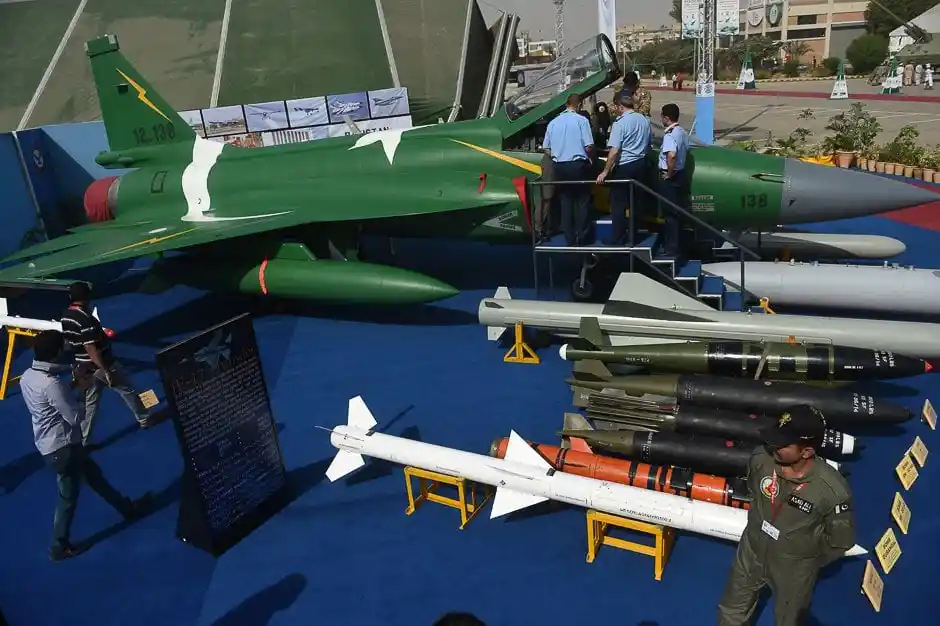
In the current global combat mission, the aircrafts are increasingly playing an important role. Operation Sindoor has established the compelling options of air power, which, once considered escalatory, is now normalized with long-range precision weapons. Pakistan is thus deliberating to invest in its Chinese-made JF-17 aircraft as an item for export. Its prime targets are the Islamic countries, many of which are in mission to modernize their air force to tackle challenges. The countries are currently passing through geopolitical turbulence and civil wars, and thus are vibrant defence market for Pakistan. Pakistan concluded a $4 billion defence deal with Libya in December 2025, including JF-17s and other training aircraft manufactured by Pakistan Aeronautical Complex. It is in the final phases of striking a $1.5-billion deal to supply weapons and jets to Sudan, ravaged by the world’s worst humanitarian crisis for more than two and a half years. With Saudi Arabia its prime financial support, Pakistan is planning to convert about $2 billion of Saudi loans into a JF-17 fighter jet deal. The Gulf Kingdom is upgrading its defence to hedge against uncertainty about U.S. commitments in West Asia.
Indeed, Pakistan’s defence export has made a noteworthy achievement last year, bagging contracts globally worth $10 billion, which is an all-time high. However, analysts look askance at the prospect of such defence sales. Some experts argued that the revenue from production (of the fighter jets) may not be sufficient to rescue the nation from its debt. The country is currently under the latest IMF programme with a $7bn arrangement, and analysts say arms exports alone cannot resolve Pakistan’s structural economic problems. Defence sales, especially of aircraft, require robust and reliable production capacity along with proper training and a guarantee for post-delivery of spare parts. The JF17 fighter jets, central to Pakistan’s ambitious drive to defence exports, hold records of fallibility in this regard. Myanmar grounded its JF17 aircrafts it bought from Pakistan and China in 2015, over technical issues and spare parts availability. Besides, the aircraft encountered a slew of crashes and was grounded several times due to issues like cracks in guide vanes, exhaust nozzles, and flame stabilizers. Moreover, Pakistan’s economic challenges and foreign exchange limitations might create obstacles for long-term commitment of spare-part exports, maintenance infrastructure, and operational support. Also, the sustainability of this defence business is questionable. Details of potential contracts are not disclosed, with most information emerging through unnamed official sources rather than signed agreements. Further, robust defence export capacity requires a strong indigenous defence industry capable of developing complex weapons systems. Pakistan is yet to reach that stage of maturity. The defense production sector of Pakistan never focused on research and development, relying mostly on foreign technology.
Unemployment rate of 7.1 per cent and stalled progress against poverty, compounded further by the COVID-19 crisis and devastating floods in 2022, put the neighbour’s fragile economy under pressure. Besides, the IMF loans it receives are conditioned with streamline of expenditure. Nevertheless, the ‘ageing’ civil-military rulers of Pakistan still live in a bubble, fantasizing about economic revival, boosting arms sales without proper preparation. However, more than reviving the economy, the ‘project JF17’ seems to carry a strategic connotation. For a decade, China tried, in vain, to promote the sale of the aircraft as a low-cost, multi-role fighter to countries of the Global South. Now, its ‘all-weather friend’ Pakistan seems to be taking the baton, which is suspected as China’s ‘backdoor’ strategy to promote its sale to ‘neutral’ countries. In this context, Field Marshal Asim Munir’s insistence on a propaganda base around JF-17 fighters is understandable. Pakistan military’s malleability towards any Chinese ‘wishes’ is obvious. Also, this defence sale mission helps the military to feign salvaging Pakistan’s ailing economy, which, anyway, it does not give a hoot. This more seems to pull the wool over the eyes of the disgruntled public rather thana result of any serious deliberation to revive the country’s economy.