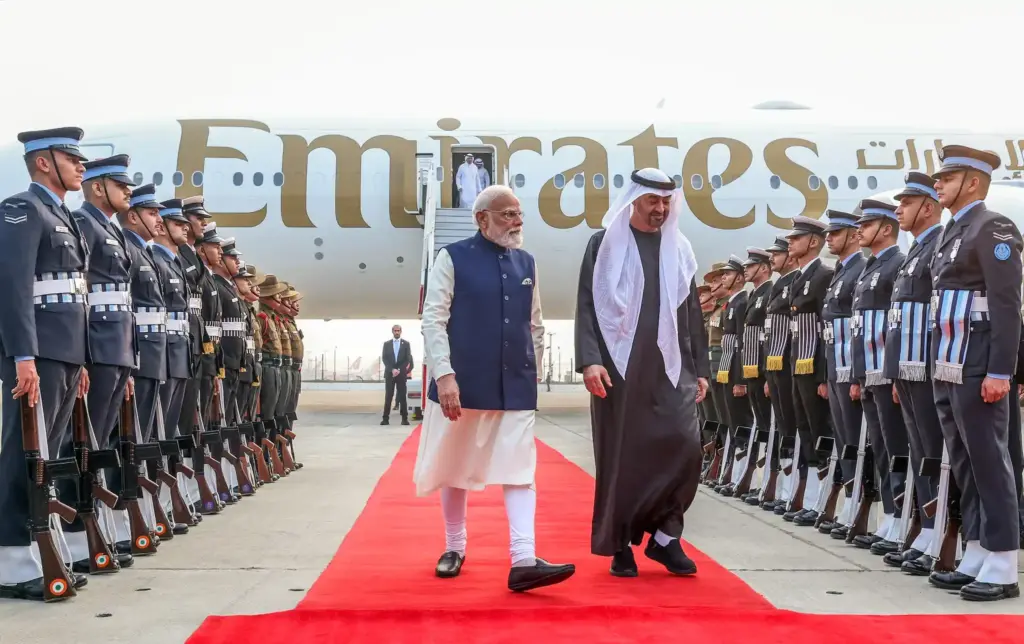
In a display of exceptional diplomatic warmth and strategic alignment, United Arab Emirates President Sheikh Mohamed bin Zayed Al Nahyan made a whirlwind three-hour visit to New Delhi on January 19, 2026. The visit, though short in duration, was rich in symbolism and substance, underscoring the deepening Comprehensive Strategic Partnership between India and the UAE. Prime Minister Narendra Modi broke from traditional protocol by personally welcoming the UAE leader at the airport, sharing a heartfelt hug, and traveling together in the same car to their meeting venue. This rare gesture not only highlighted the personal rapport between the two leaders but also reflected the elevated status of India-UAE ties in an era of global uncertainties.
The UAE President’s arrival at Delhi’s Palam Air Force Station around 4:20 PM was met with PM Modi’s enthusiastic reception. The two leaders, often referring to each other as “brothers,” exchanged pleasantries amid a backdrop of heightened regional tensions in West Asia, including ongoing conflicts in Gaza and Yemen. From the airport, they proceeded in a single vehicle—a move dubbed “car diplomacy”—to Lok Kalyan Marg, PM Modi’s residence, where they held substantive discussions. By 6:05 PM, Sheikh Mohamed departed, but not before the two nations sealed a series of agreements that promise to propel bilateral cooperation to new heights.
This visit marked Sheikh Mohamed’s fifth trip to India in the last decade and his third as UAE President, illustrating the consistent high-level engagement that has transformed the relationship from traditional trade partners to strategic allies. PM Modi’s special gesture was particularly noteworthy; it went beyond standard diplomatic norms, signaling mutual trust and the personal investment both leaders have in fostering ties. As PM Modi later posted on social media, “I am deeply touched by his gesture of visiting Delhi this evening. We discussed a wide range of issues aimed at further strengthening the multifaceted India-UAE friendship.” Sheikh Mohamed echoed this sentiment, expressing pleasure in meeting PM Modi and committing to sustainable economic growth between the nations.
The brevity of the visit—clocking in at just three hours—belied its significance, especially amid global geopolitical strains. Analysts noted that the timing was deliberate, allowing for focused dialogues without the pomp of extended state visits. It came on the heels of recent high-level exchanges, including visits by UAE’s Crown Prince of Abu Dhabi, Sheikh Khaled bin Mohamed bin Zayed Al Nahyan, and Crown Prince of Dubai, Sheikh Hamdan bin Mohammed bin Rashid Al Maktoum, to India in the past two years. These interactions emphasize generational continuity in the bilateral relationship, ensuring long-term stability and collaboration.
At the heart of the discussions was a review of the Comprehensive Strategic Partnership, which has flourished since its elevation in 2015. The leaders endorsed outcomes from recent forums, such as the 13th High-Level Task Force on Investments in September 2025 and the 16th India-UAE Joint Commission Meeting in December 2025. Economic ties took center stage, with bilateral trade surging to US$100 billion in FY 2024-25 following the 2022 Comprehensive Economic Partnership Agreement (CEPA). Buoyed by this momentum, the duo set an ambitious target to double trade to US$200 billion by 2032, driven by enthusiasm from business communities on both sides.
Key announcements included directives to connect Micro, Small, and Medium Enterprises (MSMEs) through initiatives like ‘Bharat Mart’, the ‘Virtual Trade Corridor’, and ‘Bharat-Africa Setu’. These platforms aim to promote MSME products across the Middle East, West Asia, Africa, and Eurasia, fostering inclusive growth. The 2024 Bilateral Investment Treaty was hailed for bolstering cross-sector investments, with discussions advancing on a UAE partnership for Gujarat’s Dholera Special Investment Region. This collaboration envisions infrastructure like an international airport, pilot training school, maintenance repair and overhaul facility, greenfield port, smart township, railway links, and energy projects.
Investment flows received a boost with PM Modi inviting UAE sovereign wealth funds to join the second National Investment and Infrastructure Fund (NIIF), set for launch in 2026, following the success of the first. The establishment of DP World and First Abu Dhabi Bank branches in GIFT City was welcomed, positioning it as a global financial hub linking Indian entities to GCC and MENA markets.
Food security emerged as a strategic priority, with commitments to public-private partnerships, innovation, and knowledge exchange for sustainable agriculture. In the space domain, a joint initiative was announced to commercialize space sciences and technologies, creating an integrated ecosystem with end-to-end infrastructure, industrial bases, joint missions, and startup opportunities.
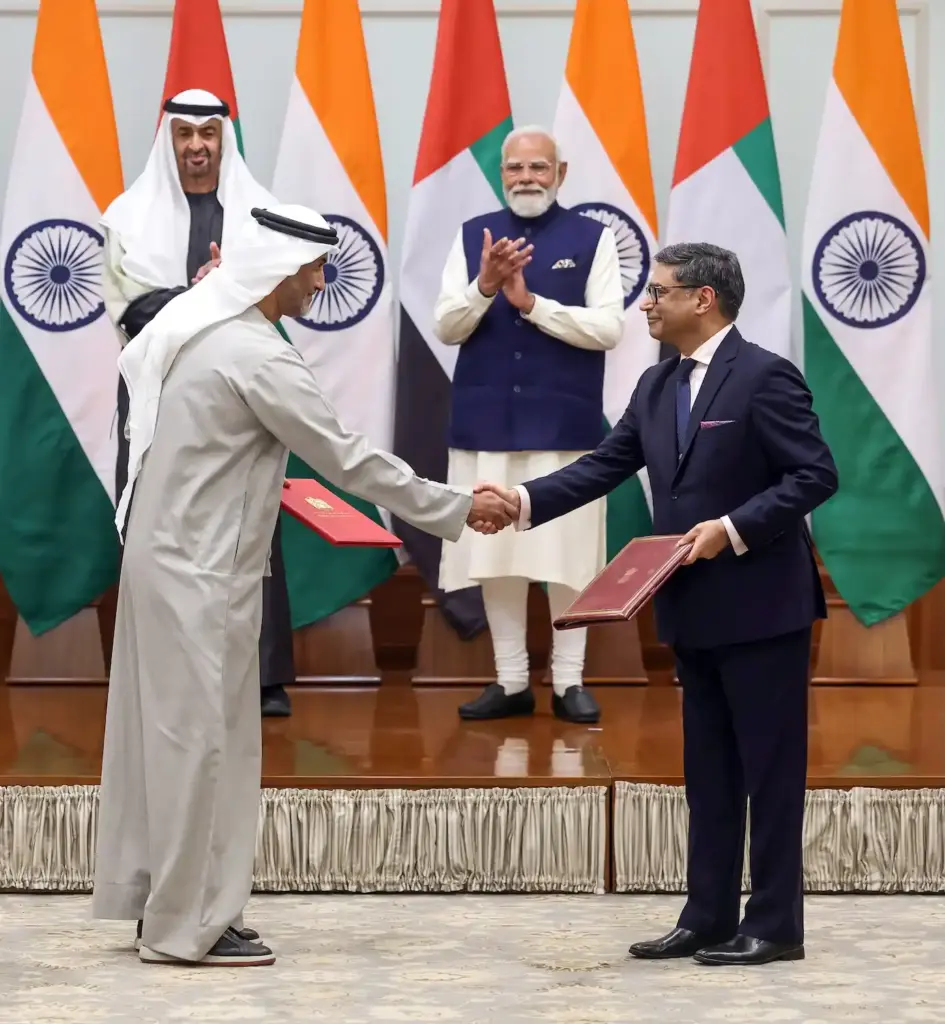
Science, technology, and innovation cooperation deepened, focusing on artificial intelligence and emerging tech. Plans include establishing a supercomputing cluster and data centers in India, exploring ‘Digital Embassies’ under sovereignty arrangements, and UAE support for India’s AI Impact Summit in February 2026.
Energy partnerships were reinforced, with the UAE’s role in India’s energy security lauded. A landmark 10-year LNG Supply Agreement was signed between Hindustan Petroleum Corporation Limited (HPCL) and ADNOC Gas for 0.5 million tonnes annually starting 2028. The enactment of India’s Sustainable Harnessing and Advancement of Nuclear Energy for Transforming India (SHANTI) law opens doors for civil nuclear cooperation, including large reactors and Small Modular Reactors (SMRs).
Financial integration advanced with efforts to link national payment platforms for seamless cross-border transactions. Culturally, the UAE will provide artefacts for the National Maritime Heritage Complex at Lothal, while a ‘House of India’ will be established in Abu Dhabi. Youth exchanges and people-to-people ties were prioritized to nurture enduring bonds.
Education was deemed a cornerstone, building on IIT Delhi and IIM Ahmedabad’s UAE campuses. Enhanced university linkages, student exchanges, and integration of India’s Digilocker with UAE platforms will facilitate degree authentication and opportunities.
Defence and security cooperation solidified with a Letter of Intent for a Strategic Defence Partnership, amid recent military exchanges and exercises. Both leaders condemned terrorism unequivocally and pledged FATF collaboration against financing.
Global issues featured prominently, with reaffirmation of the India-Middle East-Europe Economic Corridor (IMEC), support for India’s 2026 BRICS Chairmanship, and UAE’s 2026 UN Water Conference. Polar science collaboration was highlighted for climate action.
The concise visit exemplified how India and the UAE are scripting a future of shared prosperity. PM Modi’s gesture and the slew of announcements not only cement economic synergies but also pave the way for innovation-driven growth, cultural harmony, and strategic resilience in a multipolar world. As bilateral trade eyes the $200 billion mark and collaborations span from AI to nuclear energy, the India-UAE partnership stands as a model for 21st-century diplomacy.