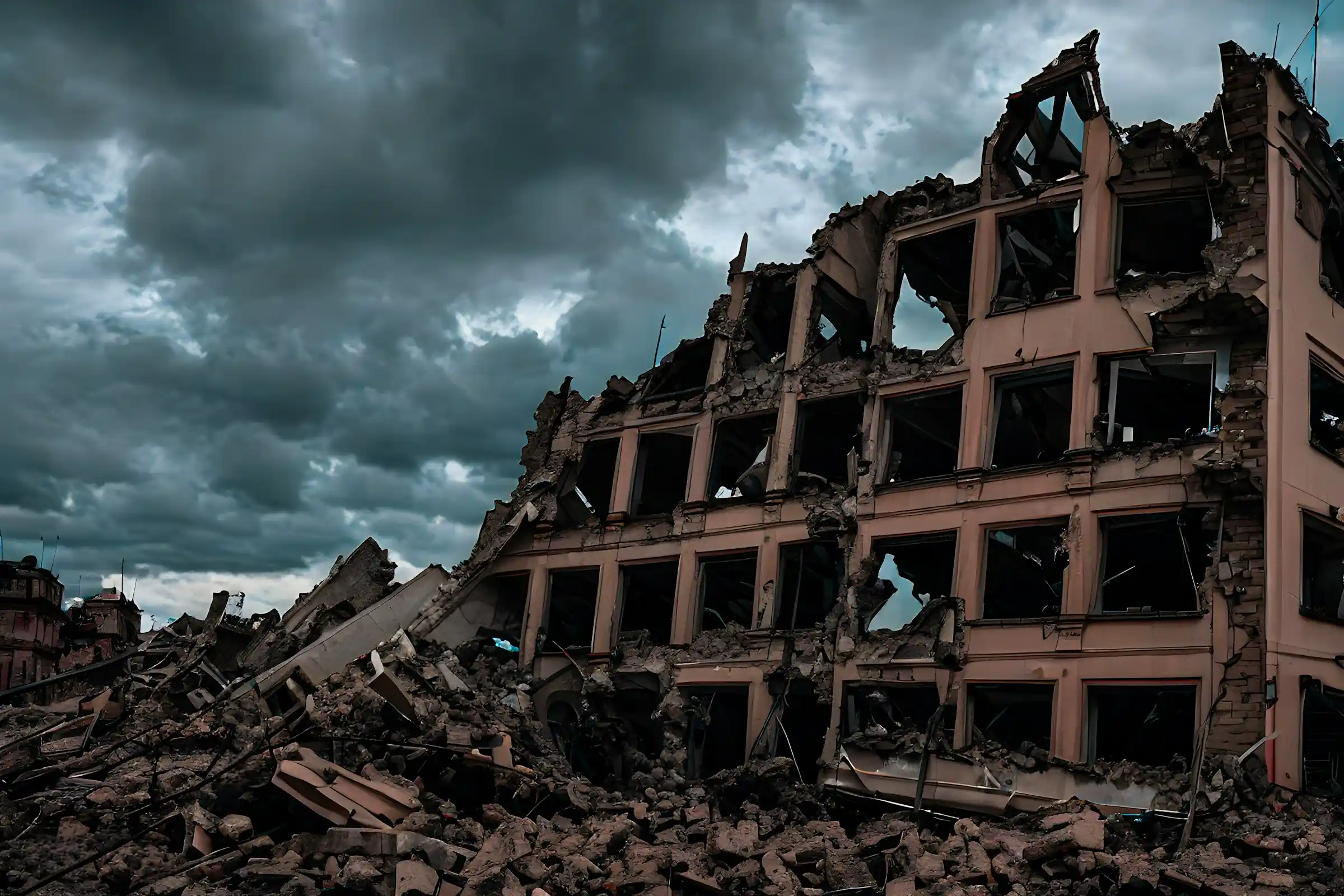
When the war in Ukraine began in February 2022, I reacted as many did, with shock at what appeared to be a clear and unambiguous act of Russian aggression. The images of armoured columns crossing borders, cities under bombardment, and civilians fleeing westward seemed to confirm a familiar narrative of revanchism and authoritarian impulse unchecked. At the time, that narrative felt sufficient. It aligned with international law, with moral intuition, and with the immediate facts on the ground.
As the war settled into duration rather than event, however, and as its political and strategic contours became clearer, that initial clarity began to erode. Not because Russia’s actions became defensible, but because the framework used to explain them proved incomplete. To insist on a single-cause story was to avoid harder questions about how Europe arrived at a point where such a war was possible, and why so many warning signals, articulated openly over years, had been absorbed rhetorically but never confronted strategically.
The war in Ukraine did not so much return history to Europe as expose the degree to which history had never actually left. What collapsed in 2022 was not a stable post–Cold War order, but a set of assumptions that had been mistaken for permanence because they coincided with a moment of Western dominance. The invasion shattered the illusion that the Cold War’s end had produced a settled European security architecture, rather than an unfinished arrangement held together by asymmetry, habit, and the absence of sustained resistance.
Europe will not emerge from this war unchanged, because the conflict has revealed structural failures that extend far beyond Russian aggression or Ukrainian vulnerability. It has forced into the open a reckoning with the intellectual shortcuts, strategic evasions, and institutional complacency that shaped Western policy toward Russia for more than three decades. The war must end, not because Ukraine’s claims are illegitimate or because Russia’s actions can be excused, but because conflicts sustained without a credible political endgame eventually erode the very principles invoked to justify them.
To understand how Europe arrived here, it is insufficient to begin the story in 2022. The deeper origins lie in the unresolved nature of the Cold War’s conclusion and in the West’s failure to distinguish between victory and settlement. What followed the collapse of the Soviet Union was not a renegotiated security order, but the outward expansion of an existing one, carried by the belief that legitimacy flowed naturally from success and that others would converge toward it over time.
This belief was reinforced by what came to be known as the “end of history,” an idea that migrated from academic hypothesis into policy instinct. Liberal democracy and market capitalism had prevailed over their principal ideological rival, and this outcome was interpreted not as contingent but as final. Power politics, it was assumed, had been tamed by institutions, law, and economic integration. Military alliances could expand without provoking counter-reactions. Norms would enforce themselves. Time would do the rest.
What this framework obscured was that history never ends for those who feel they lost it under duress.
For Russia, the post–Cold War settlement was not experienced as a shared reconstruction, but as an order consolidated during weakness and normalised as inevitability. This perception was articulated with notable consistency by Vladimir Putin long before tanks crossed into Ukraine, in interviews that now read less like retrospective justification than early warnings that were heard but not absorbed.
In a 2005 interview with 60 Minutes, conducted when Russia was economically fragile and strategically uncertain, Putin described the dismantling of the Warsaw Pact and the withdrawal from Eastern Europe as acts undertaken in expectation of inclusion within a shared European security framework. NATO’s continued expansion, he suggested, made little sense in a world where ideological confrontation had supposedly ended. The tone was not overtly hostile. It was the language of grievance and status anxiety, rooted in a belief that Russia had accepted the end of empire only to discover that the new order had no place for it beyond compliance.
This distinction between inclusion and consultation would prove decisive. Russia was offered councils, dialogues, and partnership mechanisms, but not a meaningful role in shaping the security architecture that was steadily approaching its borders. Western policymakers treated these arrangements as sufficient reassurance. Moscow increasingly viewed them as procedural theatre masking an outcome already decided.
By the time Putin returned to 60 Minutes in 2015, following the annexation of Crimea and the outbreak of war in eastern Ukraine, the earlier language of disappointment had hardened into accusation. NATO expansion was no longer puzzling but deceitful. Democracy promotion was recast as regime manipulation. Ukraine’s political upheaval in 2014 was framed not as a domestic revolt against corruption and stagnation, but as an externally sponsored coup whose consequences Russia was entitled to reverse.
The continuity between these interviews is more revealing than the contrast. Putin’s narrative does not fundamentally change; it escalates. What begins as a claim for recognition evolves into a demand for deference, and eventually into a justification for force. The sense of exclusion becomes an entitlement to revise outcomes deemed unjust. At no point is war presented as desirable, but it increasingly appears, in this telling, as unavoidable.
None of this renders Russia’s invasion inevitable, nor does it absolve Moscow of responsibility for choosing war. States experience humiliation without resorting to conquest all the time. Agency matters. But Western policy failed to take seriously the persistence of this grievance narrative, preferring instead to dismiss it as rhetorical posturing rather than as a durable feature of Russia’s strategic psychology.
This failure was compounded by triumphalism disguised as pragmatism. NATO enlargement proceeded legally and, from the perspective of Central and Eastern European states, understandably. What was largely ignored was how enlargement appeared from Moscow: not as a neutral process, but as the institutionalisation of geopolitical loss. Western officials dismissed these perceptions as outdated or cynical, failing to grasp that security perceptions do not need to be accurate to be politically decisive.
Rather than confront this tension, the West substituted process for strategy. Summits, accession criteria, confidence-building measures, and dialogue forums proliferated, but they managed disagreement rather than resolving it. Russia was consulted but not empowered, heard but not accommodated. Over time, these mechanisms reinforced the perception that the system was expanding without being renegotiated.
Economics was assigned an outsized role in sustaining this equilibrium. Trade, investment, and energy interdependence were expected to pacify geopolitics. Europe, in particular, treated dependence as stability, assuming mutual vulnerability would produce mutual restraint. This belief underestimated the degree to which identity, memory, and status can override material rationality when political trust collapses. When confrontation arrived, economic ties became leverage and liability rather than ballast.
At the same time, Western policy became increasingly moralised without becoming more effective. Values language flourished while enforcement remained inconsistent. Russia was criticised, sanctioned episodically, then re-engaged when expedient. This pattern taught Moscow that Western outrage was loud but temporary, and that violations would be managed rather than decisively punished.
The most dangerous expression of this faulty thinking emerged in the treatment of states caught in between, particularly Ukraine. Western leaders encouraged Kyiv’s Euro-Atlantic aspirations rhetorically while withholding hard security guarantees. The declaration that Ukraine “would become a member” of NATO, without timeline or mechanism, signalled intent without commitment. From Moscow’s perspective, this maximised the threat while minimising Western responsibility. From Kyiv’s perspective, it created expectations without protection.
The belief that time itself was on the West’s side completed the illusion. Demographics, globalisation, and generational change were assumed to be allies of convergence. Delay became strategy. In reality, time allowed grievances to ossify and narratives of betrayal to become politically indispensable.
The events of 2014 marked the rupture. Ukraine’s Maidan uprising was genuine and mass-based, but it unfolded in a constitutional grey zone that proved geopolitically explosive. Russia’s seizure of Crimea crossed a clear legal line, yet Europe’s response froze rather than resolved the conflict. Ukraine was left in a strategic limbo: too Western to be neutral, too exposed to be secure.
When full-scale war erupted in 2022, Europe responded with resolve and sacrifice. Energy dependence was unwound at great cost. Military aid surged. A moral consensus formed. What did not emerge was a political strategy capable of ending the war on terms that aligned means with ends. Instead, Europe slipped into a strategy of endurance, heavily dependent on American power and on the assumption that Russia would eventually break.
That assumption now looks increasingly uncertain. Russia is under strain but not in collapse. Domestic control remains intact. The economy is damaged but adaptive. Expectations of imminent failure resemble hope more than strategy.
Europe, therefore, faces a narrowing set of choices. A frozen conflict without credible security guarantees invites future war. A settlement that rewards conquest undermines international law. A prolonged war without a plausible path to victory risks exhausting Ukraine and destabilising Europe itself. There are no clean exits left, only trade-offs that demand judgment rather than reassurance.
The European Union will survive, but it will not return to its former self-image as a post-geopolitical project insulated from power. Energy innocence is gone. The belief that norms enforce themselves has collapsed. What emerges instead will be a more anxious, more conditional, and more security-conscious Europe, one forced at last to confront the costs of strategic evasion.
For audiences beyond Europe, particularly in the Global South, this war confirms a lesson long understood: international order is sustained not by declarations alone, but by the uneasy alignment of power, legitimacy, and restraint. Ukraine’s tragedy is not only that it became the site of brutal violence, but that it exposed how thin the foundations of the post–Cold War settlement had become.
The “end of history” turns out to have been a coda, not a conclusion, a pause mistaken for resolution because it coincided with Western dominance. History did not return. It resumed.
What comes next will depend less on moral certainty than on whether Europe and its partners can finally accept that stability requires not only values, but strategy, not only norms, but responsibility, and not only unity, but the willingness to redesign an order that expanded without consolidating.
The war in Ukraine must end, not because history demands closure, but because history has already rendered its verdict on the cost of mistaking postponement for settlement.