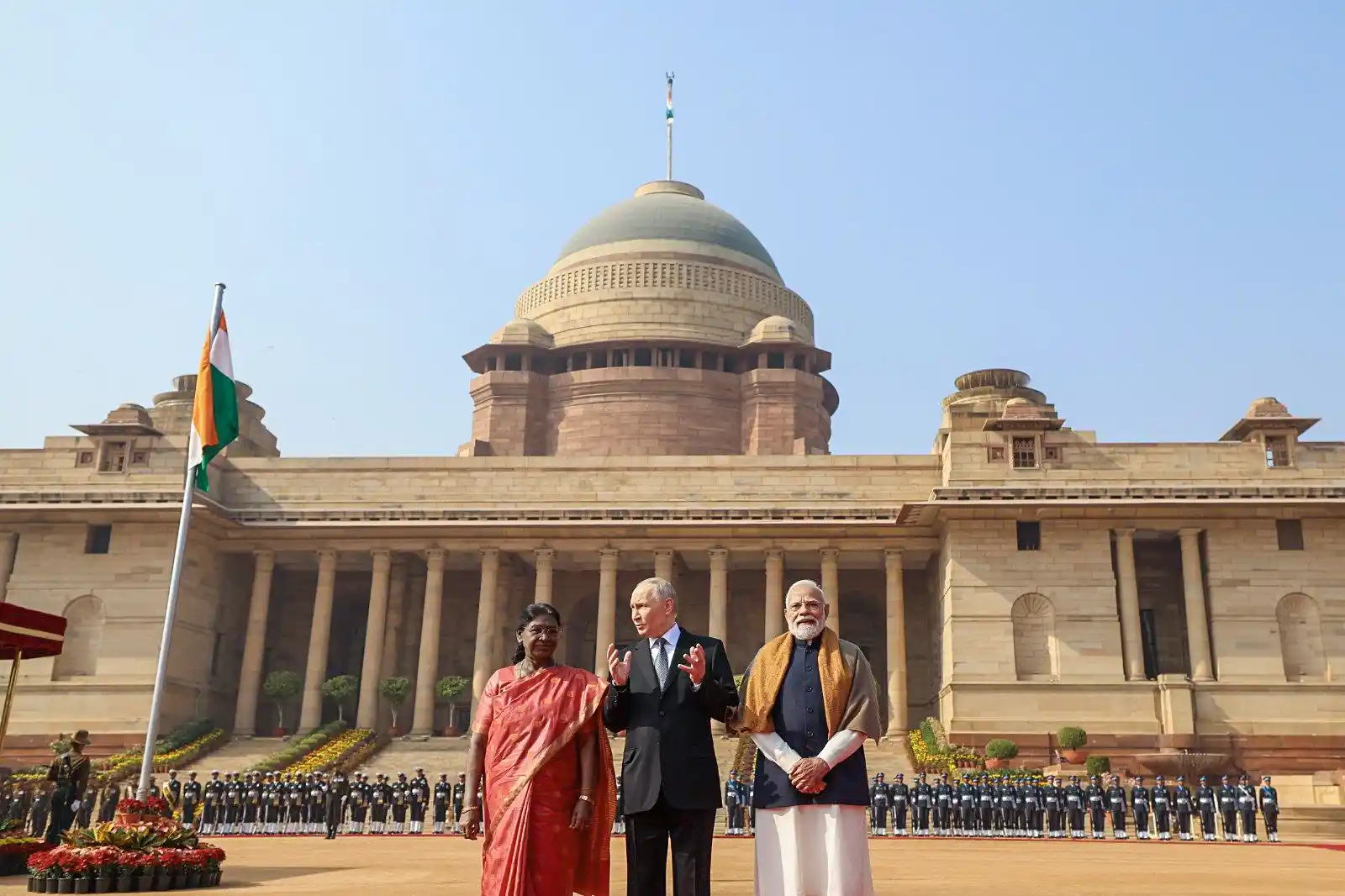
Russian President Vladimir Putin’s visit to New Delhi underscored that, in a fractured global order, the India–Russia axis is not relic but instrument: for New Delhi, a hedge on energy and defence; for Moscow, proof that it cannot be quarantined by Western sanctions. Beyond the optics of banquets and bonhomie, the visit produced a concrete economic roadmap to 2030, a reaffirmation of defence interdependence, and a calibrated message on Ukraine that preserves India’s strategic ambiguity.
Trade and energy: hard interests first
Bilateral trade has surged from roughly 8 billion dollars in 2020 to nearly 69 billion by early 2025, overwhelmingly on the back of discounted Russian crude. During the summit, both sides locked in a new target of 100 billion dollars in trade by 2030 and agreed on an “Economic Cooperation Programme till 2030” to diversify beyond hydrocarbons into manufacturing, agro-products, services and high technology.
Energy remained Moscow’s strongest card. Putin pledged “uninterrupted” oil supplies to India, signalling that Russia will keep undercutting Middle Eastern grades and absorbing Western price-cap pressure in exchange for long‑term market share. The joint messaging framed this not as opportunistic arbitrage but as a pillar of India’s energy security and Russia’s reorientation to Asia, with discussions also flagged on expanding civil nuclear cooperation and transport corridors tied to energy logistics.
Defence: from buyer–seller to co‑producer
New Delhi is still structurally dependent on Russian platforms, with roughly two‑thirds of its legacy arsenal of Soviet or Russian origin, and the MEA briefing made clear that defence ties are not up for rupture. What is changing, and was emphasised in the joint statement, is the vocabulary: both leaders stressed a shift towards joint research, development and manufacturing, in line with India’s self‑reliance agenda.
Conversations covered continued cooperation on systems such as BrahMos and prospective collaboration on hypersonic technologies, UAVs, aircraft engines and maintenance hubs to ensure spares and servicing stay insulated from geopolitical bottlenecks. This is less about new big‑ticket imports and more about de‑risking a critical relationship at a time when Western partners quietly urge India to loosen its Russian embrace without offering equivalent transition pathways.
Connectivity, corridors and the Eurasian pivot
If energy and defence are the ballast, connectivity is the aspirational layer. The joint statement and public briefings highlighted acceleration of the International North–South Transport Corridor and the Chennai–Vladivostok maritime route, both pitched as ways to cut logistics costs and give Indian exporters reliable access to Russian and Eurasian markets. New Delhi also pushed again for progress on a free trade agreement with the Eurasian Economic Union, which would lock India more tightly into continental value chains that bypass chokepoints dominated by Western‑aligned navies.
For Moscow, deepening these routes is part of a long‑term bet that its future lies in Asia–Eurasia, not Europe; for India, they are leverage—both against Chinese dominance of overland connectivity and against Western pressure by showing that Delhi has other options. The subtext is that “decoupling” from Russia is not on the table; “re‑wiring” the relationship is.
People, visas and soft power
Unusually for an India–Russia summit, people‑to‑people measures grabbed attention. PM Modi announced a free 30‑day e‑tourist visa and a 30‑day group tourist visa for Russian travellers, a clear attempt to turn the post‑Ukraine influx of Russian visitors into a stable tourism pipeline. Moscow’s decision to join India’s International Big Cat Alliance and the launch of a “Fabric of Time” cultural exhibition were crafted as soft‑power bookends to a summit otherwise dominated by oil cargoes and missile ranges.
Officials also flagged cooperation on medical education standards, a nod to the thousands of Indian students in Russia and the political fallout from crises involving foreign campuses in recent years. The message to domestic audiences is that this is not just a transactional energy‑for‑arms barter; to Russians, it is that India is a welcoming Asian partner at a time when Europe is closed.
Terrorism, Ukraine and the geopolitics of optics
Both PM Modi and Putin leaned heavily into counterterrorism rhetoric, with both leaders stressing that India and Russia “walk together” in the fight against terrorism. Moscow’s earlier solidarity after the Pahalgam attack in Jammu and Kashmir—by a Pakistan‑based group—was held up as proof that, unlike some Western partners, Russia does not equivocate when Indian security is hit.
Ukraine was the unscripted centre of gravity. Putin told the joint press interaction that Russia is working toward a “peaceful settlement” and had shared the contours of its proposal with India, effectively inviting Delhi to remain a diplomatic bridge even as it buys Russian oil and courts Western investment. India, for its part, repeated its familiar line on dialogue and diplomacy without endorsing Russian terms, using the presence of a sanctioned leader in Delhi to reassert its right to engage all sides on its own terms.
What the visit really signals
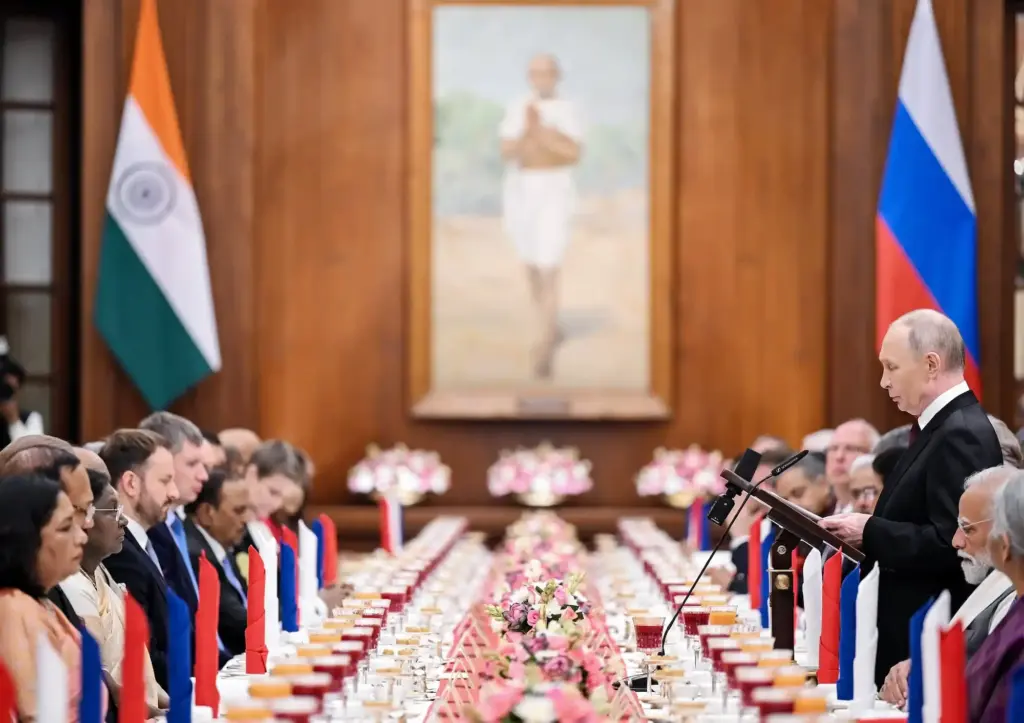
At one level, the visit delivered the predictable: a joint statement reaffirming the “Special and Privileged Strategic Partnership”, a raft of MoUs across maritime cooperation, labour mobility, health, education and media, and a photo‑op heavy programme including a state banquet with President Droupadi Murmu. At another level, it functioned as geopolitical theatre—New Delhi signalling to Washington and Brussels that its Russia policy is not written in the State Department, and Moscow showcasing an Asian democracy willing to host its embattled president with full honours.
For India, the calculus is brutally pragmatic. Discounted Russian crude keeps inflation manageable; Russian spare parts keep legacy platforms in the air; and a diversified connectivity map keeps it from being boxed into any single Western or Chinese‑led architecture. For Russia, India offers markets, diplomatic cover in multilateral forums, and proof that talk of “isolation” is aspirational rather than descriptive.