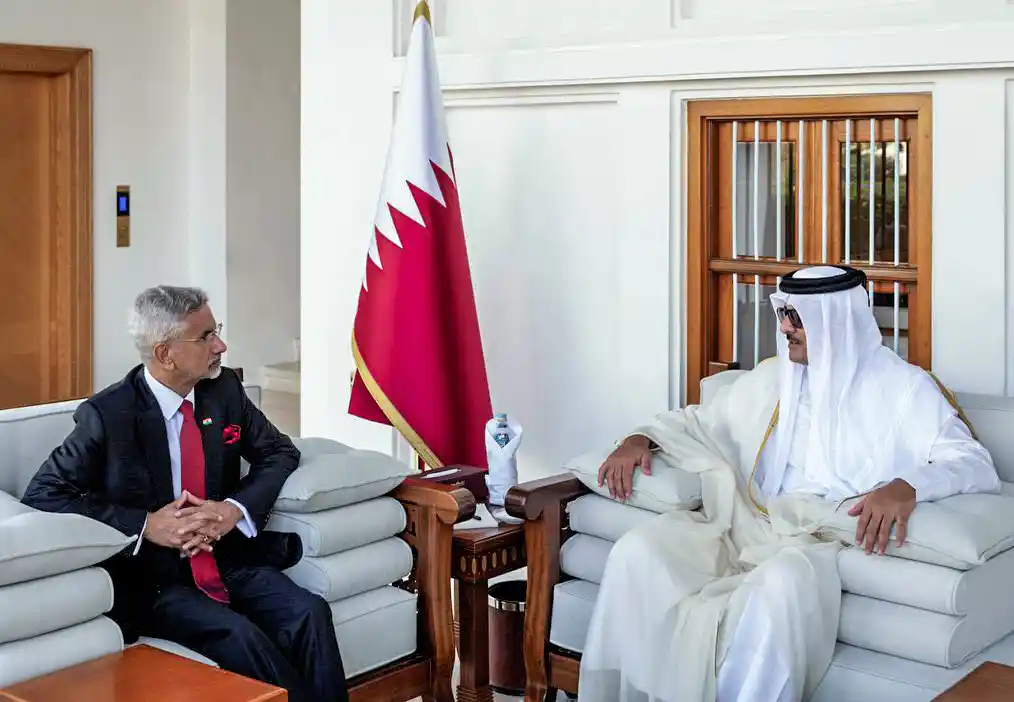
Indian External Affairs Minister Dr. S. Jaishankar’s recent visit to Qatar in November 2025 represents a significant milestone in the deepening of bilateral relations between the two nations, building on the Strategic Partnership elevated earlier in the year with the visit of the Qatari Amir to India in February 2025. The visit comes at a time when energy security, economic diversification, and geopolitical stability in West Asia have emerged as priorities for both countries. Dr. Jaishankar’s engagements with Qatar’s top leadership, including Amir Tamim bin Hamad Al Thani and Prime Minister Sheikh Mohammed bin Abdulrahman Al Thani, reflected a strategic desire to expand and diversify cooperation far beyond traditional domains, signaling a new phase in India-Qatar relations.
The India-Qatar Strategic Partnership formally elevated its bilateral ties in early 2025, recognizing the historical connections and the rapidly growing economic engagement. Both countries resolved to intensify cooperation across a broad spectrum that includes trade, energy, investments, security, culture, technology, innovation, and people-to-people ties. This partnership is underpinned by India’s growing dependence on Qatar for liquefied natural gas (LNG), with Qatar supplying over 40% of India’s LNG imports, a critical factor in India’s energy security strategy amid global energy market volatility. At the same time, Qatar has increasingly positioned itself as a regional hub for trade, logistics, and financial services, offering India an indispensable gateway to West Asia and Africa.
During Dr. Jaishankar’s visit, the discussions reaffirmed these pillars, emphasizing stable and diversified trade growth, enhanced investment flows, and working toward a Comprehensive Economic Partnership Agreement (CEPA) to facilitate smoother trade and heightened economic integration. The bilateral trade, which was valued at approximately $14 billion in 2023-24, is targeted to be doubled by 2030, reflecting ambitious economic synergy.
Expanding Economic and Energy Ties
One of the key highlights of Dr. Jaishankar’s trip was the further concretization of economic cooperation, particularly in trade and investment. Both sides reviewed progress in ongoing negotiations and agreed to expedite efforts for the CEPA. The agreement aims to address tariff and non-tariff barriers to trade in goods and services, encourage joint ventures, and attract greater foreign direct investment (FDI). Qatar’s investment environment received special mention, with Investments Qatar and Invest India signing memorandums to boost collaboration and facilitate increased capital flows.
Energy cooperation, already robust, was another focal point. As the world transitions toward sustainable energy, discussions also explored partnerships in renewable energy technologies, hydrogen development, and sustainability initiatives. India’s large energy demand and Qatar’s status as a global energy supplier make this cooperation mutually essential. Importantly, Qatar’s strategic location and infrastructure serve as a launchpad for Indian companies wanting to extend their reach in the Middle East and Africa.
Further, technology and innovation featured prominently, with mutual interest in emerging sectors such as digital governance, startups, artificial intelligence, and fintech. Indian startups have been encouraged to participate in innovation forums in Qatar, showcasing a growing people-to-people and knowledge exchange dimension to the partnership.
Geopolitical and Security Dimensions
Beyond economics, the visit saw a reaffirmation of the commitment to collaborate on regional and global strategic issues. Both India and Qatar share interest in stability in West Asia, a region beset by conflicts and geopolitical complexities. Dialogue encompassed counter-terrorism cooperation, intelligence sharing, and combating transnational crimes including cyber threats, money laundering, and drug trafficking.
Such security collaboration complements the political dialogue aimed at fostering peace and cooperation in the Gulf and wider West Asian region. Noteworthy was the shared commitment to combat terrorism in all its forms and manifestations, reflecting India’s proactive stance on global security challenges and Qatar’s growing diplomatic influence in regional peace processes.
Cultural and People-to-People Engagement
Recognizing that strong bilateral relations need a foundation beyond transactional economic and political ties, the discussions highlighted the importance of cultural exchanges and closer people-to-people connections. The large Indian diaspora in Qatar, numbering over 750,000, acts as a bridge deepening mutual understanding, business linkages, and cultural affinity.
The leaders agreed to expand cooperation in education, skills development, and cultural programs to further support this human dimension of diplomacy. Initiatives to facilitate ease of travel, skill exchange, and cultural collaboration are expected to cultivate longer-term goodwill and partnership.
The Way Forward
Dr. Jaishankar’s visit to Qatar solidifies the trajectory for a comprehensive, future-ready partnership between the two countries. Key priority areas for continued and expanded cooperation include:
- Accelerating the CEPA negotiations and expediting implementation to create a framework for freer trade and investments.
- Enhancing energy cooperation with a dual focus on traditional LNG supplies and pioneering new energy sectors like renewables and green hydrogen.
- Deepening economic ties by fostering joint ventures, startup collaborations, and investment facilitation.
- Strengthening strategic and security cooperation to counter terrorism, enhance intelligence sharing, and address transnational crimes.
- Expanding cultural, educational, and people-to-people initiatives to nurture mutual understanding and diaspora engagement.
- Collaborating on global platforms, including coordinated support at the United Nations and other multilateral forums, to advance shared geopolitical interests.
The strategic partnership reflects India’s broader diplomatic vision in West Asia, aiming to secure energy resources, promote economic diversification, and build stability in a geopolitically sensitive region. For Qatar, the engagement with India, one of the fastest-growing large economies and a major consumer market, offers economic diversification opportunities and enhanced geopolitical links.
In conclusion, Dr. Jaishankar’s visit to Qatar is not merely a diplomatic formality but a substantive step in forging a robust, multidimensional partnership. It underscores the evolving nature of India-Qatar relations from transactional energy and labor ties to a comprehensive strategic partnership shaping the geopolitics, economics, and people-to-people connections of the region for decades to come. This elevated relationship lays a foundation for mutual growth, security, and regional stability that aligns with the long-term strategic interests of both nations.