India stands at a critical juncture in its maritime strategy, facing the dual imperatives of leveraging collective partnerships to counter China’s expanding infrastructure footprint while preserving the strategic autonomy that has defined its foreign policy orientation. The convergence of port modernization and undersea cable security under the Quad framework—a partnership between India, Japan, the United States, and Australia—illuminates how New Delhi navigates the complex geopolitics of the Indo-Pacific, where infrastructure investments have become proxies for great power competition and regional influence.
For India, the Quad’s ports and undersea cable initiatives represent more than infrastructure development—they constitute a strategic recalibration of its Indo-Pacific posture at a time when China’s “String of Pearls” strategy continues to encircle the subcontinent through ports in Gwadar, Hambantota, Kyaukpyu, and Chittagong. The announcement of projects like the green hydrogen facility at Kandla Port, the operationalization of Vizhinjam as India’s first deep-water transshipment hub, and the doubling of capacity at JNPT through record foreign investment signals India’s intent to position itself as a credible alternative to Chinese-financed infrastructure in the region.
Japan’s Indispensable Role and India’s Strategic Fit
Japan emerges as India’s most critical Quad partner in this maritime calculus. Tokyo’s financial heft—evidenced by commitments exceeding $40 billion in India and an additional $68 billion investment target announced at the 15th India-Japan Annual Summit—provides the capital intensity India needs to accelerate port modernization and industrial corridor development. Japan’s development assistance has already proven transformative: the Matarbari deep-sea port in Bangladesh, developed through Indo-Japanese coordination, is designed to connect with India’s northeastern region, creating a Bay of Bengal industrial value chain that challenges Chinese dominance in the subregion.
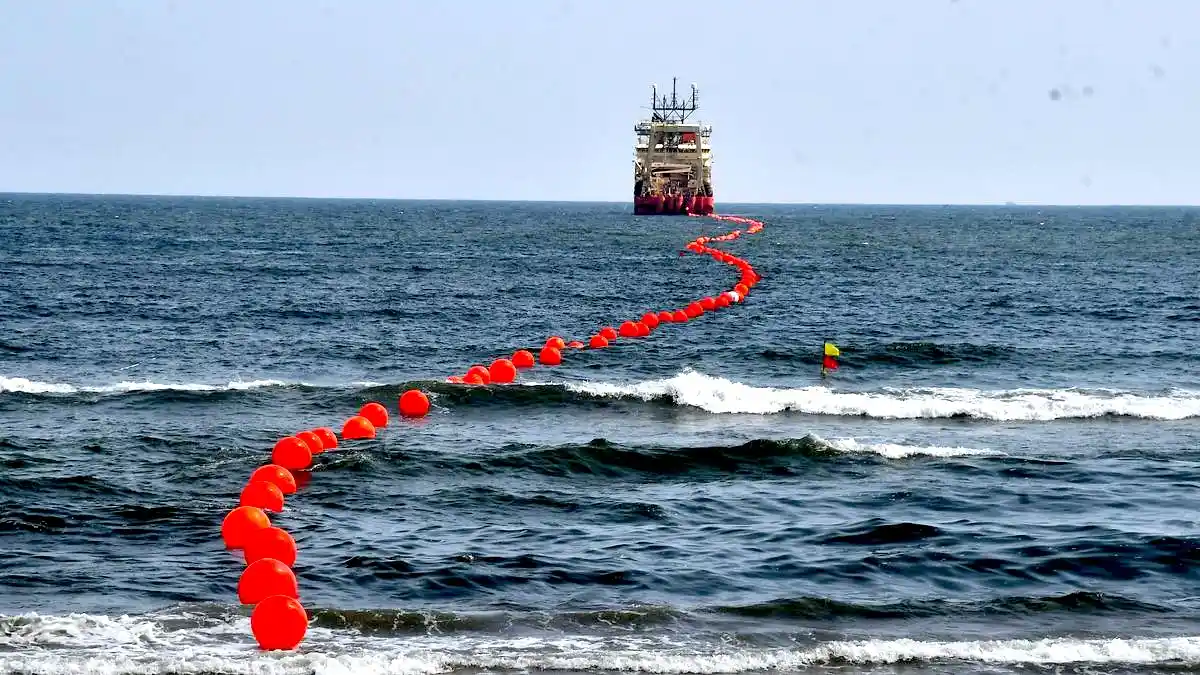
This partnership extends critically into undersea cable infrastructure, where India’s vulnerabilities are stark. Despite accounting for 20 percent of global internet traffic, India hosts only 1-3 percent of global cable capacity, with landing points concentrated in Mumbai and Chennai—a strategic weakness exposed by the 2024 Red Sea cable cuts that temporarily disrupted 25 percent of India’s internet connectivity. The Quad Partnership for Cable Connectivity and Resilience, which has mobilized over $140 million for Pacific cable builds, directly addresses these gaps. India’s commissioned feasibility study to expand undersea cable maintenance and repair capabilities in the Indo-Pacific is a logical extension of this strategic priority, positioning India not merely as a beneficiary but as a regional hub for cable resilience.
Japan’s role in this digital infrastructure push cannot be overstated. Tokyo’s expertise in advanced telecommunications—from 5G Open RAN deployment to the India-Japan Digital Partnership 2.0, which includes AI cooperation initiatives and joint R&D in quantum computing and cybersecurity—provides India with trusted vendor alternatives to Chinese systems that have proliferated across the region. The Wavelength Forum held in New Delhi in July, organized under the U.S. Department of State’s CABLES program, underscored this convergence, with discussions centered on regulatory reforms, streamlined permitting processes, and enhanced maintenance capacity to meet growing demand driven by 5G, AI, and the Internet of Things.
Strategic Autonomy Versus Integration: India’s Balancing Act
Yet India’s engagement with the Quad on ports and cables is carefully calibrated to preserve what New Delhi prizes most: strategic autonomy. Analysis of India’s approach reveals a preference for selective diplomatic engagement rather than full integration with Quad infrastructure frameworks. This nuanced posture allows India to access Japan’s green shipping expertise, U.S. technological capabilities, and Australia’s public-private partnership models without ceding control over project location, planning, or execution—particularly in its immediate neighbourhood where India seeks to maintain primacy as the preferred development partner.
The Bay of Bengal illustrates this tension most acutely. India’s investments in ports across Sri Lanka, Myanmar, and Bangladesh through bilateral channels—including the Colombo West Container Terminal developed with Japan—demonstrate a preference for maintaining strategic control while selectively leveraging Quad resources. The coordination around Matarbari Port, linking Northeast India to Bangladesh’s deep-sea infrastructure, exemplifies how India uses Japanese capital and technical expertise to extend its economic footprint while maintaining operational control.
This calculated approach stems from India’s acute awareness of China’s investments in the Bay of Bengal, which already surpass those of all four Quad countries combined. China’s Kyaukpyu port in Myanmar, with 70 percent Chinese consortium ownership, and the China-Myanmar Economic Corridor allow Beijing to circumvent the Malacca Strait—a chokepoint India has traditionally dominated through its Andaman and Nicobar bases—establishing a direct Chinese presence on the Bay of Bengal coastline. For India, the Quad’s infrastructure initiatives provide essential counterweight to this strategic encirclement, but only if New Delhi retains agency over projects in its immediate periphery.
Geopolitics Beyond Infrastructure: Undersea Cables as Strategic Assets
The undersea cable dimension adds a cybersecurity and intelligence layer to India’s Quad calculus that transcends commercial considerations. China’s PEACE cable, which provides Pakistan with low-latency connectivity to China, Africa, and Europe via landing sites in Gwadar and Djibouti, raises concerns about dual-use applications for military communications and intelligence gathering at maritime chokepoints critical to India’s energy security. Over 80 percent of India’s crude oil and 95 percent of its trade by volume transit through the Indian Ocean, making cable security inseparable from India’s economic resilience.
The Quad’s commitment to supporting all Pacific island countries in achieving primary telecommunication cable connectivity by the end of 2025, with specific projects in Nauru and Kiribati, directly counters China’s expanding digital infrastructure footprint in the region. Australia’s Cable Connectivity and Resilience Centre, launched in July, delivers workshops and regulatory assistance across the Indo-Pacific, while Japan provides technical upgrades for island nations—creating a trusted vendor ecosystem that reduces regional dependence on Chinese-controlled systems.
For India, this represents an opportunity to position itself as a maintenance and repair hub, leveraging its geographic centrality and expanding digital economy. The India-Japan Digital Partnership 2.0, which emphasizes collaboration in cybersecurity, trusted telecommunications networks, and digital governance, provides the technical foundation for India to assume this role while safeguarding data sovereignty—a priority reinforced by India’s Personal Data Protection Act 2024.
The Road Ahead: Balancing Collective Security with National Interests
India’s perspective on Quad ports and undersea cables is ultimately shaped by a fundamental tension: the need to counterbalance China’s assertiveness without sacrificing the strategic autonomy that has defined Indian foreign policy since independence. The Quad’s infrastructure initiatives offer India access to capital, technology, and institutional support on a scale it cannot mobilize bilaterally, particularly in competing with China’s Belt and Road Initiative, which has already established a formidable presence across the Indian Ocean Region.
Yet India remains acutely conscious that the Quad’s visibility as an explicitly anti-China coalition risks provoking Beijing and complicating India’s complex economic relationship with its largest trading partner. New Delhi’s strategy, therefore, emphasizes issue-based alignment within the Quad—strongly engaging in technology cooperation, infrastructure coordination, and maritime domain awareness while maintaining a more nuanced stance on explicit military entanglement.
The recent disengagement at the Line of Actual Control affords India diplomatic space to focus on maritime cooperation without the distraction of border tensions, allowing New Delhi to concentrate on developing interoperability in the maritime domain and positioning itself as a net security provider in the Indian Ocean. The Quad’s emphasis on non-traditional security issues—infrastructure, digital connectivity, capacity building—aligns precisely with this pragmatic approach, enabling India to safeguard strategic interests without provoking overt military conflict with China.
As India navigates the next decade of Quad cooperation, the ports and undersea cable initiatives will serve as litmus tests of whether New Delhi can successfully balance collective security frameworks with its fiercely guarded strategic autonomy. The mobilization of $12 billion in investment commitments and the establishment of India as the demonstrator site for port modernization pilots suggest that, for now, India has found a workable equilibrium—leveraging Japan’s financial and technical strengths, accessing U.S. and Australian expertise, and maintaining operational control over projects critical to its national interests.
The true measure of success, however, will be whether this partnership can scale beyond flagship projects to create systemic resilience across the Indo-Pacific’s maritime infrastructure—transforming ports from isolated nodes into integrated, secure, and sustainable logistics hubs that reshape regional prosperity and maritime security for decades to come. For India, the stakes could not be higher: the future of its Indo-Pacific strategy, its economic growth trajectory, and its ambitions as a leading power in Asia all hinge on navigating this delicate balance between cooperation and autonomy in the contested waters of the twenty-first century