India’s biosphere reserves represent one of the nation’s most innovative and urgent conservation experiments—a living testament to how biodiversity, cultural richness, and sustainable development can coexist. These landscapes are more than preserved wilderness; they are dynamic zones where ecological stewardship is interwoven with local livelihoods, scientific research, and policy learning. A closer look at their operations reveals both remarkable achievements and persistent challenges, underscoring India’s continuing journey to balance nature and people.
As of 2025, India counts 18 biosphere reserves, together spanning 91,425 square kilometers, and covering every major ecological region from the Great Rann of Kutch’s deserts to the lush forests of the Nilgiri hills. Thirteen of these reserves are recognized as part of UNESCO’s World Network of Biosphere Reserves, highlighting their global significance. Notable among new additions is Himachal Pradesh’s Cold Desert Biosphere Reserve, whose UNESCO designation signals India’s rising profile in planetary conservation efforts.
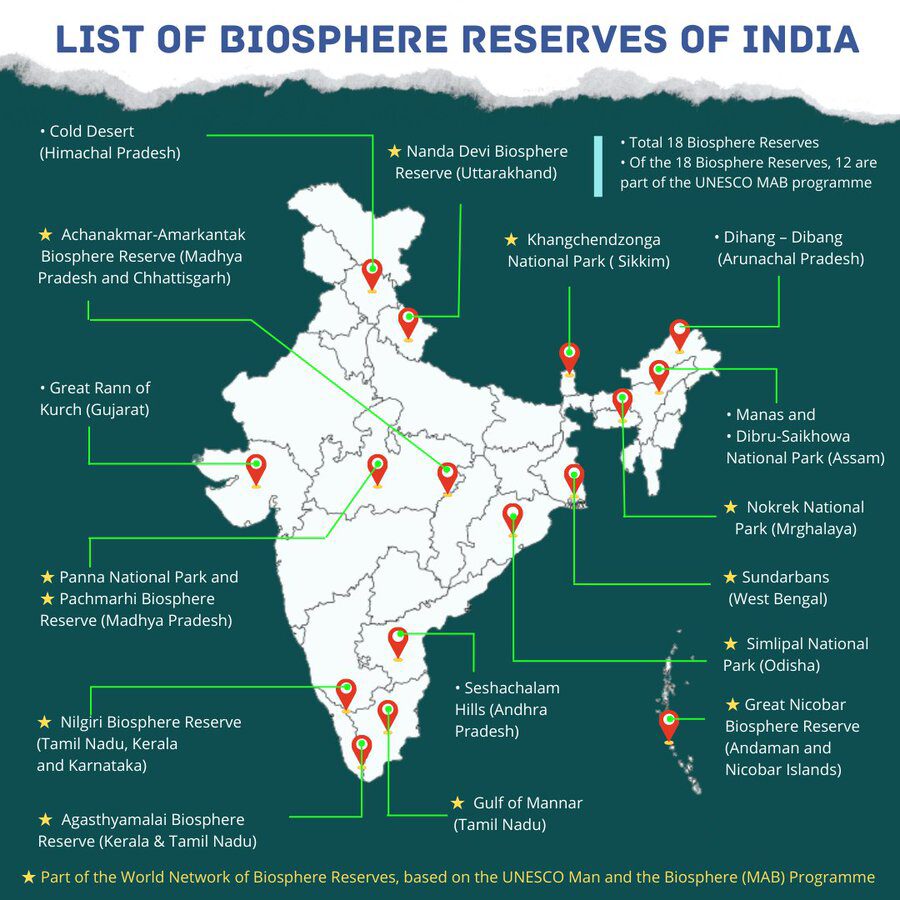
These reserves are not merely lists of protected areas—they are structured to accommodate the country’s diversity of landscapes, species, and cultures. From Nokrek, the smallest reserve in Meghalaya, to sprawling multi-state sites in the Western Ghats, each reserve is a microcosm that reflects India’s commitment to both ecological preservation and human welfare.
Redefining Conservation: The Living Laboratory Approach
India’s biosphere reserves are designed as “living laboratories,” places where sustainable practices are not just theorized but actively tested. The government’s budget for biodiversity conservation doubled to ₹10 crore in 2025–26, reflecting renewed political will and providing infrastructure for on-the-ground initiatives.
Importantly, these reserves follow a cost-sharing structure—60:40 funding between central and state governments, upping to 90:10 in the Northeast and Himalayan regions, thereby supporting fragile ecosystems and marginalized communities. This financial innovation demonstrates that protecting nature also means supporting those whose lives are intertwined with the land.
Each reserve is divided into core, buffer, and transition zones. The core protects the heart of biodiversity, while buffer and transition areas allow for regulated human activity, research, and sustainable livelihood programs. This model seeks to lessen the daily pressure on ecosystem resources while enabling communities access to development opportunities.
Links with National Conservation Programs
The biosphere reserve program is not isolated; it works in concert with iconic national initiatives such as Project Tiger, Project Elephant, and the Green India Mission. Project Tiger, now fifty years old, exemplifies successful species recovery through stringent protection and community involvement. Project Elephant adopts a holistic approach, focusing on not just preservation but also mitigating human-wildlife conflict and ensuring that habitat protection aligns with local needs.
These integrated efforts form a policy ecosystem where species conservation, ecosystem management, and community development sustain and reinforce each other, showing how a coordinated framework can have ripple effects across diverse landscapes.
Tangible Impacts and Indicators
India saw substantial gains in forest cover and quality—ranking ninth globally in total forested area, and third in annual forest increase. Such progress is not merely statistical. It signifies discernible shifts in land use, improved ecosystem resiliency, and enhanced prospects for local populations who depend on forest products and services.
Biosphere reserves have delivered other tangible benefits: demonstrable improvements in ecological health, stronger climate resilience in vulnerable habitats, and innovative alternative livelihoods for forest-dependent communities. The successful rehabilitation of tigers and protection of elephants offer templates for how focused policy, local partnership, and scientific monitoring can produce real results.
Engaging Communities: Promise and Paradox
Perhaps the most ambitious—and difficult—aspect of India’s biosphere reserve model is its focus on inclusion. These reserves are designed to foster local and tribal participation, providing not just protection but alternative livelihoods, stakeholder engagement, and support for community-led conservation.
By centering local people in governance and program design, India tries to move beyond the outmoded “fortress conservation” paradigm. Yet, real friction remains. Pressure for land, demand for timber and non-timber products, and the challenges of population growth often lead to conflicts—not only with wildlife, but with governance structures seeking to enforce ecological boundaries.
Large-scale development projects—mining, hydropower, infrastructure—sometimes intersect with reserve boundaries, risking both ecological integrity and public trust. Ensuring genuine voice for local communities in decision-making processes, sharing the benefits of conservation equitably, and protecting historical rights remain ongoing challenges.
Global Lessons from India’s Experience
India’s biosphere reserves offer valuable lessons for the world. The integrated approach—connecting science, policy, and community—shows that sustainable conservation is achievable when research, cultural knowledge, and economic needs are aligned. India’s commitments to national and international protocols, its legal framework, and willingness to experiment with financial models all set benchmarks other countries can aspire to.
The “learning by doing” philosophy, allowing site-specific adaptation, empowers each reserve to meet its unique challenges. Enhanced support for underserved regions—especially the vulnerable Himalayan and Northeastern states—demonstrates a commitment to fairness and resilience that is essential for long-term success.
The Road Ahead
India’s celebration of the International Day for Biosphere Reserves should be seen as more than a ritual. It is a moment to reaffirm that conservation is not just about hectares and species, but people, ideas, and ethics. As climate change accelerates, population grows, and economic pressures increase, the real test for biosphere reserves will be their ability to remain inclusive, flexible, and genuinely participatory.
The path forward demands not resting on past laurels, but doubling down on co-management—where local communities are partners, not just subjects of conservation. A recalibration is needed to fully integrate ecological, social, and economic perspectives, ensuring that forests, wildlife, and people thrive together.
These reserves, if managed as true partnerships, could be engines of innovation and hope for India’s—and the world’s—future. Their enduring relevance will hinge on constant learning, courageous policy-making, and an unwavering commitment to fairness and sustainability. The challenge is daunting, but India has shown that it is possible to move from idea to impact—turning living laboratories into living legacies.