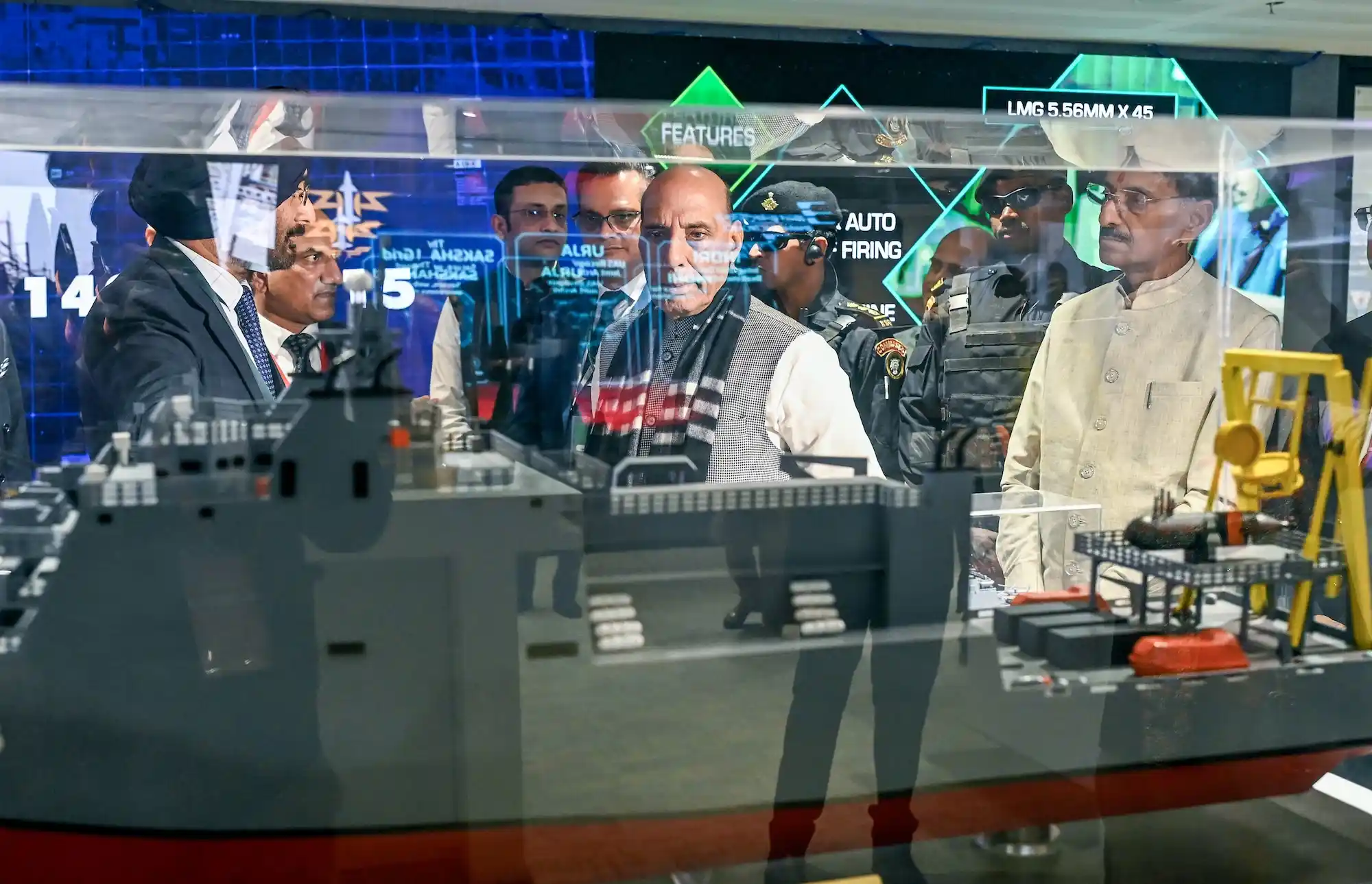
In a recent interview, Indian Defense Minister Rajnath Singh shared insights on the strategic logic behind Operation Sindoor and India’s evolving procurement doctrine. Singh clarified that India’s strikes during operation targeted terrorist infrastructure on Pakistani soil while deliberately avoiding civilian areas is a demonstration of both restraint and resolve. “We targeted only their terrorist centres,” he stressed, rejecting claims that the operation was halted under external pressure. “Operation Sindoor was not finished; it is halted for the time being.” That combination of precision and prudence also underpins a broader defense outlook. This approach, as he has outlined, entails the aspiration of cultivating India’s own defense capabilities, while also maintaining the option to procure combat-tested systems from foreign partners.
Importing Strength, Building Sovereignty
During the interview, Singh expressed his confidence in the performance of the Rafale fighter jets in the Sindoor campaign. “Rafale has performed remarkably – it is an excellent fighter aircraft,” he said. Defense officials have described how the Rafales executed precision strikes deep inside hostile territory using long-range SCALP cruise missiles and Meteor air-to-air weapons, neutralizing multiple terrorist facilities while evading enemy radar and air defences. At the same time, India’s S-400 Triumf air-defense system – known in Indian service as Sudarshan Chakra – provided a protective shield over frontline bases and command infrastructure. “We do need the S-400,” Singh told. “If we get the opportunity, we’ll buy them.” His statement highlighted that, despite a strong push toward domestic production, New Delhi remains pragmatic about importing proven systems when national security demands it.
It is also worth noting that India’s interest in expanding its S-400 fleet may be influenced by the system’s performance in other conflict zones. In the Russia-Ukraine conflict, the S-400 has been deployed in sustained high-intensity operations, providing long-range air-defense coverage against Western-supplied weapons. Open-source defense analyses, including reports from Janes and The Drive, indicate that Russian air-defense units may have used S-400 batteries to engage AGM-88 HARM anti-radiation missiles, Storm Shadow and SCALP-EG cruise missiles, and aerial platforms such as Su-27s and MiG-29s retrofitted with western targeting systems. It is worth noting that these tests were conducted in conditions that simulated electronic warfare, which is a testament to the S-400’s radar resilience and its capacity to address multiple threats simultaneously across distances of up to 400 kilometers and at altitudes of 30 kilometers. For India’s planners, such operational data offers tangible evidence that the system can endure pressure. This aligns with Singh’s insistence that any imported weapon “must be reliable and effective when it matters most.”
While discussing the advantages of acquiring advanced weapon systems from abroad, Singh underscored that imports must serve as stepping stones toward self-reliance rather than substitutes for it. He emphasized that India’s long-term strength lies in producing critical technologies domestically. Responding to questions about the Tejas and the Advanced Medium Combat Aircraft, he confirmed that India’s engine-manufacturing collaboration with companies such as GE and Safran would “ensure that within a year, we will reach a position where we will build the engines for these fighter planes in India, on Indian soil, by Indian hands.” The minister added that a similar strategy is being pursued for unmanned aerial systems, with indigenous drone development already underway. “These drones will be made here in India, and their technology too will increasingly be our own,” he noted, stressing that true security depends not only on what India can buy, but on what it can build.
A Message of Deterrence
In closing, Singh reiterated India’s readiness to respond decisively to any provocation. The minister’s tone was measured, yet firm. “We are not warmongers,” he said, “but if someone provokes us, we will not spare them.” That principle defines India’s modern military posture. Operation Sindoor showed that the country could strike surgically, sustain command control, and integrate imported and indigenous systems into a coherent battle network.
As Singh put it, India’s defence modernisation is not a race for arms, but a guarantee of peace on Indian terms. “If India’s sovereignty is harmed,” he said, “India will give a strong response.” It seems that New Delhi has communicated a clear message to its adversaries: India remains committed to acting in accordance with its national interests, while also maintaining resilience against external pressures.