The future of the Indo-Pacific hinges on the freedom of navigation, the security of sea lanes, and the resilience of maritime infrastructure. At this critical juncture, India’s maritime transformation—embodied in the Maritime India Vision 2030 and its extension to 2047—is not merely a domestic policy initiative. It represents a strategic pivot that positions India as an indispensable anchor of the Quadrilateral Security Dialogue (Quad) and a vital counterweight in the evolving geopolitical architecture of the Indo-Pacific.
With nearly 95% of India’s trade by volume traversing maritime routes, the nation’s economic lifeline is intrinsically tied to the security and efficiency of its ports and shipping lanes. But India’s maritime ambitions transcend commercial interests. They are rooted in a vision of regional leadership, collective security, and a rules-based maritime order—principles that align seamlessly with the Quad’s strategic objectives and the broader Indo-Pacific framework.
The Quad’s Maritime Imperative and India’s Strategic Role
The Quad—comprising India, the United States, Japan, and Australia—has emerged as the most consequential security partnership in the Indo-Pacific, with maritime cooperation at its core. This emphasis is not coincidental. China’s aggressive naval expansion, which has seen its fleet grow to over 340 battle force ships by 2021, surpassing the United States, poses a direct challenge to the freedom of navigation and the established maritime order. Beijing’s Belt and Road Initiative, particularly its Maritime Silk Road, has extended Chinese influence across the Indian Ocean through a network of ports from Gwadar to Hambantota, raising concerns about strategic encirclement and dual-use infrastructure.
India’s response has been measured but assertive. Through initiatives like SAGAR (Security and Growth for All in the Region) and the Indo-Pacific Oceans Initiative, India has positioned itself as a net security provider, complementing the Quad’s collective efforts. The first-ever Quad at Sea Ship Observer Mission, launched in June 2025, which saw Indian Coast Guard officers embark alongside their counterparts from Japan, the United States, and Australia, exemplifies this operational convergence. Such cross-embarkation missions enhance joint readiness, domain awareness, and interoperability—critical capabilities for addressing unlawful maritime activities, from illegal fishing to piracy and territorial violations.
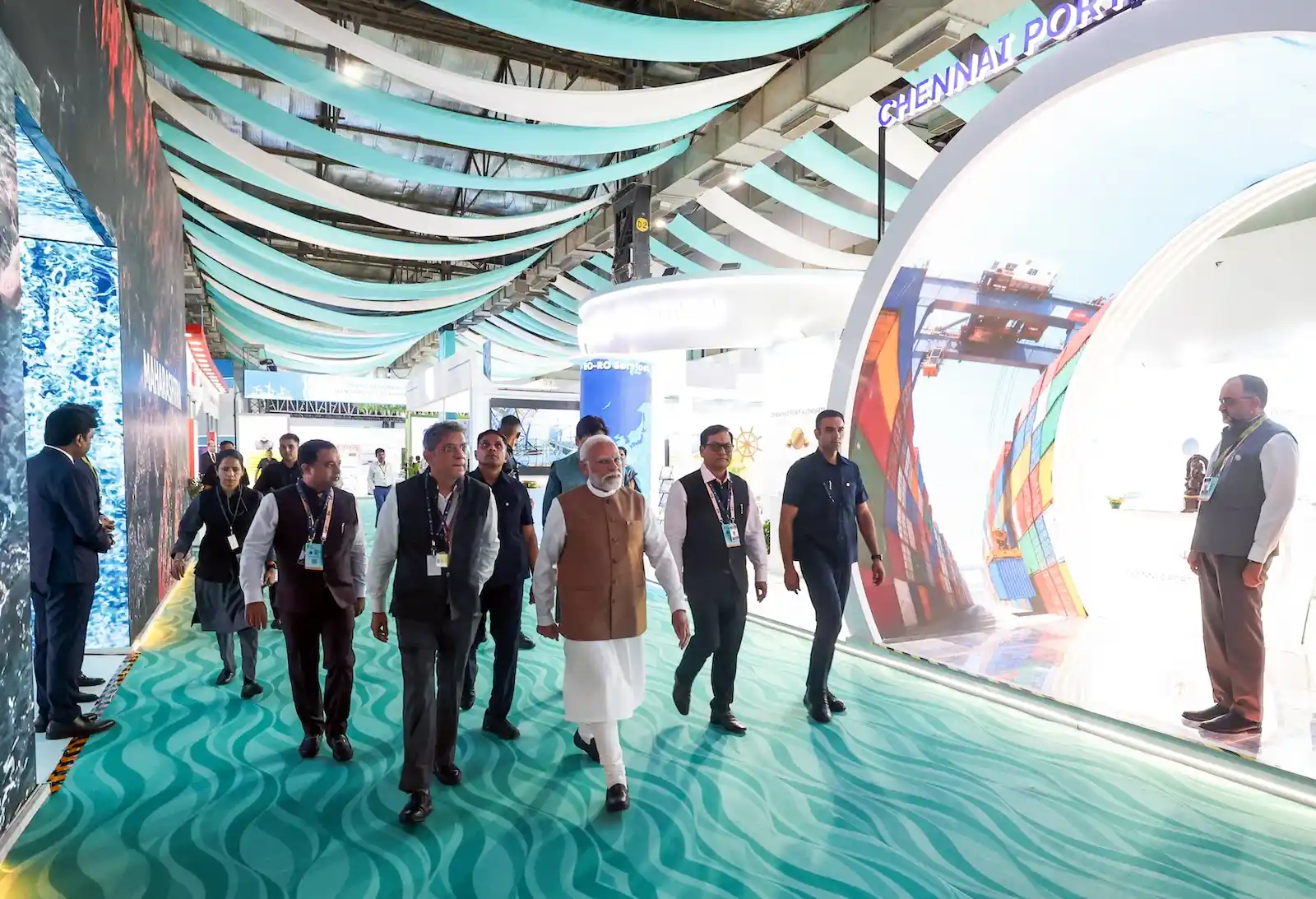
The inaugural Quad Ports of the Future Conference, hosted by India in Mumbai during Maritime Week 2025, further underscores this leadership. Bringing together 120 delegates from 24 Indo-Pacific nations, the conference focused on building resilient, secure, and future-ready ports through collaboration on infrastructure, financing, digital ecosystems, cybersecurity, and sustainability. India’s role as convener signals its transition from a regional power to a strategic architect of maritime infrastructure in the Indo-Pacific.
Infrastructure as Strategic Asset: From Vizhinjam to Vision 2047
India’s maritime infrastructure development is perhaps the most tangible manifestation of its Indo-Pacific strategy. The commissioning of Vizhinjam International Seaport in May 2025, India’s first deep-water transshipment hub, is a watershed moment. Located just 10 nautical miles from major international shipping routes connecting Europe, the Persian Gulf, and the Far East, Vizhinjam is strategically positioned to capture 75% of India’s transshipment cargo currently handled at ports such as Singapore, Colombo, and Dubai. This shift is expected to save India USD 200-220 million annually in potential revenue and reduce logistics costs by 30%.
The arrival of MSC Irina, the world’s largest container ship by TEU capacity, at Vizhinjam in June 2025 marked a symbolic and operational milestone. With a capacity of 24,346 TEUs and a length of nearly 400 meters, the ship’s berthing demonstrated Vizhinjam’s readiness to handle ultra-large container vessels. This capability positions India as a critical node in global shipping networks. By 2028, the port’s capacity is expected to triple from 1 million to 3 million TEUs annually, further consolidating India’s maritime prowess.
This infrastructure expansion is not isolated. Under the Maritime India Vision 2030, port capacity has nearly doubled from 1,400 million metric tonnes per annum (MMTPA) to 2,762 MMTPA, while cargo handling has surged from 972 MMT to 1,594 MMT. Vessel turnaround time has been reduced from 93 hours to 48 hours, and inland waterways cargo has grown by more than 700%, with operational waterways jumping from 3 to 32. The development of the Vadhavan mega-port in Maharashtra, with an estimated cost of ₹76,000 crore, and the Bahuda greenfield port in Odisha, with a capacity of 150 MTPA and projected investment of ₹21,500 crore, further illustrate India’s ambition.
These projects are underpinned by a landmark ₹69,725 crore package for shipbuilding and the revitalization of the maritime ecosystem. The Maritime Development Fund (MDF), with a ₹25,000 crore corpus, provides long-term financing to expand India’s shipping tonnage and shipbuilding capacity. At the same time, the Shipbuilding Financial Assistance Scheme (SBFAS) and Shipbuilding Development Scheme (SbDS) allocate ₹24,736 crore and ₹19,989 crore, respectively, to tackle cost disadvantages and drive greenfield clusters. The granting of infrastructure asset status to large ships unlocks cheaper financing, potentially transforming India’s shipbuilding sector from a niche player to a global competitor.
Securing Sea Lines of Communication: The Geopolitical Stakes
The security of Sea Lines of Communication (SLOC) is the strategic fulcrum upon which India’s Indo-Pacific engagement pivots. Over 80% of global trade by volume is transported by sea, and for India, SLOCs through the South China Sea and the Indian Ocean are critical to peace, stability, and prosperity. External Affairs Minister S. Jaishankar has repeatedly emphasized that these sea lanes must be governed by a substantive and practical code of conduct consistent with international law, in a pointed message to China’s unilateral maritime assertions.
India’s strategic calculus is clear: control over SLOCs translates to leverage in regional and global affairs. The Indian Navy has enhanced its Mission-Based Deployments, permanently positioning warships at five choke points stretching from the Gulf of Aden to the Malacca Strait. Such deployments spread influence, create domain awareness, and enable immediate response to threats. India’s intervention in piracy incidents, including the rescue of 23 Pakistani nationals from a hijacked vessel in March 2024, reflects its capability to act as a first responder.
Yet, India’s SLOC security efforts are not unilateral. The Quad’s Indo-Pacific Partnership for Maritime Domain Awareness (IPMDA), which includes space-based collection and sharing of radio frequency data, analytical training, and capacity building, represents a multilateral approach to combating illegal fishing, piracy, and gray-zone activities. The Maritime Initiative for Training in the Indo-Pacific (MAITRI), planned for 2025, aims to assess capability gaps and enhance maritime capabilities in consultation with regional partners. These initiatives position the Quad as a collective security provider, with India serving as the critical anchor in the Indian Ocean.
The China Challenge and India’s Counterbalancing Strategy
China’s maritime expansion cannot be divorced from India’s strategic imperatives. Beijing’s “string of pearls”—a network of naval bases and commercial facilities from Gwadar to Hambantota—has been perceived by India and Western capitals as strategic encirclement. Five of India’s six South Asian neighbors have joined the Belt and Road Initiative, with Chinese investments in infrastructure projects raising alarms about dual-use capabilities. Chinese research vessels with dual-use capabilities have expanded operations in the Indian Ocean, conducting surveys that collect oceanographic data critical for submarine operations and undersea warfare. In July 2025, a Chinese research vessel was caught operating covertly in the Bay of Bengal near Indian waters, likely conducting seafloor mapping and acoustic analysis.
India’s response has been multifaceted. Diplomatically, India has deepened partnerships with the United States, France, Japan, Australia, and ASEAN members, fostering technology transfer and enhancing security capabilities. Operationally, India has participated in multilateral exercises like Malabar, which brings together Quad navies for advanced tactical training, enhanced interoperability, and joint operational planning. The 29th edition of Exercise Malabar, hosted by the United States at Guam from October 28 to November 8, 2025, featured India’s INS Sahyadri, the USS Abraham Lincoln, Japan’s JS Izumo, and Australia’s Collins-class submarine in high-intensity drills, including anti-submarine, anti-air, and surface warfare, as well as cyber, AI, and humanitarian relief training.
Strategically, India’s concurrent chairmanship of the Indian Ocean Rim Association (IORA) and the Indian Ocean Naval Symposium (IONS) from 2025 to 2027 places it in a unique position to lead cooperative maritime initiatives. This leadership, combined with investments in indigenous naval capabilities—such as the aircraft carrier INS Vikrant and plans for six diesel-electric submarines—underscores India’s commitment to strategic deterrence.
The Blue Economy and Sustainable Maritime Growth
India’s maritime strategy is not solely militaristic. The Blue Economy, designated as the sixth dimension of India’s Vision of New India by 2030, envisions a USD 100 billion blue economy by 2030, integrating economic growth with environmental responsibility. The Draft Policy on Blue Economy, prepared by the Ministry of Earth Sciences, emphasizes seven thematic pillars, including sustainable fisheries, marine biotechnology, ocean renewable energy, and coastal tourism.
This vision aligns with the Quad’s emphasis on sustainability and climate resilience. The Quad Ports of the Future Partnership explicitly focuses on green corridors, green hydrogen bunkering, and methanol-fueled vessels. India’s launch of a megawatt-scale green hydrogen facility at Kandla Port signals its commitment to clean energy transitions. The Maritime Amrit Kaal Vision 2047, with projected investments of nearly ₹80 lakh crore, outlines over 300 initiatives to position India as one of the world’s top maritime and shipbuilding powers by the centenary of independence.
Navigating Toward 2047
India’s maritime resurgence is not a peripheral concern—it is central to the Quad’s strategic coherence and the Indo-Pacific’s future stability. As China’s naval power grows and its maritime assertiveness intensifies, the Quad’s ability to maintain a free, open, and rules-based order depends on India’s capacity to secure the Indian Ocean, enhance regional maritime infrastructure, and provide collective security goods.
The statistics are compelling: India’s port capacity nearly doubled in a decade, its seafarer workforce surged from 1.25 lakh to over 3 lakh, and its inland waterways expanded from 3 to 32 operational routes. The commissioning of Vizhinjam, the hosting of the Quad Ports of the Future Conference, and the signing of MoUs worth over ₹66,000 crore in September 2025 demonstrate tangible progress. The Maritime India Vision 2030, with its 150 initiatives and projected investments of ₹3-3.5 lakh crore, is not merely aspirational—it is actionable.
Yet, challenges remain. India faces budget constraints, rapid technological changes, and fierce competition from South Korea, Japan, and China in shipbuilding. The Quad lacks a formalized mandate and relies on the resolve of its members, with India seeking to balance its counterbalancing of China with economic pragmatism. The rise of Chinese naval power—projected to reach 440 ships by 2030—requires sustained multilateral cooperation, advanced surveillance, and joint operational planning.
Ultimately, India’s maritime future is inextricably linked to the Quad and the Indo-Pacific, as Prime Minister Narendra Modi stated at India Maritime Week 2025. India’s coastline, strategic geography, and bold vision for Blue Economy growth position it as a natural investment destination and a maritime leader. The question is not whether India will shape the Indo-Pacific maritime order, but how swiftly and decisively it can leverage its strategic assets to anchor a free, open, and prosperous region. The waves of change are already in motion—India must navigate them with vision, strategy, and determination.