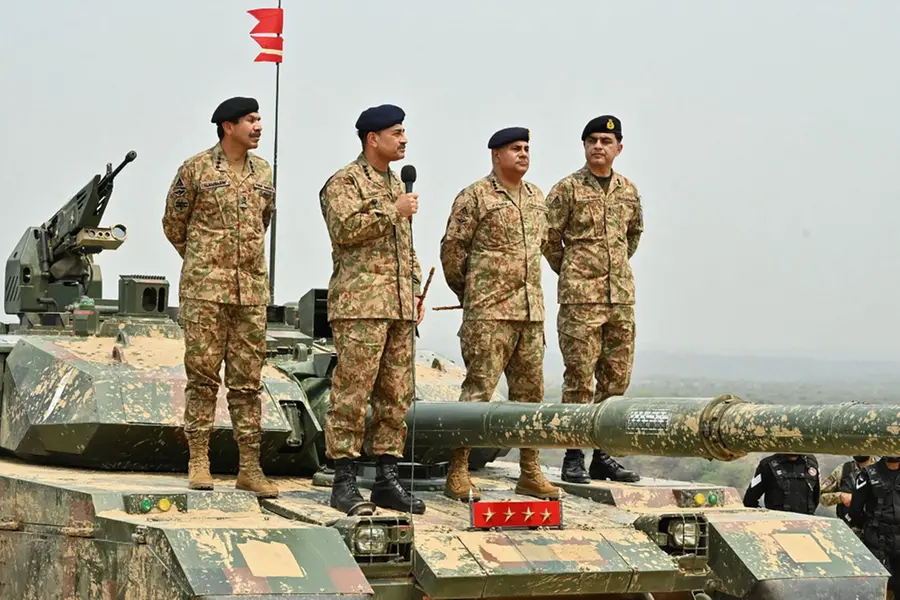
Asim Munir’s rise to Field Marshal and his enduring dominance over Pakistan’s political and institutional landscape mark not a renaissance of national strength but a deepening of a historic pathology — the military’s delusion of grandeur that has repeatedly sabotaged the country’s potential for stability and progress. Like Ayub Khan, Zia-ul-Haq, and Pervez Musharraf before him, Munir embodies the army’s conviction that salvation lies not in democracy or developmental reform, but in a militarised nationalism that exalts the soldier above the citizen and paranoia above pragmatism.
For seventy-five years, Pakistan’s generals have fashioned themselves as guardian angels of a fragile state, swooping in to “rescue” it from civilian incompetence. From Ayub Khan’s coup and Zia’s Islamisation to Musharraf’s “Enlightened Moderation,” each intervention was justified as a patriotic necessity — and each left the country weaker, poorer, and angrier. Asim Munir’s accession to the rank of Field Marshal in 2025, following a brief border conflict with India, continues that tradition. Cloaked in rhetoric about national pride and Islamic fortitude, his ascendance was a theatrical assertion that the real seat of power in Islamabad remains behind the khaki curtain of Rawalpindi’s GHQ.
Munir’s self-styled image as the devout general — a Qur’an memoriser and moral guardian — plays well in a society steeped in religio-military nationalism. Yet it obscures the essential truth: that Pakistan’s generals, intoxicated by their perceived divine destiny, have repeatedly mistaken personal authority for state strength. The result has been an endless cycle of authoritarianism wrapped in ideology, breeding both political stagnation and economic ruin.
The sense of divine mission that animates the Pakistani military — the so-called “Ghazi delusion” — is at the core of its dysfunction. Convinced that Pakistan is the spearhead of an Islamic struggle and perpetual rival to India’s ascendant democracy, successive army chiefs have treated foreign policy as jihad by other means. The cost has been catastrophic. Decades of adventurism — from Kargil to Kabul — have drained resources, estranged allies, and fostered a global reputation for duplicity.
Munir’s tenure has accelerated this pathology. Far from recalibrating Pakistan’s regional posture, he has doubled down on confrontation, undercutting even pragmatic voices within the army who advocate economic and diplomatic sobriety. His insistence on elevating the military’s political role — from running investment councils to steering domestic governance — reveals not confidence but insecurity: a desperate assertion that only men in uniform can manage the national destiny.
The tragedy of Munir’s Pakistan lies in its duplicity: a republic in name, a garrison in practice. Civilian governments exist merely as administrative extensions of military consent. The judiciary bends under the weight of “national security” imperatives. The media lives under perpetual siege. Munir’s recent manoeuvres — including a ten-year extension plan to remain in power until 2035 — crystallise the military’s view that Pakistan’s salvation lies in “continuity of command” rather than constitutional accountability.
But history offers a grim lesson. Every general who clutched at permanence — from Yahya Khan’s swagger in 1971 to Zia’s sanctimony in the 1980s — left Pakistan more fractured and fragile than he found it. Munir’s militarisation of economic and civic life, couched as a “stability doctrine,” risks pushing Pakistan into irreversible dependency, where the veneer of order masks a decaying state hollowed out by military greed and ideological rigidity.
The ultimate danger of Pakistan’s military delusion lies not merely in external miscalculations but in its internal corrosion. The generals’ addiction to grandeur blinds them to the realities of an economically desperate, climate-vulnerable society. Munir’s pursuit of prestige — from ceremonial field marshal status to foreign policy pageantry — cannot disguise the shrinking legitimacy of the state he commands.
Unless Pakistan’s citizens reclaim sovereignty from its barracks, the nation will remain a tragic theatre of militarised hubris — where generals dream of empire while their country staggers under debt, disillusionment, and decay. Munir’s reign, though wrapped in the pomp of a Field Marshal, will likely be remembered not for victories won but for opportunities lost — a continuation of Pakistan’s longest, most ruinous delusion: that salvation wears a uniform.