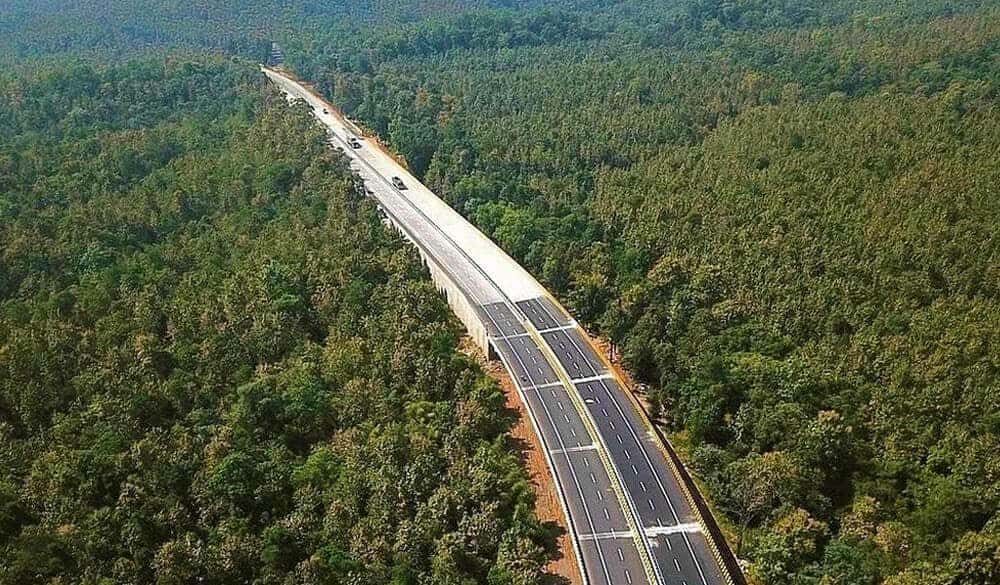
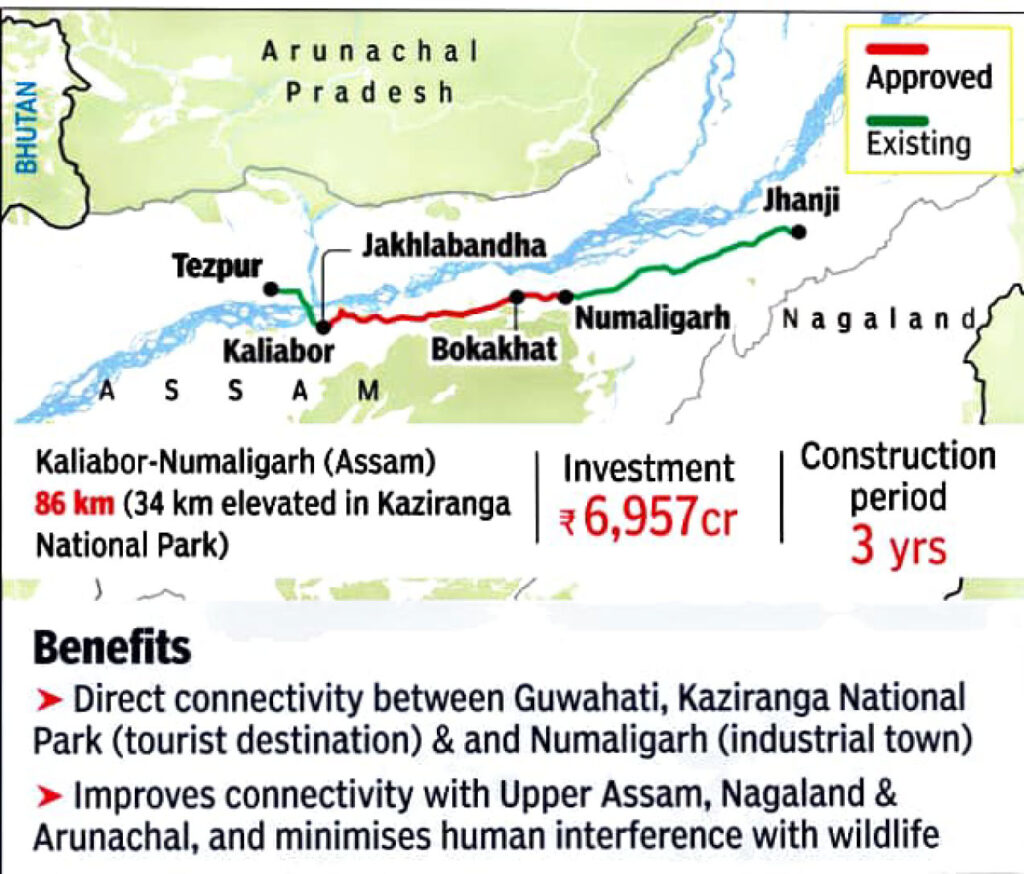
The Central Government’s decision on October 1, 2025, to upgrade a stretch of National Highway 715 near Kaziranga National Park (KNP) marks another milestone in the region’s development. The decision to realign and upgrade the existing highway has been conceived primarily to ensure the safety of the animals in KNP, especially during the monsoon season.
Floods and Animal Movement
Kaziranga experiences heavy flooding during the monsoon. While a certain level of flooding is essential to maintain the park’s wetlands and grasslands, excessive inundation forces animals to migrate to the Karbi Anglong hills, located south of the highway, for safety. During this migration, many animals fall victim to vehicle collisions, drowning, or poaching, while others are affected by man-animal conflicts.
Animal deaths in KNP due to floods over recent years are as follows:
- 2019: 17
- 2020: 157
- 2021: 26
- 2022: 19
- 2023: 29
- 2024: 225 (the highest recorded since 1991)
Supreme Court and Government Action
In a directive issued on November 20, 2024, the Hon’ble Supreme Court instructed the National Highways Authority of India (NHAI) to expedite the construction of elevated corridors through the park. The project was subsequently approved by the Cabinet on October 1, 2025.
With the proposed realignment, animals will be able to move safely to the higher grounds of Karbi Anglong during floods and return to their natural habitats afterward.
Project Details
Kaziranga National Park, covering an area of approximately 430 sq km (about 40 km in length and 13 km in width), runs parallel to the southern boundary of NH 715.
Earlier, the National Green Tribunal (NGT) had directed authorities to install speed breakers every 400 meters and enforce strict speed limits to protect animals using designated animal corridors. While these measures improved safety, they significantly increased travel time.
The new project—comprising a change in alignment and construction of elevated corridors—will achieve dual objectives: ensuring animal safety and reducing travel time.
The project involves upgrading 86.67 km of the highway, including 34.45 km of elevated corridors, at an estimated cost of ₹6,957 crore. This initiative will ensure safe and uninterrupted movement of wildlife across the park.
The new alignment will also integrate NH 129, NH 127, and State Highway 35, while connecting three railway stations and three airports. It is expected to encourage tourists visiting KNP to explore nearby attractions such as the Deopahar archaeological site and the Kakochang Waterfalls.
In addition to wildlife protection, the project will promote infrastructure development and employment generation. It is estimated to create 15.42 lakh person-days of direct employment and 19.19 lakh person-days of indirect employment.
A Brief History of Kaziranga
Although the early history of KNP remains somewhat obscure, the proposal to declare it a reserve forest gained momentum following the visit of Mary Victoria Leiter Curzon, wife of Lord Curzon, in 1904. She apprised the then Viceroy of India about the importance of protecting the one-horned rhinoceros. Consequently, on June 1, 1904, the area was declared a Reserve Forest.
Post-Independence, in 1950, it was renamed Kaziranga Wildlife Sanctuary, and later, in 2006, it attained the status of a National Park. In 1985, Kaziranga was inscribed as a UNESCO World Heritage Site.
Tourism and Conservation Success
Tourism in Kaziranga has increased significantly in recent years, thanks to proactive efforts by the Central and State Governments and private operators. The establishment of numerous homestays and star-category hotels has boosted tourism.
During the last tourist season (October 1, 2024 – May 18, 2025), 4,43,636 tourists visited Kaziranga—making it the third most visited wildlife destination in India, after Periyar National Park (Kerala) and Ranthambore National Park (Rajasthan).
Visitors can also enjoy nearby tea gardens, orchid parks, and traditional folk performances, offering a holistic cultural experience in and around the park.
Conservation Achievements
Due to enhanced security measures—including deployment of special commando forces, thermal sensors, and camera traps—poaching, particularly of rhinos, has declined sharply.
According to the 2022 survey, Kaziranga hosts 2,613 rhinos, comprising 1,823 adults, 365 sub-adults, 279 juveniles, and 146 calves. The Royal Bengal Tiger population has also risen—from 104 in 2022 to 148 in 2024—making Kaziranga the third-highest tiger density zone in the world.
The park is also home to significant populations of elephants, swamp deer, and several vulnerable species, including Hoolock gibbons, Indian pangolins, and wild buffaloes, as well as over 480 bird species, diverse aquatic life, and reptiles.
A Vision for the Future
On October 1, the Prime Minister tweeted:
“The Cabinet decision on widening and upgrading the Kaliabor–Numaligarh section of NH 715 with elevated corridors and wildlife-friendly measures in the Kaziranga stretch will boost development as well as animal safety. Tourism to Kaziranga will receive a big boost.”
Although a formal completion timeline has not been announced, the project is expected to be executed expeditiously. This initiative will undoubtedly delight conservationists and wildlife enthusiasts, reaffirming India’s commitment to the coexistence of development and nature conservation.