When the Oli government in Nepal decided to ban 26 social media platforms last week, it likely imagined a swift compliance battle with tech companies and perhaps a few murmurs from civil society. Instead, it lit the fuse on one of the most explosive political crises in the country’s modern history — one that ended with the prime minister’s resignation, dozens dead, and the ruling coalition teetering on the brink.
A Ban That Became a Movement
Prime Minister KP Sharma Oli framed the ban as a regulatory necessity. The official rationale — that platforms like Facebook had failed to register with the government and were enabling scams and misinformation — might have seemed defensible in a region where online disinformation is a real problem. But the decision ignored one fact: in Nepal, social media is not just entertainment. For millions, especially the young, it is the only uncensored space for airing grievances, organizing activism, and holding power to account.
Young Nepalis, who already felt excluded from a political system dominated by aging elites, saw the ban as a direct assault on their freedom of speech. It wasn’t just about memes and messages — it was about silencing criticism of corruption, nepotism, and a governing class seen as more concerned with personal luxury than public service. Within days, the hashtag-driven frustration morphed into a real-world mobilization branded the “Gen Z Movement.”
Their demands were simple yet radical: lift the ban, tackle corruption, and hold leaders accountable. The slogans painted across placards — “Shut down corruption, not social media” — captured both the generational outrage and the political opportunity the protests represented.
From Protest to Uprising
On Monday morning, tens of thousands gathered in Kathmandu. Initially peaceful, the demonstrations swelled to surround Parliament. The protesters’ energy was raw and unfiltered, powered not by party leaders but by young students, job seekers, and digital activists who had cut their political teeth online.
But by the afternoon, the fragile peace shattered. Clashes erupted as some protesters breached Parliament’s perimeter. Police responded with tear gas, water cannons, and eventually live fire. The government’s heavy-handedness — resulting in at least 20 dead and over 250 injured in two days — turned a protest into an uprising.
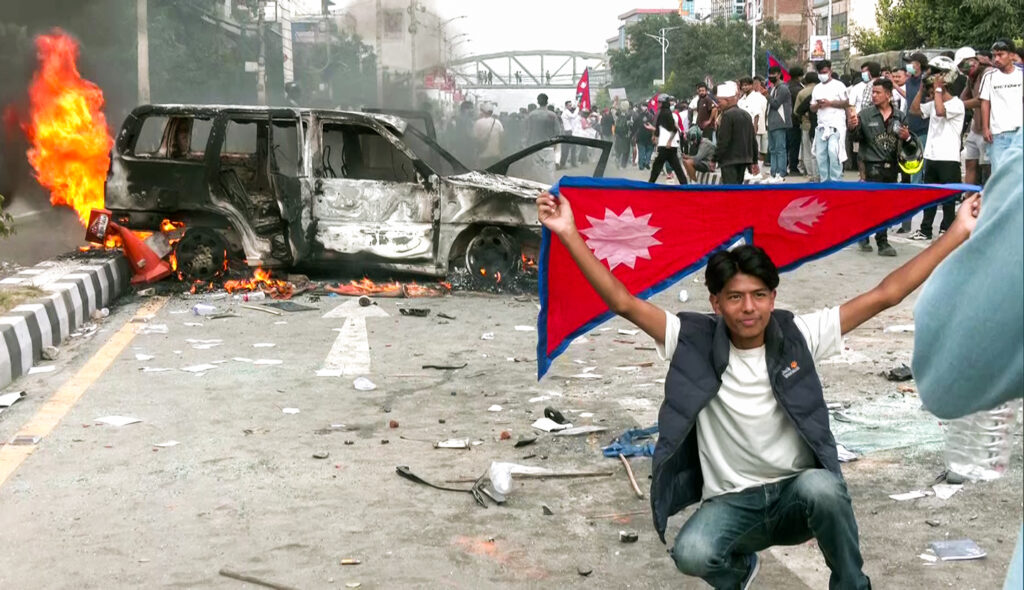
The violence spread quickly to other cities, from Pokhara to Itahari. In each, the grievances were the same: a rejection of both the social media ban and the entrenched political order.
The Anger Targets Everyone
In an unusual twist for Nepal’s fragmented politics, the rage spared no party. Protesters vandalized the residences of leaders from across the spectrum — Oli’s own home, President Ram Chandra Poudel’s residence, the Nepali Congress leader Sher Bahadur Deuba’s house, Maoist leader Pushpa Kamal Dahal’s home. Even a private school owned by Foreign Minister Arzu Deuba Rana was set ablaze.
These were not random acts of vandalism. They were calculated symbolic strikes — a youth-led indictment of an entire political class, whose personal wealth and privileges stand in jarring contrast to the unemployment and economic stagnation faced by ordinary citizens.
The chaos reached such heights that army helicopters had to airlift ministers from government quarters, and Kathmandu’s main airport suspended operations after protesters used drones and laser lights to disrupt flights.
Oli’s Last Moves
Faced with mounting casualties, nationwide unrest, and a collapsing coalition, Oli tried to project calm in a televised address, urging peaceful dialogue. But behind the scenes, his position was collapsing. According to reports, even the army — long a decisive power broker in Nepal’s politics — told Oli that stability was impossible unless he resigned.
His departure marked the end of his fourth term since the country became a republic in 2008. In his final hours in office, he announced an investigation into the crackdown, compensation for victims’ families, and medical care for the injured. Yet with his resignation, the future of these promises is uncertain.
A Coalition in Crisis
Oli’s resignation didn’t just create a leadership vacuum — it triggered a full-blown political crisis. Key ministers resigned in quick succession, including the Home, Agriculture, Health, Youth and Sports, and Water ministers. Legislators began abandoning the government, with the National Independent Party threatening a mass resignation of its MPs.
The coalition’s majority in Parliament now hangs by a thread. The Maoist Centre has hinted at pulling out, and factions within the Nepali Congress are openly calling for withdrawal from the government. If just a few more MPs defect, the ruling alliance could lose its majority, triggering early elections.
Why This Is Different
Nepal is no stranger to political instability. Since the monarchy’s abolition in 2008, the country has cycled through prime ministers with dizzying speed, and coalition governments rarely last. But this crisis is different for three reasons.
First, it is youth-driven and leaderless. Unlike previous street movements tied to political parties or ideological causes, the “Gen Z Movement” is powered by grassroots digital organizing. It has no central figure to negotiate with — and therefore, no easy way for the establishment to co-opt it.
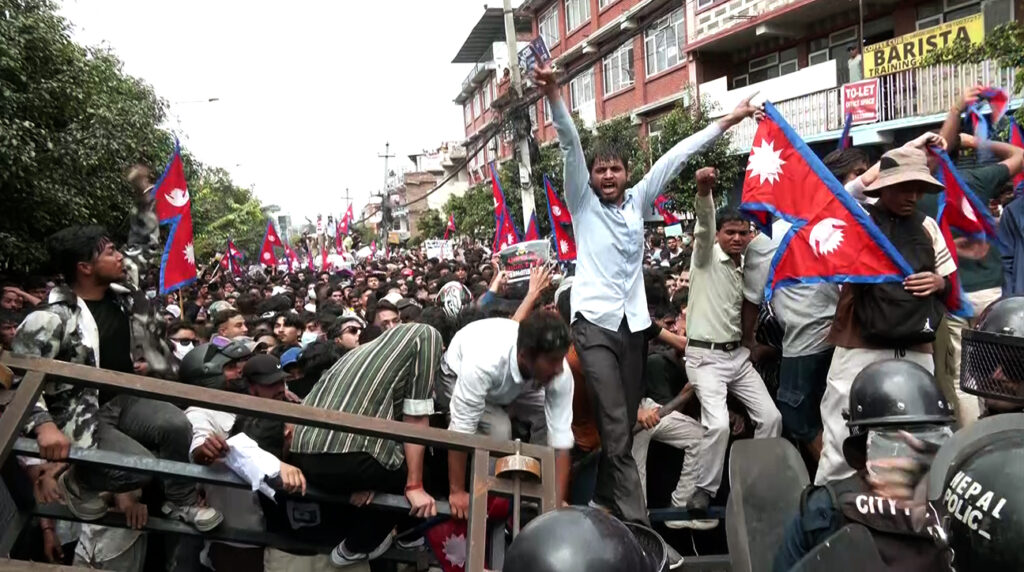
Second, it targets systemic corruption rather than a single policy. The social media ban was the spark, but the fire is fueled by years of disillusionment with leaders who, in the protesters’ eyes, treat public office as a means of personal enrichment.
Third, it is explicitly anti-elite in a way that transcends party lines. By attacking the homes of leaders from all major parties, protesters have signaled they won’t be satisfied with a simple change of prime minister.
The Risks Ahead
The immediate risk is that the protests could spiral into sustained violence, especially if the political vacuum persists. An interim or caretaker government may struggle to control the streets without either making significant concessions or resorting to further crackdowns — both of which could backfire.
There is also the danger of military overreach. So far, the army has avoided taking control, but prolonged chaos could tempt it to step in “for stability,” setting back Nepal’s fragile democratic institutions.
Economically, the unrest threatens tourism — a major revenue source — and foreign investment. The airport shutdown is a warning sign of the wider disruptions that could follow if the crisis drags on.
What Comes Next
The most likely short-term scenario is the formation of a caretaker government tasked with organizing early elections. But without credible reforms — especially around corruption, transparency, and youth representation — the elections risk becoming another reshuffling of the same political elite.
For the “Gen Z Movement,” the challenge will be to convert street power into political influence without losing its authenticity. That means deciding whether to remain an extra-parliamentary force or to create new political vehicles that can compete for power.
For Nepal’s establishment, the message should be clear: the days when youth could be placated with vague promises are over. This generation is digitally connected, politically aware, and unwilling to wait another decade for change.
A Moment of Reckoning
Oli’s fall is a watershed moment not just because of how he fell, but because of who pushed him — a generation that grew up in a nominal democracy but feels it has reaped few of its benefits. Their revolt has exposed the bankruptcy of Nepal’s current political compact and signaled that legitimacy will increasingly depend on delivering tangible results, not just surviving coalition arithmetic.
Nepal’s leaders can respond in two ways: treat this as a law-and-order problem to be suppressed, or as a political awakening to be engaged. The first path risks entrenching the crisis. The second could open the door to a renewal of Nepal’s democratic experiment.
The choice they make in the coming weeks will determine whether the fall of KP Sharma Oli is remembered as just another episode in the country’s endless political drama — or as the moment Nepal’s youth forced a nation to confront its future.