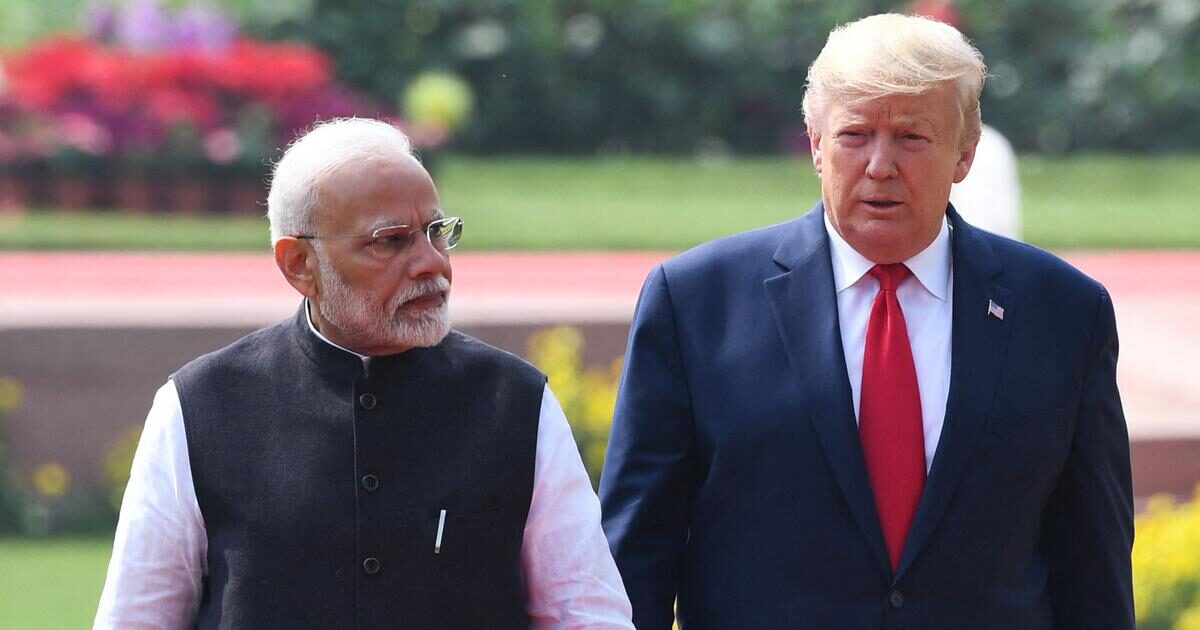
‘India is a Laundromat for the Kremlin’ is the latest accusation of Team Trump in reference to India’s continuous buying of Russian oil. President Donald Trump’s trade advisor, Peter Navarro, could hardly hide his frustration in his recent TV interview, indulging in this scurrilous comment on a sovereign country’s decision to act in its national interest. He accused India of fueling Russia’s what he called ‘war machine’ in Ukraine by buying Russian oil. However, it is not just the oil business, as China is spared, even though it is the largest importer of Russian oil. Apparently, the strategy is to hit Russia’s oil-oriented economy, depriving it of a valuable customer (White House cannot pressurize China), to rein in the Kremlin’s march in Ukraine. However, a recent piece in the New York Times claims that Indian Prime Minister Narendra Modi’s outright refusal to endorse either President Trump’s claim of ending the Indo-Pak conflict this May or, worse, his indomitable aspiration for the Nobel Peace Prize had a role in the current India-U.S. friction. If so, then it manifests that the unconscionable and vacuous style of functioning of the U.S president is shaking an otherwise strong bilateral relationship, meticulously constructed over the last two decades, to its roots.
The United States’ perceptions about India have traditionally been of skepticism and wariness. Throughout the Cold War era, relations were marred by distrust and suspicion. The root cause had been India’s policy of non-alignment. In other words, India’s refusal to give in to the U.S.’s peremptory attitude had been a significant source of disgust and anger for the latter. However, if such an anti-India policy, which reached its zenith during the Indo-Pak war of 1971, was based on a larger anti-Soviet Cold War strategy, today’s situation emanates clearly from the inane decisions of one bumptious leader.
President Trump’s decision to entertain the Pakistani Army Chief Asim Munir this June, following cracks in relations with India, was more than just about irritating New Delhi. Report suggests days before the Pahalgam terror attack in April a deal was struck between a privately owned U.S crypto-currency firm, World Liberty Financial, with stake holding by Trump’s sons Eric and Donald Junior, and newly founded Pakistan Crypto Council. A high-profile team of top executives traveled to Islamabad to sign the deal. The team was welcomed personally by the Pakistan Army Chief, Asim Munir. Now, Jake Sullivan, the National Security Advisor in the previous Biden administration, accuses Trump of prioritizing his family business over U.S.-India relations. If so, then the USA’s strategic maneuvering hobbles under the president’s personal priority consideration.
President Trump’s India policy is indeed casting a shadow over the USA’s China-centric Indo-Pacific strategy. India dominates the U.S’ strategic calculations in the Indian Ocean region as Japan and South Korea do in the Pacific region context. The sheer geographic location of these countries in the two adjacent maritime zones makes them the spokes of the grand U.S Indo-Pacific strategic design. Besides, today’s China cannot be dealt with by the U.S military might alone. In fact, China is fast narrowing the gap in its naval strength with that of the USA. The USA suspects that the Chinese Navy is to challenge the U.S Navy’s ability to achieve and maintain wartime control of blue-water ocean areas in the Western Pacific. China is increasing its ships’ firepower, possessing more vertical launching system (VLS) launchers, narrowing the gap with the USA. Besides, China currently has more warships (234) than the USA (219). China is also advancing its missile technologies and leading in hypersonic munitions technology. And the USA is getting increasingly nervous as China gallops ahead with its military modernization mission.
It is not within the U.S.’s sole capacity to handle this rising China. Besides, the USA is fast losing its superpower status in the emerging new world order, with China coming up as a major stakeholder in it. Thus, the USA needs to recalibrate its alliance policy. She cannot afford the combative foreign policy of her president, targeting both allies and adversaries. Trump’s USA needs to invest in its alliance and partnership network to strengthen it further, rather than damaging it. China is a security concern and a strategic challenge to all its neighbours, wary of its growing military strength. And the USA, with its technological expertise and military might, is a significant source of reliance for them. Following the Galwan skirmish in 2021, intelligence provided by the USA, with actionable satellite imagery, about Chinese positions along the 3,200km frontier, helped India successfully ward off a potential Chinese military incursion in 2022. This was not only a help for India but also a boost to the U.S strategy, thwarting China’s military misadventure in the South Asian zone. The USA cannot sidestep India if it wishes to counter expanding Chinese diplomatic and strategic maneuvers in South Asia.
Despite Trump’s tariff onslaught, India keeps the door open for collaboration, participating in the U.S.-India 2+2 Intersessional Dialogue this August, which covers issues such as regional security developments and strategic priorities. In contrast, Donald Trump’s decision to skip the Quad summit meeting, scheduled for later this year in India, will challenge the Quad’s objectives. This comes as Prime Minister Narendra Modi’s recent visit to Japan, en route to China, underlined that the Quad remains a priority for New Delhi. The Quad is indeed a crucial platform for all the major China-wary powers in the Indo-Pacific region, with the potential to thwart the Chinese design in the region collectively. However, President Trump’s tariff war is alienating the US’ Quad partners, India, Japan, and Australia. Today, all three partners are forced to adjust to Beijing, thanks to Trump’s tariff policy. Instead of unlocking the potential of Quad to augment economic coordination, technological collaboration, and industrial integration among the partner countries, President Trump is choosing to relegate the group. And while doing so, he is undoing the efforts of his predecessors, from Bill Clinton to Barack Obama, who recognized the strategic importance of India in the context of rising China and invested conscientiously to secure the USA as a major non-NATO strategic partner in the Indian Ocean region.