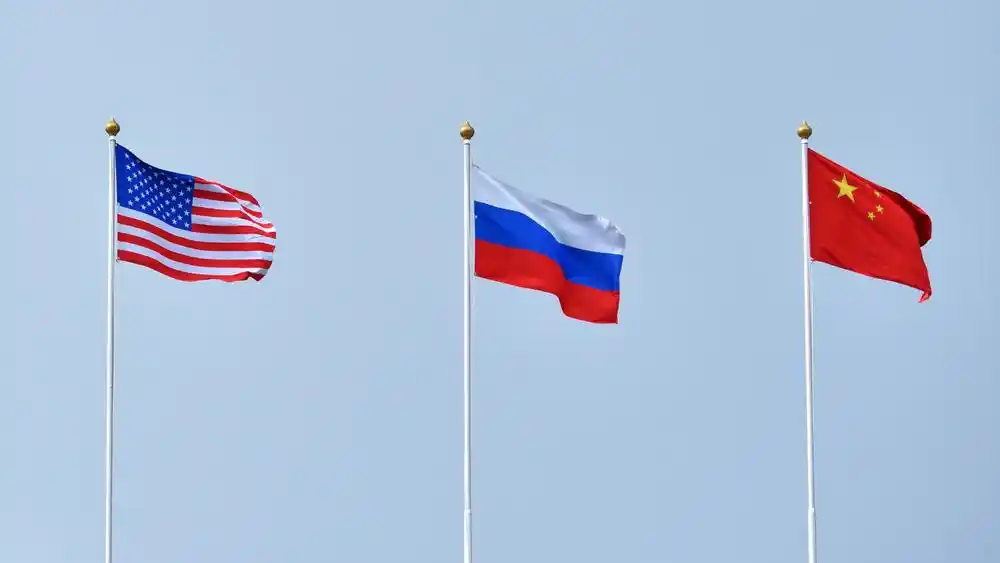
When rivals need each other, the rules of power change. The Iran crisis is rewriting them in real time.
There is a moment in every great crisis when the map of the world quietly redraws itself—not through the thunder of conquest, but through the slow rearrangement of who needs whom. We are living through one of those moments now. The Iran crisis, which exploded into open military confrontation on February 28, 2026, when American and Israeli forces struck Iranian nuclear and missile infrastructure, has done something that years of diplomatic commentary failed to anticipate: it has forced Washington, Beijing, and Moscow—three powers that have spent the better part of a decade positioning themselves as rivals—into a state of awkward, grudging, structurally inescapable interdependence.
Call it the Beijing Triangle. Not an alliance. Not a partnership. Not even a tacit understanding. Something stranger and more consequential than any of those: a configuration in which the United States cannot resolve its most urgent strategic crisis without Chinese cooperation, Russia cannot maintain its global relevance without Chinese cover, and China—despite possessing no aircraft carriers in the Persian Gulf, no treaty with Iran, and no formal role in any negotiation—has somehow become the indispensable actor in the most dangerous standoff of the twenty-first century. The triangle is not a product of design. It is a product of gravity. And understanding its geometry is the most important task facing strategic analysts today.
The Iran crisis is not a story about the Middle East. It is a story about what happens to the architecture of global power when the world’s three leading states discover, to their mutual discomfort, that they cannot manage a systemic crisis alone.
The Chokepoint That Changed Everything
To understand why Iran has become the crucible of great-power relations, you have to begin with geography. The Strait of Hormuz—barely 33 kilometres wide at its narrowest, yet carrying roughly one-fifth of the world’s traded oil daily—is the planet’s most consequential waterway. It is not merely a shipping lane. It is the circulatory system of the global economy. When it is threatened, the entire body politic of international order feels the constriction.
Since hostilities began, Iran has maintained what it euphemistically calls “traffic management” in the Gulf. The United States calls it unlawful interference with freedom of navigation. The result, whatever you call it, is a “Hormuz Premium” baked into global oil prices—a surcharge that has stoked inflation across every import-dependent economy from New Delhi to Berlin. Operation Epic Fury, the American designation for the campaign against Iranian military and nuclear infrastructure, has so far cost an estimated $29 billion, claimed the confirmed loss or damage of at least 42 US aircraft including F-35A stealth fighters and 24 MQ-9 Reaper drones, and—according to a New York Times–Siena College poll published in May 2026—turned 64 percent of American voters against the war, driving President Trump’s approval rating to 37 percent.
Tactically, the operation has achieved things. Iranian ballistic missile stockpiles have been degraded. Senior commanders have been eliminated. But Iran’s nuclear programme—its centrifuges buried in fortified underground facilities, its enriched uranium stockpile hovering near the 60 percent threshold that places it weeks away from weapons-grade material—has proved stubbornly, humiliatingly resilient. The lesson is as old as modern warfare and as difficult to absorb: military superiority and political compellence are not the same thing. You can destroy a country’s hardware without changing its will.
This is the strategic gap into which China has quietly, deliberately, and with remarkable effectiveness inserted itself.
The Art of Being Indispensable
The concept of great-power influence has traditionally been measured in the currencies of military reach and economic mass. China is building both, but neither explains its current centrality to the Iran crisis. What explains it is something less visible and more durable: what this article calls Broker Power—the strategic capacity to maintain simultaneous high-trust relationships with all competing parties in a multipolar crisis, creating a form of leverage that military force cannot generate and that sanctions cannot replicate.
China’s position rests on three interlocking pillars, each reinforcing the others. The first is economic dependency. China is Iran’s largest trading partner, the dominant buyer of its crude oil at discounts that have partially insulated Tehran from the full force of Western sanctions. The 2021 China-Iran Comprehensive Cooperation Agreement—a 25-year framework with trade targets analysts estimate could approach $600 billion—has embedded Chinese economic interests so deeply in Iran that no serious diplomatic architecture can be drawn without Beijing’s participation. As Sadegh Azad documents in his authoritative study of the relationship, China has been Iran’s economic lifeline since Washington withdrew from the JCPOA in 2018. To put it plainly: without Chinese demand for Iranian oil, Tehran’s economy collapses. That is leverage of a very particular and irreplaceable kind.
The second pillar is Gulf-wide reach. Here is where the Broker Power argument becomes genuinely surprising. China is not merely Iran’s economic patron. It is simultaneously a major strategic and economic partner of Saudi Arabia, the UAE, and Qatar—the very states that regard Iranian power as their most direct existential threat. In March 2023, Beijing pulled off a diplomatic feat that had eluded Washington for years: it brokered a formal normalisation between Saudi Arabia and Iran. Research published in PLOS ONE by Chen and colleagues demonstrates that China’s Belt and Road engagement has constructed precisely this web of economic relationships across the Gulf—giving Beijing credible interlocutor status on both sides of the region’s deepest sectarian and strategic divide. It is a position no other external power currently occupies.
The third pillar is the most dramatic, and it is the one that has turned heads in every foreign ministry from Washington to Riyadh. Reports from May 2026 indicate that negotiations in Doha are actively exploring the transfer of Iran’s enriched uranium stockpile to Chinese custody as the centrepiece of any eventual deal. The logic, once you see it, is elegant in its simplicity. The material leaves Iranian territory—satisfying Washington’s core non-proliferation demand. It does not go to the United States or any Western state—giving Tehran the face-saving exit that its domestic politics require. And China, as custodian, becomes the physical guarantor of the agreement’s most sensitive clause. That such an arrangement is even under discussion tells you everything you need to know about where real diplomatic gravity has come to rest.
Beijing has become the essential node—not because it outspent Washington or outgunned Moscow, but because it made itself the one actor that neither Washington nor Moscow can do without. Indispensability, it turns out, is its own form of power.
Russia’s Gamble: Leveraging Chaos Without Drowning in It
Russia’s position in the Beijing Triangle requires a subtler reading than either triumphalism or despair. At first glance, Moscow is a beneficiary of the Iran crisis: elevated energy prices ease the fiscal strain of a war economy under Western sanctions; American strategic attention diverted from Ukraine is American pressure that Ukraine does not receive; and every joint statement signed with Xi Jinping in Beijing—and on his twenty-fifth visit to China since coming to power, Putin signed more than forty of them in May 2026 alone—reminds the world that Russia is not diplomatically isolated.
The declarations from that summit, which denounced “unilateral bullying” in language calibrated for global audiences, were not mere ceremony. They were Moscow’s bid to position itself as a necessary pillar of the non-Western order that the Beijing Triangle is assembling. The 2025 Russia-Iran Strategic Partnership Agreement, analysed by Gevorg Keryan in a peer-reviewed study of the Eurasian security axis, gave the relationship institutional form: military cooperation, nuclear diplomacy, economic integration. Russia is not merely an observer of Iran’s crisis. It is a structural participant.
And yet Russia is simultaneously one of the parties with the strongest objective interest in preventing the crisis from becoming truly uncontrollable. Here is the paradox at the heart of Moscow’s calculus: the same global economic disruption that benefits Russia in the short term—by raising commodity prices—would, if severe and sustained enough, damage China, which has become Russia’s most consequential remaining economic partner. A world in which Chinese manufacturing falters because Gulf energy routes have collapsed is a world in which the Power of Siberia pipeline revenues mean rather less than Moscow hopes.
The deployment of the Oreshnik intermediate-range ballistic missile against Ukrainian infrastructure—a nuclear-capable system travelling at speeds approaching Mach 10 with a reported range of 3,000 to 5,500 kilometres—should be read in this context. It is not a sign of Russian recklessness. It is deterrence performing as diplomacy: a message dispatched simultaneously to NATO capitals, to Washington’s negotiators in Doha, to Tehran’s hardliners, and to Beijing’s strategic planners, saying simply: exclude us at your peril. Russia seeks leverage from instability, not the chaos that would make leverage worthless. That distinction—razor-thin but crucial—is what keeps the Beijing Triangle from becoming a triangle of miscalculation.
Washington’s Trap: When Maximum Pressure Isn’t Enough
The Trump administration arrived at the Iran crisis with a theory of change borrowed from the negotiating table: apply overwhelming pressure, extract maximum concessions, declare victory. It is a theory that has worked in real estate. In geopolitics, it has encountered a problem that no amount of military capability can solve: you can compel a government to come to the table, but you cannot compel it to accept terms that its domestic politics will not survive.
Iran’s Foreign Ministry spokesperson has publicly described both sides as simultaneously “very close and very far” from an agreement. That formulation is not evasion. It is a precise description of a negotiation in which the technical gap has narrowed—both parties agree that a framework involving a 60-day ceasefire, the reopening of the Strait of Hormuz, and a time-limited nuclear process is achievable—but the political gap remains immense. Final-status questions: complete sanctions relief, frozen Iranian assets, and permanent enrichment limits, have been deferred to subsequent rounds, which is diplomatic language for “we have not actually solved the problem.”
The Netanyahu variable sharpens this dilemma. Israel has made clear that its definition of an acceptable outcome—total removal of enriched material, dismantlement of enrichment infrastructure—goes substantially beyond what Washington appears willing or able to enforce. The tension between Israeli maximalism and American pragmatism is not new, but it has rarely been this consequential. At the same time, Washington’s engagement of Pakistan as an Iran mediator—Army Chief General Asim Munir has reportedly visited Tehran personally—has introduced yet another variable, one that has not gone unnoticed in New Delhi, where the sight of a Pakistani general serving American diplomatic interests in the Gulf provokes more than polite concern.
What Washington has discovered, at considerable cost, is that military superiority creates the conditions for negotiation without guaranteeing its outcome. The administration now requires a diplomatic architecture that Iran will enter willingly—and that architecture, as every party to the Doha talks understands, requires China at its centre. This is the profound, uncomfortable, and strategically clarifying implication of the Beijing Triangle: America’s most urgent security objective now depends, at least partially, on the cooperation of its most significant strategic competitor.
India at the Crossroads: The Stakeholder Nobody Asked
No analysis of the Beijing Triangle is complete without reckoning with the actor that the triangle’s three principal vertices have largely chosen to overlook. India is not a passive bystander in the Iran crisis. It is the most consequentially positioned external stakeholder—and the one with the most to lose if the diplomatic architecture that emerges from this crisis consolidates China’s role as the indispensable broker of West Asian security.
Secretary Rubio’s visit to New Delhi and the Quad foreign ministers’ meeting of May 2026 signalled that Washington understands this, at least in outline. India imports more than 80 percent of its crude oil, a substantial portion of it from Gulf producers. Any sustained closure of the Strait of Hormuz does not merely raise petrol prices in Mumbai; it threatens the macroeconomic stability of the world’s most populous democracy. India’s strategic petroleum reserves provide a buffer measured in weeks, not months.
The deeper stake is connectivity. India’s most ambitious geopolitical project—the India-Middle East-Europe Economic Corridor, conceived explicitly as a strategic counterweight to China’s Belt and Road Initiative—depends entirely on Gulf stability and Saudi-Israeli normalisation. Both are currently suspended. Lina Qin’s assessment of IMEC’s stalled trajectory makes clear that the corridor cannot advance in a region under active military conflict. If China brokers a Gulf settlement whose architecture favours the International North-South Transport Corridor—running through Iran and Russia—India will find itself marginalised from precisely the connectivity order it hoped to shape. The Beijing Triangle, in that scenario, does not merely redraw great-power relations. It redraws the map of Eurasian commerce, and India is not holding the pen.
This is why New Delhi’s strategic choice—whether to remain a principled non-aligned observer or to deploy its genuine relationships with Riyadh, Tehran, Moscow, and Washington as an active diplomatic instrument—may be the most consequential foreign policy decision India makes in this decade. The window is not indefinitely open.
The Geometry of the New Order
It is worth pausing to address the most obvious objection to the argument being made here. Critics will say: China is not a great diplomatic power. It lacks the military presence to enforce any deal it brokers. It cannot provide the security guarantees that Gulf monarchies actually require. The United States remains the only state with the treaty infrastructure, the intelligence capacity, and the force projection to be truly indispensable in the Middle East.
These points are substantially correct, and this article does not dispute them. What it disputes is the conclusion drawn from them. There is a categorical difference between supremacy and indispensability. The United States is supreme in this theatre in almost every conventional measure. But supremacy has not produced a solution. China is not supreme by any of those measures. But its absence makes a solution structurally impossible. In a crisis where the hardest problem is not military defeat but diplomatic consent, the actor who can deliver Tehran’s agreement is not interchangeable with the actor who can bomb its facilities. Both matter. Only one of them is currently available to Washington.
This is the geometry of the Beijing Triangle: three vertices that compete across every other domain of international relations—technology, trade, military posture, alliance architecture, ideological narrative—yet are bound together in this crisis by a logic that overrides their competition. The logic is simple and almost embarrassingly straightforward. No single great power can manage a systemic crisis of this complexity alone. The energy stakes implicate China existentially. The nuclear stakes implicate all three. The military stakes implicate the United States and Russia. The diplomatic stakes implicate Beijing uniquely.
What emerges from this convergence is not a new Concert of Powers in the nineteenth-century sense. It is something less stable and more modern: a functional interdependence among rivals that coexist uncomfortably, cooperate minimally, and yet cannot afford to disengage. It is multipolarity as it actually works, stripped of the idealism that usually accompanies the term.
Three Futures, One Question
The crisis resolves—or fails to resolve—along three plausible trajectories. In the first, the uranium escrow arrangement succeeds: enriched material moves to Chinese custody, a broader nuclear framework follows, the Strait reopens, and Chinese diplomatic prestige rises sharply. This is possible. It is not, as of this writing, probable.
In the second and most likely scenario, the parties settle into managed stalemate: rolling ceasefire extensions, periodic military signalling, diplomatic activity without diplomatic resolution. This is the equilibrium that great-power competition tends to produce in contested theatres—uncomfortable for all parties, sustainable for none, but preferable, from each actor’s perspective, to the alternatives. The Beijing Triangle persists, but without the transformative settlement that would give China’s role institutional permanence.
In the third and most dangerous scenario, miscalculation produces escalation: an Israeli strike on remaining Iranian nuclear sites, a Hormuz closure of sufficient duration to trigger a genuine global energy shock, oil at $150 or beyond, supply chains fractured, and the financial architecture of interconnected economies under acute stress. This scenario is the least likely, but its consequences are the most severe and the most difficult to reverse.
What all three scenarios share is the centrality of China. In the first, Beijing is the settlement’s guarantor. In the second, it is Iran’s economic oxygen supply and the principal diplomatic channel. In the third, it is the mediator of last resort. The Beijing Triangle does not disappear in any of these futures. It deepens.
The Most Important Lesson Nobody Wanted to Learn
Here, then, is the argument in its fullest form. The Iran crisis has not merely created a regional military confrontation. It has served as a pressure test for the entire architecture of twenty-first century great-power competition—and the results are uncomfortable for almost everyone.
The United States has demonstrated, once again, that it possesses unmatched military capacity. It has demonstrated, with equal clarity, that military capacity has limits as an instrument of political compellence when the adversary has sufficient external support to absorb punishment. Washington’s strategic imagination is being tested not by Iran’s resistance—that was anticipated—but by the discovery that resolving the crisis requires the active cooperation of the state it has designated its principal long-term competitor.
Russia has demonstrated that it can remain geopolitically relevant even while bogged down in a European war, that its alignment with China provides real diplomatic dividends, and that deterrence-as-diplomacy still works as a method of extracting leverage from instability. What it has not demonstrated is a path from leverage to resolution. Moscow can complicate. It cannot conclude.
China has demonstrated something more significant than either. It has shown that Broker Power—the capacity to remain trusted by all parties simultaneously, to hold the enriched uranium and the diplomatic escrow and the economic lifeline and the Gulf relationships in a single set of hands—is a distinct and genuinely novel form of geopolitical influence. It is not hegemony. It is not dominance. It is something that the international system has rarely seen and does not yet have adequate vocabulary to describe: a rising power that has made itself indispensable not by imposing its will but by making itself impossible to exclude.
The lesson this teaches is the most important and the least welcome in the curriculum of contemporary statecraft. In a multipolar world, the most powerful actor and the most indispensable actor are not necessarily the same entity. The state that can destroy is not always the state that can resolve. And the actor who has quietly built trust with every party—even at the cost of committing fully to none—may find, in the crucible of a systemic crisis, that its restraint was, all along, its greatest strategic asset.
The Iran crisis has not announced the end of American power. It has announced the emergence of a world in which power wears new faces—in which the capacity to connect, to mediate, to be the node through which essential flows must pass, matters as much as the capacity to compel. The Beijing Triangle is not a temporary arrangement born of crisis. It is a preview of the order to come. Whether Washington grasps that before the next crisis arrives is the question on which a great deal depends.