
Between 2014 and 2024, India added more internet users than live in the United States today, and its citizens now make up the largest national user base anywhere (DataReportal 2024) for WhatsApp, YouTube, and Instagram. Read one way, that is simply the connectivity story of the century. Read another way, it is the story of a country supplying an extraordinary share of the raw material for a new industry, human attention, without owning much of that industry or governing it in any deep sense.
The puzzle is not that Indians use these platforms heavily; every large, young, connected population does. The puzzle is why India, alone among the major digital powers, has moved hard on one lever of platform governance while leaving two almost untouched. What exactly is being extracted when attention becomes a commodity? Who has moved to reclaim control over that extraction, and through which instrument? And why has India, the country with the largest stake, moved least?
Platforms can be understood along three separable axes: what content circulates, how it is algorithmically amplified, and who owns the infrastructure doing the amplifying. Within the first seven months of 2026 alone, the United States acted on the third axis, ownership. The European Union acted on the second, design. China, as it has for years, fuses all three under direct state control. India has legislated almost exclusively on the first, content, while the assets generating the attention economy’s value sit outside its reach. That asymmetry, more than any statistic about screen time or cybercrime, is what this piece means by digital colonisation.
The theoretical foundation predates the platforms themselves. Herbert Simon observed in 1971 that a wealth of information produces a poverty of attention (Luzzati, Tucci, and Guarnieri 2022), since every source competing for notice draws on the same finite capacity to absorb it. Economists later formalised the point as rational inattention (Maćkowiak, Matějka, and Wiederholt 2023): people ration their limited processing capacity deliberately, weighing better information against the cost of acquiring it. For decades this stayed a theory of individual psychology. What changed after roughly 2010 is that attention became something a firm could manufacture and sell, not merely study — what Shoshana Zuboff called surveillance capitalism, a business model built not to observe behaviour but to predict and shape it.
Three mechanisms do the shaping. Behavioural data extraction converts every scroll and click into a saleable signal about what will hold a user’s attention next. Network effects bind users to whichever platform their contacts already occupy, turning a communication preference into infrastructural dependence: switching costs, not habit alone, keep people on WhatsApp rather than a rival. Algorithmic amplification ranks content by its capacity to sustain engagement rather than accuracy or civic value, because engagement, not truth, is what the business model prices. None of this is specific to any one country; what varies by jurisdiction is how much of it a state can see into, tax, redesign, or forbid — and that is where India’s position starts to diverge from Washington’s, Brussels’, and Beijing’s.
Consider ownership first, the bluntest instrument and the most recently deployed. For most of the platform era, the United States treated its tech sector as a source of pride rather than suspicion, shielded by Section 230’s broad immunity (Rana and Solanki 2022) from liability for user content. That reluctance has a boundary, though: it covers domestic ownership, not foreign-controlled algorithms operating on American soil. In January 2026, after years of litigation, ByteDance completed a forced divestiture of TikTok’s American operations (Bloomberg 2026) into a joint venture roughly four-fifths American-owned, led by Oracle, Silver Lake, and MGX, with the recommendation algorithm retrained under Oracle’s supervision. Washington could reach for this remedy because the issue was framed as foreign-adversary control, not domestic business regulation, a framing unavailable against Meta or Google, whose attention-extraction practices sit untouched by the same legal reflex. The fix is nationality-specific rather than mechanism-specific: it changes who owns a foreign platform without touching how any platform allocates attention.
The European Union has no domestic champion to protect and no ownership lever to pull, so it reaches for the instrument its own legal tradition supplies: rights-based, design-focused regulation descended from the GDPR. The Digital Services and Digital Markets Acts (Singh 2024) impose graduated duties on platforms regardless of where they are headquartered, and enforcement hardened through 2026 — Meta fined €200 million and X fined €120 million (CNBC 2026) within months of each other. Most tellingly, the European Commission found in July 2026 (European Commission 2026) that Instagram and Facebook’s infinite scroll, autoplay, and personalised recommendations breach the Digital Services Act by design, exposing Meta to a fine of up to six percent of global turnover. That case asks not who owns the algorithm but how it is built, and finds the construction itself unlawful — the closest any jurisdiction has come to regulating the mechanism this piece treats as the whole phenomenon’s engine.
China dissolves the distinction between these levers altogether. Dominant platforms are domestic, algorithm registration is mandatory and state-reviewed, and the Great Firewall filters what reaches Chinese users before amplification becomes a question at all. Where Washington needed a national-security rationale to touch ownership, and Brussels needed an entire regulatory architecture to touch design, Beijing never separated the state from either in the first place.
India’s position differs again, not merely by degree. Its 2021 intermediary rules (Puri 2025), tightened in February 2026 to cover AI-generated and deepfake content (Chambers and Partners 2026), regulate what may circulate: takedown obligations, originator traceability, graded due diligence. Its Digital Personal Data Protection Rules (Shardul Amarchand Mangaldas and Co. 2025), notified in November 2025, will not reach full effect until May 2027. Both are real; neither touches ownership or design. India has legislated on content while leaving the algorithm and the balance sheet to Menlo Park and Mountain View — not obviously irrational, since India has no state-linked platform positioned to absorb Meta’s or Google’s local operations the way Oracle absorbed TikTok’s, and its regulatory tradition, closer to colonial-era press law than to GDPR-style rights, was built to compel takedowns, not redesign products. A subtler reason compounds this: the same WhatsApp architecture a design-focused regulator would need to constrain is the infrastructure through which the ruling party organises voters, which dulls the incentive to constrain it.
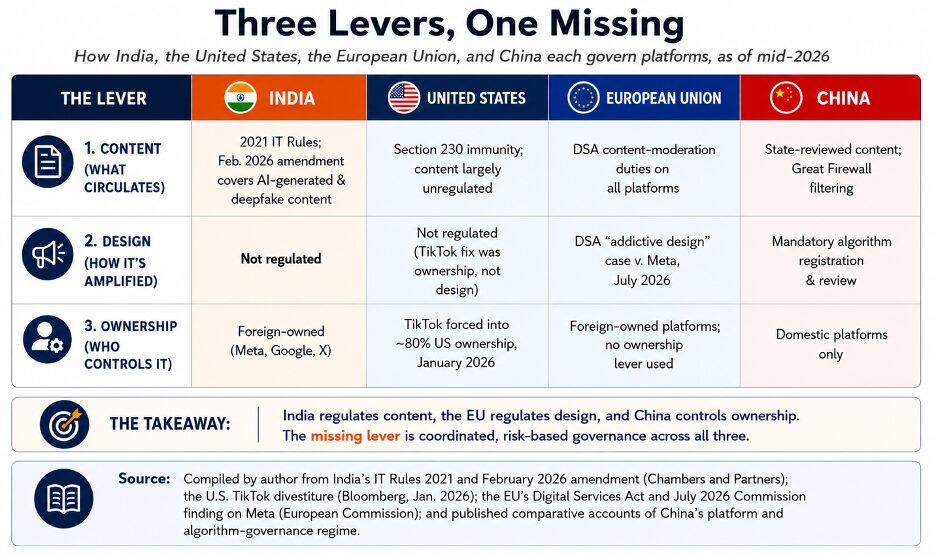
The table understates as much as it reveals: India’s regulatory ambition is real and rising, but the assets that matter, ownership and algorithmic design, sit outside its jurisdiction in a way they no longer fully do for the United States, and increasingly do not for the European Union.
The cleanest test of whether these costs are inherent to “digital India” or specific to one business model runs inside the country already. UPI, India’s public payments rail, delivers real financial inclusion without monetising attention or user dwell-time. WhatsApp, Instagram, and YouTube, serving the same population on the same devices, do. The productivity and mental-health literature tracks the second group, not the first — evidence the harms are structural to the extraction model, not to smartphones or India as such. Duke and Montag link self-reported productivity loss (Duke and Montag 2017) to on-the-job smartphone use; Finkelsztein prices the toll in Argentina (Finkelsztein 2025) at 12.7 percent of gross value added in the most exposed sectors; and in India, a quarter of surveyed college students score high on smartphone-addiction measures (Handa and Ahuja 2020), disrupted sleep the most consistent casualty. Three unrelated economies converging on one finding resists easy explanation by any single national culture of use.
The mental-health literature points the same way at greater scale. Across 113 countries surveyed through the Wellcome Global Monitor (Ranabhat, Marion, and Jakovljević 2025), social-media users report anxiety or depression at markedly higher odds than non-users, an association concentrated among the young, women, and the lowest income quintile — a burden that falls disproportionately (Naslund et al. 2020) on the low- and middle-income countries that also host most of the world’s social-media users. An Indian adolescent cohort study (Maurya et al. 2024) finds the relationship runs both ways at once: heavier use predicts worse wellbeing, and worse wellbeing predicts heavier use, a loop rather than a one-way effect.
Where the attention economy meets Indian politics, the evidence points to something more specific than ordinary polarisation. A field experiment testing whether media-literacy training helps Indians identify misinformation (Badrinathan 2021) found no significant average effect — but among respondents who supported the ruling party, the training left them significantly worse at identifying misinformation favourable to their own side. The finding travels beyond India: the standard demand-side remedy for platform misinformation, teaching users to spot false content, runs into a wall exactly where the content flatters an existing political identity. If correction fails where it matters most, the burden shifts to the supply side, to the design of systems deciding what a partisan user sees — exactly the lever India’s rules do not pull. The problem’s scale was visible by 2019, when the ruling party built WhatsApp outreach around each of India’s 927,533 polling booths (Time 2019), a network with theoretical reach above 700 million, even if actual reach fell well short.
The security dimension has scaled alongside the platforms. Ministry of Home Affairs figures (The Print 2026) show cybercrime complaints reaching 28.15 lakh in 2025, up 24 percent on the year, with reported losses of roughly ₹22,495 crore — dipping only slightly from 2024, as faster fund-freezing offset a caseload prosecutions have not kept pace with. A decade-long survey (Tripathy 2024) documents a parallel rise in ransomware and social-engineering attacks, and generative AI has layered a new risk on the old one: AI-generated misinformation already circulates on WhatsApp (Garimella and Chauchard 2024) among users newly arrived online, who are least equipped to recognise it. As early as 2018, the government formally asked WhatsApp to curb disinformation (Neyazi and Schroeder 2021) on its own platform — an early admission that a foreign-owned messaging system had become a domestic security concern the state could request action from but not directly govern.
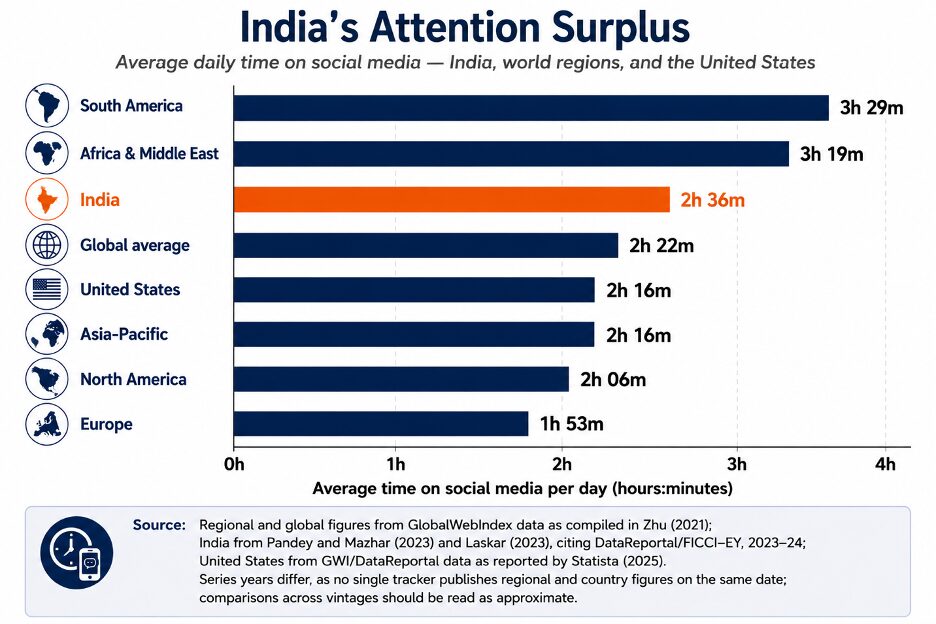
The term digital colonisation deserves scrutiny rather than assertion, and in India it carries a charge the word would not carry everywhere. Indian economic historiography already has a name for extraction without reinvestment: Dadabhai Naoroji’s nineteenth-century “drain of wealth” thesis, which held that colonial India generated raw wealth processed and valorised elsewhere, returning home only as a finished good India then had to buy back. Reproducing that structure today requires no viceroy. No one is compelled to install WhatsApp, and India’s parliament could legislate on ownership or design tomorrow if it chose to; the disanalogy with historical colonialism is real, and worth stating plainly. What survives is narrower than territorial subjugation: a dependency in which value generated by one population’s attention is captured mainly by firms domiciled elsewhere, on terms that population did not set. That is compatible with voluntary use and full nominal sovereignty — a claim about where economic rents and design authority sit, not coercion, though for India it is a structure with an uncomfortably familiar shape.
Nor is the record univocal. Short-video platforms have created new entrepreneurship and reached audiences the traditional media economy ignored; diaspora communication is cheaper and richer than a decade ago; and India’s own digital-governance record mixes genuine democratic features with illiberal ones (Kurt 2026) rather than sitting cleanly on either side. Rising cybercrime figures partly reflect improved reporting rather than pure deterioration. None of this overturns the argument; it bounds it. The gains concentrate in platforms India built or subsidises itself; the costs concentrate in platforms it neither owns nor redesigns.
Three trajectories remain open, and none of them is a prescription. Continued concentration would extend today’s ownership structure into generative AI and ambient computing, embedding current costs permanently into the Indian economy. Fragmentation — Washington on ownership, Brussels on design, Beijing on state control — would raise compliance costs for any platform operating across all three, making India’s market size a decisive factor in how that fragmentation settles. A third path would see India extend UPI’s public-infrastructure logic into communications, identity, and algorithmic systems more broadly, recovering some autonomy without China’s degree of closure. Which of the three unfolds is an empirical question this piece does not resolve; what the 2026 record shows is that passivity is not the neutral, low-risk option it might once have seemed.
The puzzle was why platforms built to connect societies became infrastructures capable of reshaping behaviour, markets, culture, and security, and why India sits unusually exposed to that transformation. The answer, on this evidence, is structural rather than incidental: attention is now an economic input, behaviour a prediction product, and platforms the firms that own both processes. Measured against Washington’s ownership lever and Brussels’ design lever, both exercised within 2026’s first seven months, India has so far pulled only the content lever — real, but narrower than the problem it addresses. Whether digital colonisation proves the right term, the asymmetry it names is not in serious dispute: the country contributing the largest volume of attention and data to this system has the least say in how that system gets built. What happens to that asymmetry will shape India’s internal security and help decide how the wider international political economy of attention gets written.