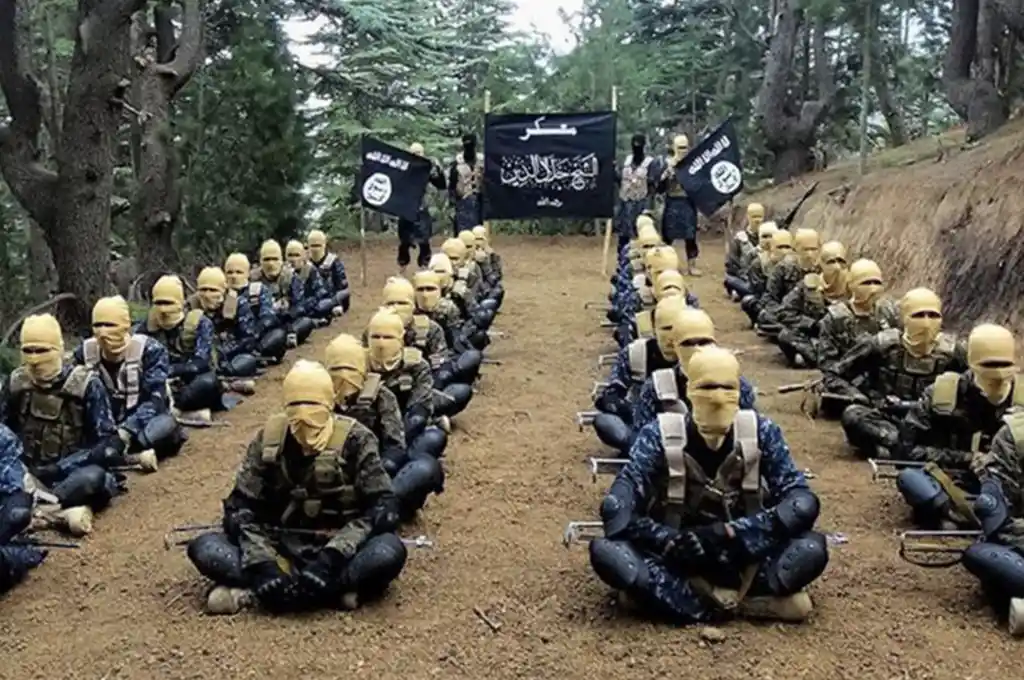
ISIS-K is a term that is still relatively unknown in India. Few people are aware of their existence, let alone of the risks involved. It is, however, an ever-increasing threat in the region. There may not be a reason to be alarmist. But at the same time, it doesn’t harm to know which threats the country and the region are facing.
ISIS-K, also known as ISKP, is an offshoot of the famous ISIS or ISIL in Iraq and Syria. It is originally known for its ultra-violent caliphate, established in 2014. At the time the militants seized vast territory across in the two countries in the Middle East. They declared their own State. A concept that proved attractive. Fighters from around the globe were flocking to assist. These foreigners became known as the Foreign terrorist Fighters (FtF`s). The world came together in a coalition to fight this self-declared sectarian Islamic project. As a result, the coalition militarily defeated ISIS in 2019. The caliphate is no more. Many of the FtF`s went back to their country of origin. Their reintegration is still ongoing in a number of countries of origin. The military defeat of ISIS resulted from the joint efforts of what is called `the global coalition against ISIS[1]`.
The ideology
However, the ISIS ideology did not disappear. On the contrary. ISIS thinking is rooted in the idea that there is only one proper interpretation of the Islamic religion. ISIS defines every non Sunni Muslim as kafir. It considers therefore every non Sunni as legitimate target of their violent actions. This is why Shia Muslims and their mosques are often targeted. These targeted attacks on `the others` often result in tensions between Shia and Sunni communities. Othering and identity politics have impact in real life. It works. The other important element in ISIS ideology is the continued ambition to create a proper State with the required institutions. The creation of the caliphate in Iraq and Syria was not an incident. It is the very idea. ISIS opposes the existing model of a `Muslim majority State`. To them it is not in line with Sharia law and it is not `pure` enough.
After the defeat of the ISIS caliphate in 2019 the organisation took some time to regroup and reorient itself. The results of this `time off` are visible in faraway Africa. But also in the Indian neighbourhood.
Where is ISKP?
As the name tells us ISIS-K or ISKP is the offshoot of ISIS, based in the Khorasan Province. The province covers most of Central Asia, part of Pakistan, Afghanistan and a big part of Iran. This is a big chunk of Central Asia. ISKP is also recruiting their potential followers in India. ISKP attempts to radicalize Indian youth through propaganda via regional magazines like “Voice of Hind”. There is even a localized offshoot called the Islamic State – Hind Province (ISHP). ISKP`s radicalisation and recruitment process however are technologically `ahead of the curve` in the online environment. As the ICCT[2] uncovered recently ISKP exploits AI driven tools to identify their target audience and seduce them into a gaming world where violence is normalised. Subsequently AI tools are used to escape the monitoring tools of the platforms and the security services.
Eventually establishing a caliphate in the Khorasan province is the plan. Very much like a copy of the (failed) caliphate in the Levant. ISIS has learned some lessons however. One of the lessons learned is the fact that the creation of a caliphate provokes a strong military reaction. Especially because they attract too much attention of the international community at a too early stage. So they choose to stay under the radar for a longer period of time and expand their sphere of influence before going overtly public. AI is helping ISKP to stay under that radar. And it is happening in the online space. It is spreading in communities where security services can hardly detect. The AI race is on. The new caliphate is online[3]. And `online` is global by definition.
Who is fighting ISKP?
Even though ISKP has decided not to declare a new physical Sunni Islamic State too soon, they have certainly been noticed and some governments are actively fighting this new threat. Since the attack by ISKP on American troops on August 26, 2021 that killed at least 182 people, including 169 Afghan civilians and 13 U.S. service members, the US is keen to confront this outfit. And they have found Pakistan as their partner. In February 2025 Pakistan arrested the alleged planner of the August attack on US forces in Afghanistan. Since ISKP has conducted high-profile strikes against ideological opponents and rival seminaries[4] the organisation creates tensions between Sunni and Shia communities inside the country as part of their approach. So Pakistan is keen to cooperate with the US because ISKP is a serious headache for the country.
But there is more to it. Because the global reach of ISKP has motivated youngsters around the globe to commit lone wolve attacks. It is only a couple of days ago (mid-June this year) that Europol coordinated a week-long counter-terrorism operation with Ireland, Belgium, Czechia, Germany, Finland, Italy, and Spain and the US FBI. This operation targeted support networks in Europe for ISKP. Several ISKP-affiliated individuals were arrested, mainly of Chechen and Central Asian origin. The action focused on financing, facilitation and operational support for ISKP. The Global reaction is on.
India can not ignore the issue. There are indications that ISKP is targeting potential supporters in southern regions of the country. The security services are aware and are dismantling whenever and wherever they can. But international cooperation is at least part of the answer. India is not yet a partner in the Global Coalition[5]. It may want to consider the option of joining the 90 other partner countries.
But most importantly, as the ICCT indicated in their article, an important part of the solution is offline. In the words of the ICCT: `Counter-terrorism response is never the exclusive domain of security agencies. A threat operating at the level of culture, identity, and belonging demands a societal response — one that mainstreams prevention across education, community leadership, and digital literacy, enabling early and meaningful intervention well before radicalisation reaches an operational stage`.
In other words: if ISKP goes online, we go offline to confront the threat on a human level.
[1] https://theglobalcoalition.org/en/
[2] Engineering the Virtual Caliphate: Islamic State’s Exploitation of Gen-Z Culture” by Tahir & Jadoon, published by International Centre for Counter-Terrorism in April 2026.
[3] https://www.visionofhumanity.org/the-terror-group-expanding-beyond-borders-and-into-cyberspace/
[4] https://www.aljazeera.com/news/2025/2/28/blast-at-taliban-linked-pakistani-seminary-kills-six-people-injures-20
[5] https://theglobalcoalition.org/en/partners/#asia