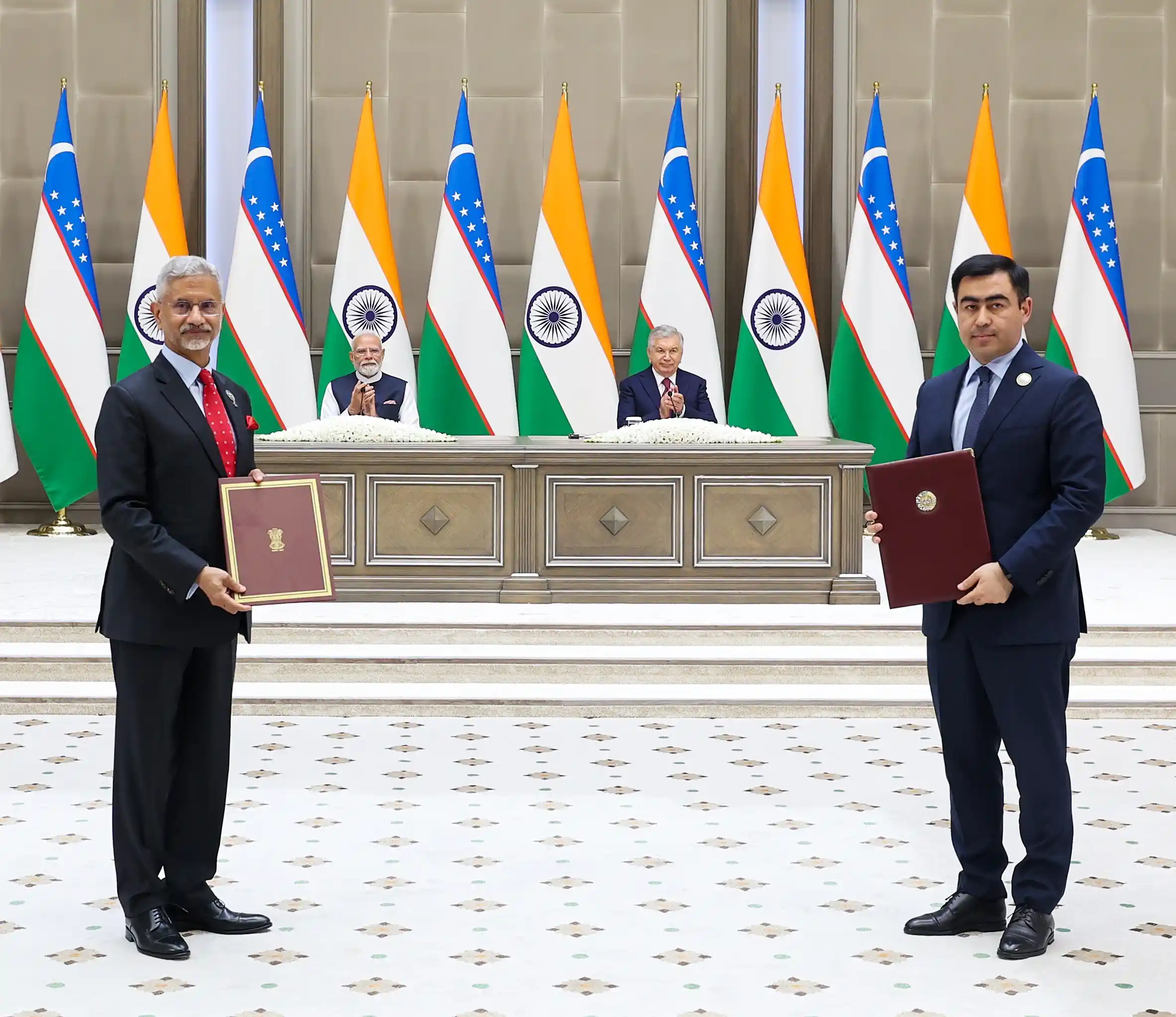
Prime Minister Narendra Modi’s four-day visit to Uzbekistan and the Kyrgyz Republic from in August-September 2026 is significant for India’s renewed engagement with Central Asia. The visit included bilateral diplomacy in Tashkent with multilateral diplomacy at the Shanghai Cooperation Organisation (SCO) Summit in Bishkek. While the visit to Uzbekistan focussed on upgrading bilateral economic, technological, security and cultural cooperation, the visit to Kyrgyzstan positions India in the broader strategic discussions related to Central Asia, India and SCO. This visit is important because Central Asia has become relevant to India’s security, connectivity, energy, critical mineral, counterterrorism and geopolitical interests. It also indicates New Delhi’s effort to pursue strategic autonomy by engaging simultaneously with different power centres. The main point is that India’s Central Asia policy is shifting from merely “connecting India to Central Asia” to connecting Central Asia with Indian technology and digital systems. In this context, energy cooperation is also of strategic significance due to its hydrocarbon and critical mineral reserves. So, Central Asia is becoming part of India’s broader energy-security architecture, alongside New Delhi’s relationships with Russia, the Gulf countries, Australia, and other resource-rich nations.
The most important outcome of PM Modi’s visit to Uzbekistan is the Comprehensive Strategic Partnership agreement between India and Uzbekistan. This is significant because it enhances the bilateral relationship beyond traditional political cooperation to include trade, infrastructure, digital technology, AI, critical minerals, healthcare, education and cultural exchanges. Both India and Uzbekistan have also set an objective of increasing bilateral trade to more than US$5 billion by 2030. This indicates the aim to move India–Uzbekistan relations towards a stronger economic partnership. For India, Uzbekistan is particularly important because it is geographically and demographically central to the Central Asian region. Deeper engagement with Tashkent will give India an important platform for expanding its presence across the wider Central Asian region.
One of the most important dimensions of this visit is cooperation in critical minerals. India’s rapidly expanding manufacturing and defense-industrial needs require secure and diversified access to these resources. Uzbekistan can become an important partner in India’s attempt to diversify critical mineral supply chains, particularly at a time when China possesses substantial influence over global mineral processing and supply chain networks. So, India’s engagement with Uzbekistan is increasingly about resource security as much as regional diplomacy. Another important dimension of this is related to India’s UPI ecosystem and Uzbekistan’s national online payment infrastructure. Indian UPI applications will be enabled to make merchant payments in Uzbekistan through the country’s national QR system. This is strategically important because India is increasingly using its Digital Public Infrastructure (DPI) as an instrument of foreign policy and economic diplomacy.
One of the major challenges that India faces vis-à-vis Central Asia is connectivity. India has no direct land connectivity with the Central Asian republics. In addition, Pakistan’s geographical position prevents easy overland access, while instability in Afghanistan creates additional complications. In this scenario, the quest for an alternative connectivity route becomes more crucial. India’s development of Chabahar Port and the International North-South Transport Corridor (INSTC) becomes strategically important in this context. A successful connectivity network through Iran could eventually connect India to Afghanistan, Uzbekistan and other Central Asian republics while also providing access towards Russia and Europe. So, PM Modi’s visit to Central Asian region can be viewed as India’s larger connectivity strategy. Further, India’s ability to transform Central Asia into an economically accessible region will ultimately determine the success of this engagement. The Uzbekistan visit also emphasised India’s cultural and civilisational connect with Central Asia. India and Uzbekistan agreed to cooperate in preserving Buddhist heritage sites, while India announced a Sanskrit Chair and scholarships for Hindi-language studies. These initiatives will help in strengthening India’s civilisational diplomacy and soft power.
The second phase of PM Modi’s visit is in Bishkek, Kyrgyzstan, where he participated in the 26th SCO Summit. The summit brought together leaders including Russian President Vladimir Putin, Chinese President Xi Jinping, Iranian President Masoud Pezeshkian and other regional leaders. This was strategically valuable because the SCO is one of the few forums where India can simultaneously engage with China, Russia, Iran, Central Asia and other Eurasian states.
The Kyrgyzstan visit eventually complemented the Uzbekistan visit. Where, Tashkent strengthened India’s bilateral relationship with a key Central Asian power, Bishkek enabled India to shape the broader Eurasian strategic conversation. In all of this, security remains one of India’s strongest aspirations in Central Asia. The region’s proximity to Afghanistan makes Uzbekistan, Kyrgyzstan and the other Central Asian republics important partners in addressing terrorism, radicalisation, narcotics trafficking and instability. Central Asian cooperation can therefore contribute to India’s intelligence, counter-terrorism and regional-security objectives.
The visit also had major geopolitical significance because it occurred amidst continuing competition between China, Russia and the United States. India’s objective is not to turn Central Asia into an anti-China or anti-Russia platform but seeks to preserve strategic autonomy by maintaining working relationships with all major regional powers. The Bishkek meetings where PM Modi met Russian President Putin discussed bilateral relations as well as the Ukraine conflict reiterating New Delhi’s stand favouring an end to the war and diplomatic efforts towards peace.
PM Modi’s visit to Uzbekistan and Kyrgyzstan is therefore much more than a routine diplomatic tour. It represents India’s renewed attempt to transform Central Asia from a relatively peripheral component of its foreign policy into a more important pillar of its Eurasian strategy. The elevation of India–Uzbekistan relations to a Comprehensive Strategic Partnership, the focus on critical minerals and digital connectivity, the expansion of trade, cultural diplomacy and security cooperation, and India’s active participation in the SCO collectively demonstrate a more ambitious Indian approach to the region. However, the central challenge is still the connectivity issue. India’s strategic vision will have limited economic impact unless it can develop reliable routes linking the Indian market with Central Asia. Chabahar, INSTC and multimodal connectivity will consequently remain crucial. In strategic terms, the visit signals that Central Asia is becoming increasingly important to India’s national security, economic security and geopolitical strategy. New Delhi aims to establish itself as a credible, long-term partner while preserving the region’s strategic autonomy. This approach fits in New Delhi’s wider foreign policy philosophy of multi-alignment in an increasingly fragmented Eurasian order.
The views expressed are those of the author and do not represent the institution.