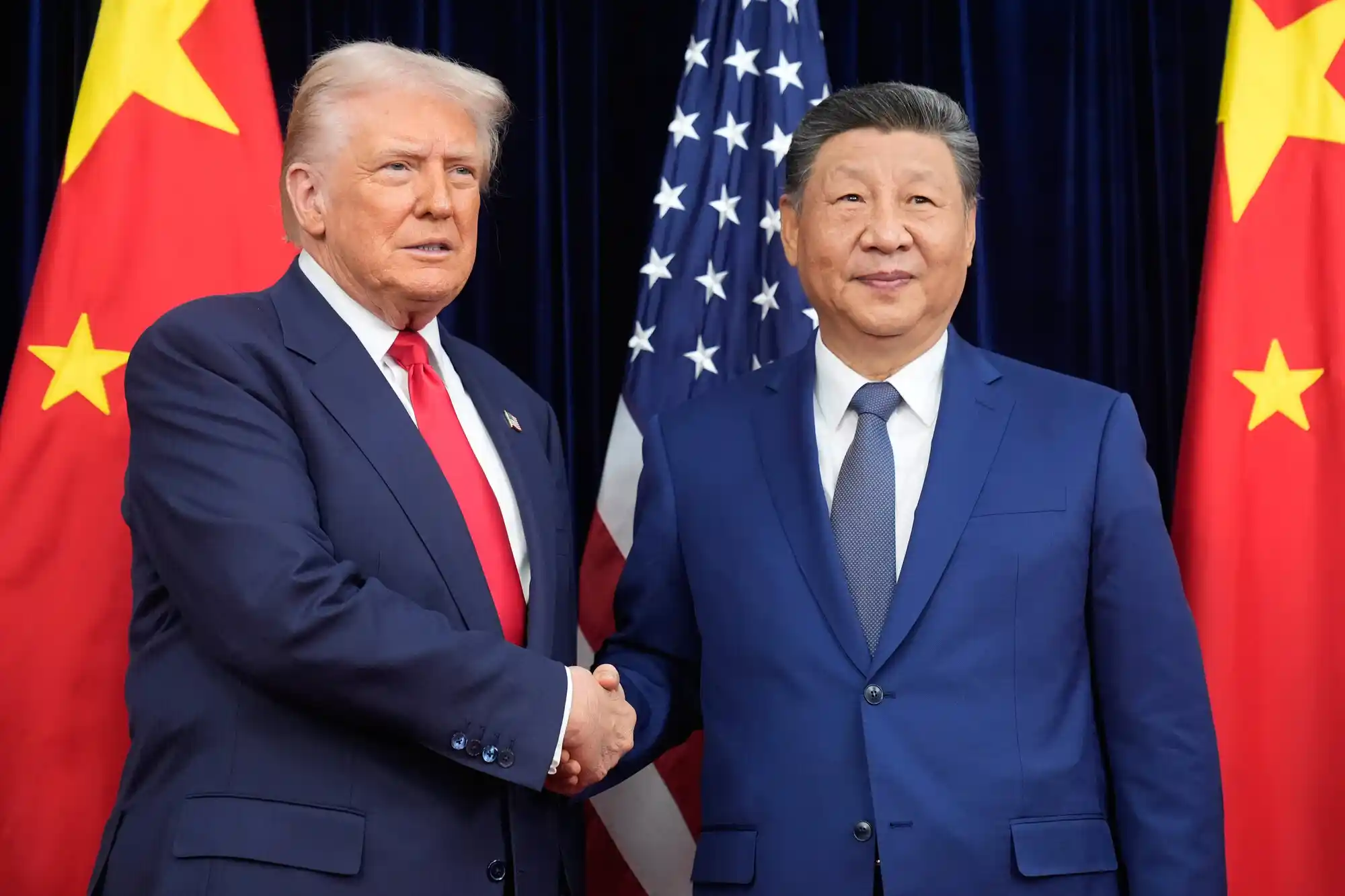
Before he met Xi Jinping in South Korea, Donald Trump declared in his usual bombastic style: “THE G2 WILL BE CONVENING SHORTLY!” He implied that the meeting was between the world’s two dominant powers, responsible for setting the global agenda.
Trump was attempting to hype up the importance of his meeting with Xi—both to satisfy his own ego as the most powerful actor on the global stage and, at the same time, appeal to Xi’s vanity by elevating China’s status. This is a PR tactic. He is very generous in praising foreign leaders in his folksy style, especially when his actual policies towards them are punitive. He is so imbued with a sense of US power and superiority that he patronises others by liberally doling out praise.
This G2 hype was misplaced because Trump and Xi were meeting to sort out bilateral issues, not to address wider regional or global ones. On the Chinese side, the rhetoric against the US has been quite harsh in recent months over issues of US tariffs, trade wars, and technology denials. The Chinese retaliated by ceasing to buy soya beans and corn from the US and, more painfully, by imposing strict restrictions and controls on exports of rare earths, including rare earth magnets, whose processing and production China practically monopolises.
Rare earth elements are vital inputs for the defence industry and for electric vehicles, besides being used in numerous applications, including electronics like smartphones and computers, green technologies like wind turbines, and medical devices such as MRI machines. For the US, easing Chinese restrictions on rare earths had become a priority. The US is now signing agreements with a host of countries on rare earths—even Pakistan—which shows how vulnerable it feels.
Trump may claim that the meeting with Xi was a great success, but the reality is that the issues dividing the two countries have not been resolved durably. Both sides have agreed to suspend the measures they had taken against each other for one year only. They will review whether the agreements are implemented in good faith. With Trump’s unpredictability and inconsistency, and internal anti-Chinese pressures within the US system, China is being cautious. It is significant that China has kept the upper hand and will take reciprocal steps only after the US implements its part of the bargain.
The US has reduced tariffs on China to 47%, rolled back port fees on Chinese ships docking in US ports, and paused for one year the “50 percent ownership rule” for Chinese-owned vessels. Reciprocal countermeasures by China on US vessels have also been suspended. China has agreed to resume the purchase of soya beans from the US, much to Trump’s relief, as the interests of US farmers in Republican states were being seriously hurt. This had become a political problem for Trump. Interestingly, China has eased restrictions on exports of only 5 of the 12 rare earth elements.
The Trump–Xi meeting was far from a G2 dialogue, especially given the absence of any discussion on Chinese purchases of Russian oil. Trump admitted that he did not raise the issue, despite the US imposing sanctions on two major Russian oil companies—Rosneft and Lukoil—and maintaining the punitive 25% tariffs on India for buying Russian oil. Clearly, Trump judged that he would not get any positive response from China. Trump discussed the Ukraine conflict with Xi, but without pressing China to stop buying Russian oil. The argument that purchasing Russian oil helps finance Russia’s military operations in Ukraine—an argument used against India—does not apply to China. A true G2 would have involved some meeting of minds on the Ukraine issue, too, at Russia’s expense, but this did not happen.
Any G2 would also require a US–China understanding on the future of Taiwan. It would, in effect, mean accepting an eventual takeover of Taiwan by China, as this issue has become one of entitlement for the Chinese leadership. But Trump said that the Taiwan issue was not discussed with Xi.
The very fact that the Trump–Xi meeting took place in South Korea—a US ally where the US has a strong military presence—also undermines the logic of a G2, unless the US intends to withdraw not only from South Korea, but also from the western Pacific as a whole, including Japan, conceding that this region lies within the Chinese sphere of influence. A G2 cannot be based on competing spheres of influence in East and Southeast Asia, especially if the US continues to have defence obligations in the region.
Russia, which is also a Pacific power, will not accept a US–China G2. Russia wants to develop its eastern regions, and as it does so, it will fortify its defensive presence in the Pacific. The Arctic route, which Russia dominates and China eyes, gives Russia a strategic advantage, quite apart from its military capabilities, including the recent testing of highly advanced missiles.
India, too—with its rising economic profile, growing military capacities, and ambitions for a bigger role in global governance—will not accept a G2. The logic of a G2 would involve the US and China agreeing to subordinate India’s role in Asia and beyond to their own overriding interests. India has repeatedly stated its support for multipolarity, with the caveat that Asia must be multipolar as a prerequisite.
The agenda of BRICS, the SCO, and the IBSA forum (India–Brazil–South Africa) is geared toward multipolarity. The issues of UN reform—especially of the UN Security Council—and reform of international financial institutions revolve around more equitable distribution of power within the international system, and a greater say for developing countries in global governance. This entails an erosion of traditional Western hegemony, including that of the US. Talk that the US now wants to concentrate on hemispheric defence and extricate itself from obligations in other parts of the world, including Europe, is not in line with Trumpian ambitions to “Make America Great Again,” nor with threats to resume nuclear testing and to force Europe, Japan, South Korea, and others to heavily invest in the US—a demand they will only accept if the US remains committed to their security.
Multipolarity does not imply that all poles will be equal in power or influence. Power differentials will remain. Rather, it means that the US and China—as a so-called G2—will not be able to impose decisions on issues of global importance solely on the basis of their bilateral understandings. The G2 will not be able to substitute for consensus-building in UN bodies—whether political, environmental, trade-related, or health-related—nor replace forums like the G7, G20, BRICS, or SCO, even if the US under Trump is upending the existing global system.
China has benefitted immensely from the existing system and would like to preserve it as much as possible. It has launched its own initiatives in the areas of development, security, civilisation, and global governance, aimed at shaping its role in international affairs. A G2 would require US support for these initiatives—an unlikely scenario.