It has not been long since contemporary global dynamics began to be described as a “field of exploding realities” within an “era of uncertain fluidity.” Amidst constant shifts in the balance of power, alliances, and international relations, nations must remain hyper-vigilant and entirely prepared to safeguard their national aspirations and core interests. The relationship between Nepal and India is no exception to this reality.
Geography, civilization, deep people-to-people ties, and a shared commitment to democratic ideals provide a stable foundation for the relationship between these two neighbors. However, geopolitical dynamics are constantly evolving. The drivers of this fluidity are multidimensional, no single nation or government is solely responsible for these shifts.
The impressive rise of the Rastriya Swatantra Party (RSP), which secured a near two-thirds majority as a fresh political force, has generated widespread expectations of long-term political stability in Nepal. Crucially, this internal political stability must now be leveraged as a tool to maintain geopolitical equilibrium. To be sure, this is not the first time Nepal has seen a government with a near two-thirds majority. In the 2017 general elections, the left-wing alliance achieved a similar landslide victory. However, that was a shared success between two distinct entities, the CPN-UML and the CPN (Maoist Centre) and was deeply entangled in the sharp internal contradictions of the communist movement. Consequently, that massive mandate was squandered, leaving the country’s geopolitical balance even more fractured.
Following the Gen Z-led movement and the recent general elections, Nepal has entered a new chapter of opportunity. These historic milestones have generated profound expectations for a meaningful shift in both political mindset and governance. The young, newly appointed Prime Minister, Balendra Shah, has already made it clear that Nepal will move away from traditional, passive concepts like acting as a “buffer state” or maintaining “equal distance.” Instead, his administration aims to pursue a foreign policy centered on being a “dynamic bridge” and practicing “equal proximity.”
While analysts and politicians may debate the semantics of these terms, the core intent and spirit behind them are what matter most. Meaningful efforts driven by genuine goodwill are bound to yield positive results.
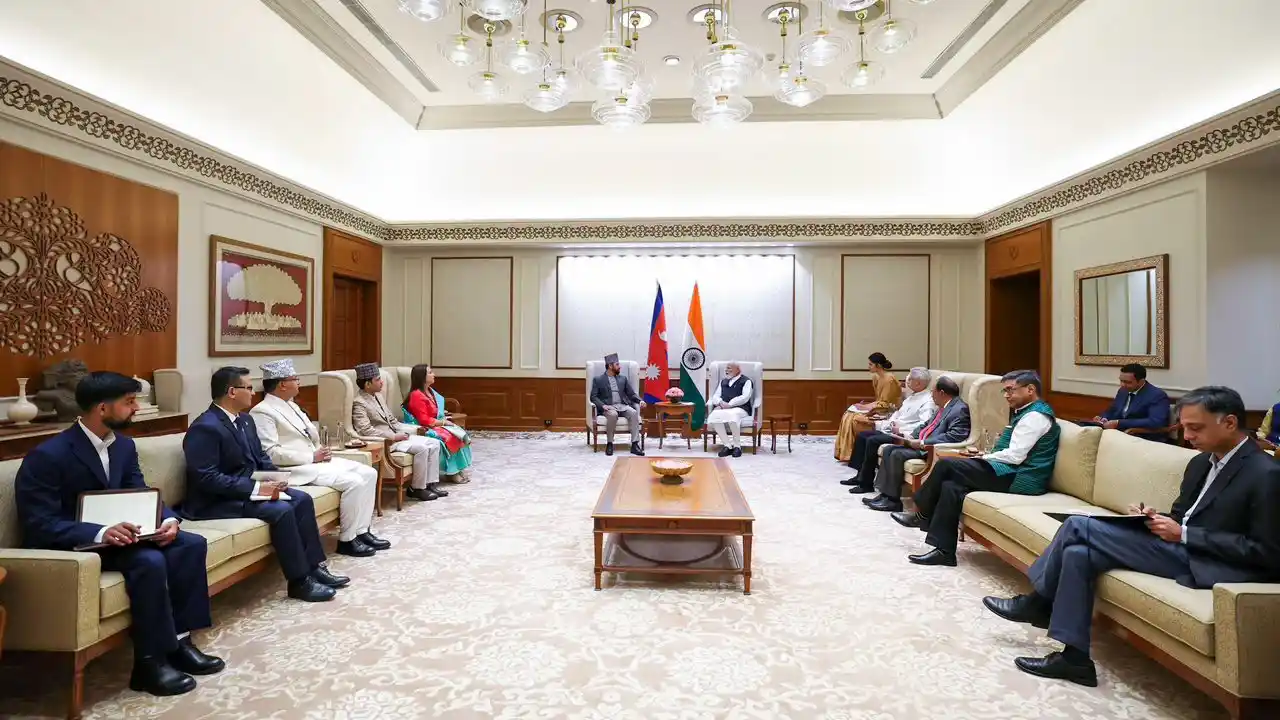
Recently, RSP Chairman Rabi Lamichhane concluded a five-day visit to India. Undertaken at the invitation of Bharatiya Janata Party (BJP), Lamichhane’s visit should be viewed as a strategic effort to elevate bilateral ties within this altered political context. High-level engagements of this nature are rarely confined to mere state formalities, they are driven by a strong sense of purpose and underlying missions. It is precisely this shared sense of purpose that makes such high-level dialogues possible.
Lamichhane’s meetings with top-tier Indian leadershipincluding PM Narendra Modi, Home Minister Amit Shah, External Affairs Minister S. Jaishankar, National Security Advisor Ajit Doval, and Foreign Secretary Vikram Misri, indicate that India is keenly observing and welcoming Nepal’s new political landscape. It also underscores that New Delhi continues to accord high priority to its relationship with Kathmandu.
Immediately after Lamichhane’s return, Foreign Minister Shishir Khanal embarked on an official visit to New Delhi. The meetings between Minister Khanal and his Indian counterpart, S. Jaishankar, culminated in several preliminary agreements. These initial understandings signal a harmonious start to cooperation under Nepal’s new political dispensation.
Nevertheless, persistent issues like the boundary dispute continue to shadow bilateral ties. It remains unclear what specific discussions the RSP leadership and the current government held with their Indian counterparts on this matter, or what response they received, as both sides have publicly maintained their traditional stances.
The Ministry of Foreign Affairs recently urged observers to look at the spirit rather than the literal wording of Prime Minister Balendra Shah’s remarks during a parliamentary Q&A session. While the cloud of suspicion has thinned slightly following clarifications that the Prime Minister’s remarks on “encroachment” were meant in the context of “cross-border occupation” and that Nepal is not seeking British mediation on the boundary issue, the ruling coalition must deeply reflect on whether these diplomatic maneuvers are sufficient. While governance shortcomings in domestic politics may be forgiven or have limited fallout, any signs of immaturity in managing geopolitical balance and diplomatic relations can carry an incredibly high price tag.
The boundary disputes over Kalapani, Lipulekh, and Limpiyadhura are historical. There is no alternative to resolving these issues through bilateral talks and quiet diplomacy aimed at fostering mutual trust and empathy. Finding the right resolution for long-standing issues can take time; impatience, hyperbole, or any form of political extremism will not yield positive results. More importantly, a stalemate on one specific issue should not be allowed to paralyze progress across other dimensions of the relationship.
In this altered environment, both India and Nepal must clearly define their current priorities and core concerns. Nepal needs to articulate exactly what it expects from India, requiring a well-defined, mutually agreed-upon agenda. The strengthening of bilateral ties must be anchored in structured agendas rather than emotional rhetoric or preconceived notions. If certain legacy issues prove too difficult for either side to navigate right now, both nations must be prepared to shelve them temporarily.
The report of the Eminent Persons Group (EPG) is a case in point. It has been eight years since this joint report was prepared. If it has become unacceptable, the reasons behind this gridlock need to be openly addressed. Could a new joint task force not be formed to review it under the current realities? When joint initiatives undertaken through bilateral consensus stall because one party finds them problematic, every effort must be made to find a mutually acceptable middle ground. If that proves impossible, there is no choice but to shelve the matter for the time being. Geopolitical dynamism demands that relationships be viewed through the lens of adaptation, review, and continuous improvement rather than rigidity or stagnation. Protecting shared interests does not mean compromising on sovereignty or surrendering core principles.
Traditional frameworks, such as the historic “Roti-Beti” connection, now require a modern redefinition. While the profound social, cultural, religious, and civilizational ties between the two nations remain foundational, they cannot endure in the modern era without contemporary connectivity, robust physical infrastructure, and deep economic cooperation. In today’s world, economic partnership is paramount, and infrastructure is an absolute prerequisite for deepening that economic collaboration.
In Nepal, there is frequent and loud public discourse surrounding a potential railway connection northward to China. In contrast, very little attention is paid to the fact that a Raxaul-Kathmandu railway line to the south—favored by much easier geography—would be faster to build, significantly cheaper, and far more economically viable. If both governments demonstrate strong political will, constructing this 136-kilometer railway line would not take long. Such infrastructure would dramatically boost people-to-people ties, economic integration, trade, and tourism.
The financial realities of the Pokhara and Bhairahawa international airports have already demonstrated that without robust economic and infrastructure cooperation with India, Nepal will struggle to reap returns from its largest capital investments. On such matters, New Delhi needs to demonstrate greater flexibility, accommodation, and generosity.
Water and energy partnership between Nepal and India must also be elevated to a new level. As Nepal inches closer to becoming self-sufficient in hydropower, India remains its most accessible and logical market. Given India’s massive population and its skyrocketing demand for clean energy, a long-term, strategic energy partnership between the two neighbors is vital.
Reviewing legacy irrigation agreements like the Koshi, Gandak, and Sharda treaties could unlock substantial benefits for both sides, especially since these projects rely on century-old technology and design capacities. Similarly, both nations must critically evaluate why mega-projects like the Pancheshwar Multipurpose Project have remained stalled due to mutual distrust.
Concepts like the Cultural Circuit, the Ramayana Circuit, and the Lumbini-Buddhist Circuit present clear win-win opportunities for both countries, where neither side stands to lose anything. There are dozens of such potential agendas between Nepal and India that require meticulous analysis, identification, and execution.
Historically and contemporaneously, Nepal and India have never been adversaries, nor will they be in the future. Sharing a porous border stretching over 1,750 kilometers, the two nations are not merely neighbors; they are partners in a shared civilization. Barring hyperbole and prejudice, it would not be an exaggeration to describe them as “twin nations” of the same civilization. Their heritage, historic sites, and national pride are inextricably linked. The bond between Janakpur and Ayodhya is irreplaceable, just as nothing else can replicate the profound connection connecting Lumbini, Bodh Gaya, and Sarnath.
Historical misunderstandings that have flared up from time to time have ultimately harmed both nations, leaving behind painful memories that neither side can recall with pride.
Nepal has no reservations in acknowledging the reality of India as an emerging global power. Similarly, India has never textually or in principle refused to recognize Nepal’s sovereignty and strategic autonomy. That being the case, there are no objective reasons why this relationship should not move forward smoothly. Problems born out of subjective anxieties and political posturing are short-lived and yield no good outcomes. Rising above complexes of power superiority or small-state vulnerability to shape relations realistically is the only way to ensure the well-being of the citizens of both countries.
The Balendra Shah administration must leave no stone unturned in imparting a new momentum and warmth to Nepal-India relations. A corresponding reciprocity is naturally expected from the Indian establishment. Treating Nepal as a primary partner under New Delhi’s “Neighbourhood First” policy must transcend geopolitical rhetoric and become a tangible reality, a humble acceptance of geographical and historical truth.
Ultimately, both nations lag behind the contemporary developed world in terms of economic development and human living standards. Crucially, the pockets of deepest underdevelopment and poverty in India lie precisely in the states bordering Nepal. The northern regions of Bihar, Uttar Pradesh, and West Bengal much like the southern plains of Nepal’s Terai-Madhesh remain plagued by weak infrastructure, limited economic opportunities, slow human development, and low per capita income.
Both New Delhi and Kathmandu must honestly acknowledge that they have failed to do justice to their borderlands. Global examples demonstrate that border regions can become vibrant hubs of economic dynamism, high commercial returns, and elevated living standards. Both sides need to seriously ponder why the reality along the Nepal-India border remains so starkly different.