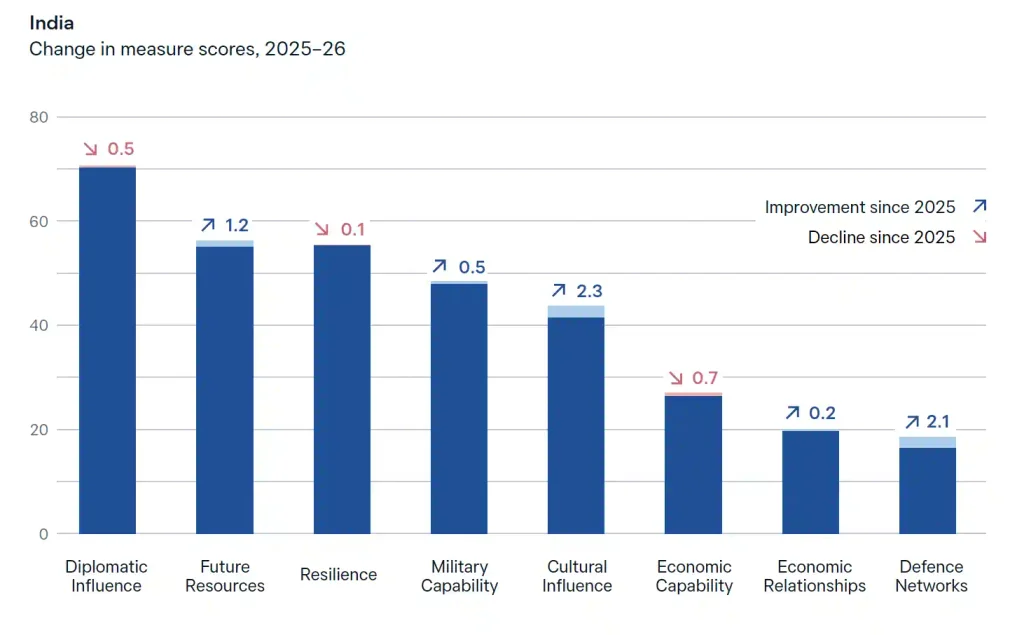
The most consequential figure in the Lowy Institute’s 2026 Asia Power Index, released in November, may not be India’s third-place ranking. It is the difference between two of its scores. India registers 40.5 points in comprehensive power but 56.2 in future resources. China, by comparison, scores 73.6 and 72.8, respectively. The distance between the two countries is considerably smaller when measured against their prospective capabilities than against their present influence. Moreover, the overall power gap between India and China is now at its narrowest since the index’s inception in 2018.
India’s opportunity lies not necessarily in overtaking China, but in ending the concentration of Asian industrial power around a single dominant economy. Whether that happens will depend less on population growth itself than on New Delhi’s ability to convert demographic abundance into sophisticated manufacturing, technological competence and durable economic relationships. The distinction is fundamental. A large population provides strategic potential; an indispensable industrial economy exercises strategic power.
The demographic divergence is already visible. China’s population contracted by 3.39 million in 2025, its fourth consecutive year of decline. Births fell to 7.92 million, according to China’s National Bureau of Statistics. Meanwhile, an April 2026 study published by the US Federal Reserve, drawing on United Nations projections, places India’s working-age population at approximately 1.1 billion around the middle of this century, while China’s continues to contract.
The significance extends beyond labour availability. Ageing societies confront rising pension and healthcare obligations, potentially limiting the fiscal resources available for infrastructure, technological investment and military modernisation. Countries with expanding productive workforces have an opportunity to enlarge their tax bases, deepen domestic capital markets and sustain investment without facing equivalent demographic pressures.
This mechanism helped transform East Asia during the second half of the twentieth century. Economists David Bloom and Jeffrey Williamson demonstrated in their landmark 1998 study that favourable demographic changes contributed materially to East Asia’s extraordinary economic expansion between 1965 and 1990. The region benefited from a growing proportion of working-age citizens relative to dependants. But demographic change became economically consequential because institutions, education systems and industrial policies created productive employment for those workers.
South Korea illustrates the distinction particularly well. Its transformation from an agrarian economy into an industrial exporter was accompanied by investments in education, infrastructure and technological acquisition. International markets imposed commercial discipline on domestic producers. Over successive decades, Korea progressed from labour-intensive manufacturing towards industries requiring substantial capital and technical expertise. Its geopolitical importance eventually became disproportionate to its population.
India possesses something South Korea never had: a domestic market of continental proportions. Yet it faces a challenge that Korea encountered in a different technological era. Manufacturing is becoming less labour-intensive precisely when India needs to absorb more workers into productive employment.
China understands this transition. According to the International Federation of Robotics’ September 2026 report, China installed 354,000 industrial robots in 2025, representing nearly three-fifths of worldwide installations. Its response to demographic contraction is not industrial retreat but accelerated automation.
This is the strongest objection to expectations of demographic convergence. A shrinking workforce need not produce a shrinking economy if technology raises output per worker sufficiently. China’s extensive supplier networks, engineering capabilities, transport infrastructure and accumulated manufacturing expertise cannot be replicated simply by offering cheaper labour elsewhere.
India must therefore industrialise without relying exclusively on the advantage of labour abundance. Its strategy should combine employment-intensive industries with advanced manufacturing, using the former to absorb workers and the latter to accumulate technological capabilities. The objective is not to reproduce China’s development model, but to compete with the economy that model has produced.
There are encouraging signs of such a transition. Indian electronics exports reached $31.97 billion between April and September 2026, increasing by 44 per cent over the corresponding period a year earlier. More revealingly, exports of electronics other than smartphones expanded by 56.5 per cent, encompassing products such as printed circuit boards, communications equipment and memory devices.
The composition matters more than the headline growth. Manufacturing ecosystems become strategically valuable when they develop multiple layers of production rather than merely assembling finished products. Component suppliers, precision-engineering firms, industrial software developers and research facilities create capabilities that can migrate across sectors, including aerospace, energy, telecommunications and defence.
Vietnam offers a cautionary example. Its emergence as a manufacturing destination demonstrates how effectively investment and exports can transform an economy. Yet the World Bank and OECD estimate that foreign-owned enterprises account for 73 per cent of Vietnamese exports. Weak connections between multinational manufacturers and domestic suppliers have constrained the wider diffusion of industrial capabilities.
India needs to avoid a similar outcome. The strategic return on attracting a multinational manufacturer should ultimately be measured by the domestic capabilities that remain if that manufacturer leaves.
India’s several FTAs, especially the most recent one with the European Union, represent a potentially important adjustment. Access to sophisticated external markets, alongside access to foreign capital and technology, could accelerate industrial upgrading.
Domestic reforms are equally important. The World Bank’s 2025 assessment of India’s development prospects identifies higher investment, increased workforce participation and stronger productivity growth as essential conditions for attaining high-income status by 2047. Greater participation by women in paid employment, better vocational education and more efficient urban labour markets would allow India to extract substantially greater economic value from a demographic advantage it already possesses.
The geopolitical consequences of successful industrialisation would extend well beyond bilateral competition with China. Countries across Southeast Asia, Europe and the wider Indo-Pacific would gain alternative sources of manufactured goods, investment and technology. Their ability to diversify economic relationships would expand without requiring them to disengage from Beijing.
Multipolarity, in this sense, is not primarily a diplomatic arrangement. It is an economic condition in which several centres of production possess sufficient scale and sophistication to prevent excessive dependence on any single one.
India does not need to displace China from the centre of Asian manufacturing to achieve this outcome. It needs to establish another centre of comparable strategic relevance across a sufficient number of critical industries. Even partial success would alter the calculations of governments and corporations throughout the region.
The next two decades offer India an unusually favourable intersection of demographic capacity, economic expansion and international demand for diversified supply chains. None of these conditions, however, will remain favourable indefinitely.
The demographic arithmetic is already moving in India’s direction. The industrial arithmetic is still being written. Asia’s future balance of power will depend on whether the two converge before India’s own demographic window begins to close.