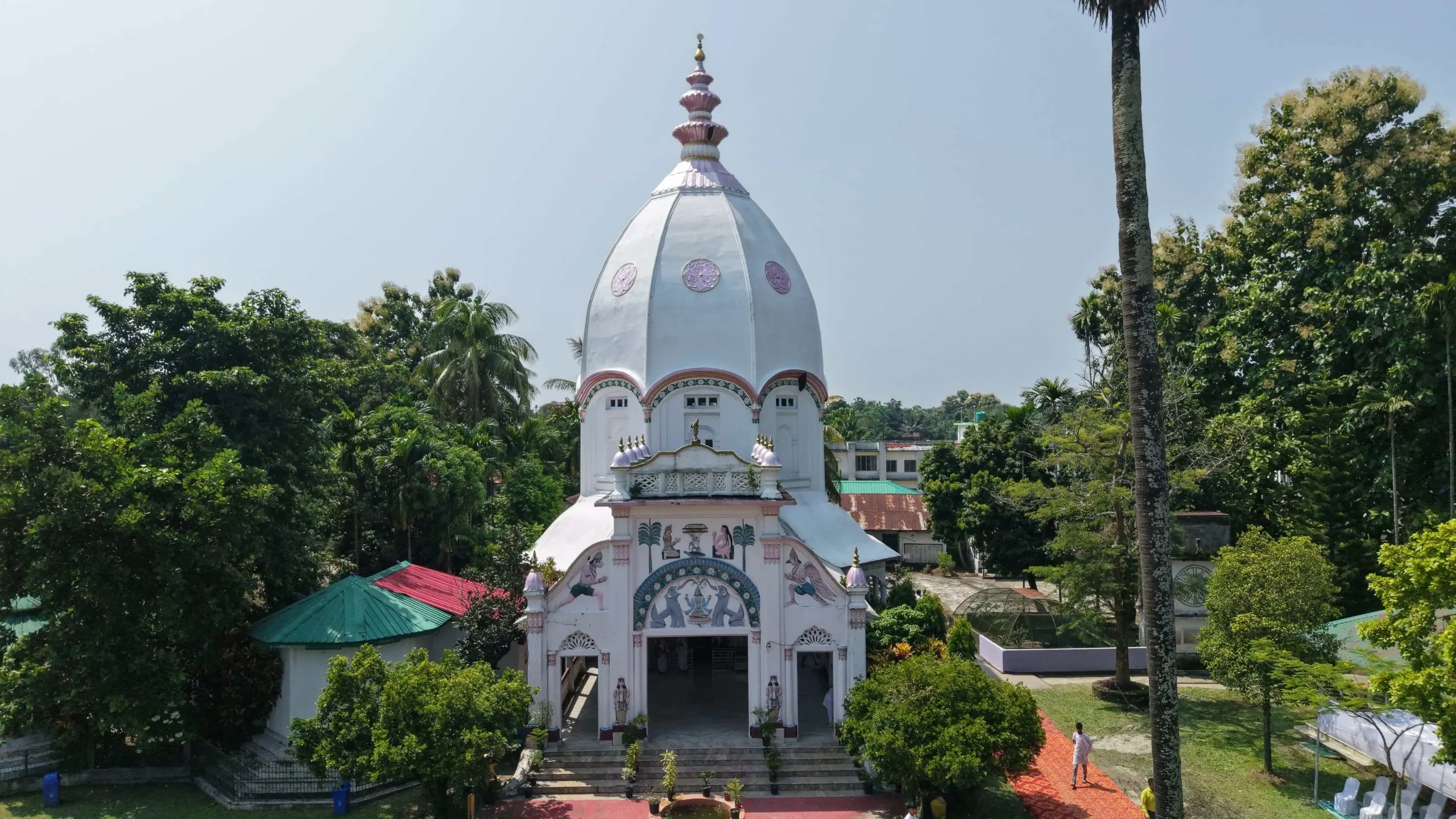
The decision to develop Madhupur Satra in Cooch Behar as a religious tourism destination deserves to be viewed as more than another tourism project. It is an opportunity to recover a forgotten geography of Assam’s cultural memory. The historic Satra lies in West Bengal, yet its deepest associations belong to Assam. It is linked to Srimanta Sankardeva, the architect of Assam’s Neo-Vaishnavite movement, and to the final chapter of a life that transformed religion into a culture of literature, music, theatre, dance and community.
Assam Chief Minister Himanta Biswa Sarma’s visit to Madhupur on September 19 and the announcement of a joint development effort with West Bengal have brought this place back into public attention. The proposal envisages Madhupur as a religious tourism centre, with Assam and West Bengal working together. Reports indicate that Assam has proposed contributing ₹35 crore, while West Bengal is expected to contribute ₹30 crore, subject to land and other arrangements. The challenge is ensuring that development does not overwhelm heritage.
Madhupur’s significance begins with Sankardeva himself. The Cooch Behar district administration records that during the reign of Koch king Nara Narayan, Sankardeva received shelter in the region and stayed at Madhupur Dham, which subsequently became a pilgrimage centre for Vaishnavite followers. West Bengal Tourism similarly identifies the Madhupur Dham Temple with Sankardeva’s final journey to Cooch Behar. The site is therefore not an isolated Assamese religious outpost. It is evidence of an older cultural landscape in which political boundaries did not define the movement of ideas, saints and communities.
That historical context matters. Sankardeva’s Ekasarana tradition was never merely a theology. It created institutions in which devotion, artistic expression and social participation could coexist. The satra became a space for prayer, but also for Borgeet, Bhaona, Sattriya dance, manuscript preservation, mask-making and other forms of cultural production. Assam’s Directorate of Archaeology has surveyed 862 satras in the State, illustrating the remarkable institutional footprint of the tradition. Madhupur belongs to that wider cultural world, even though it is geographically situated in present-day West Bengal.
The history of Madhupur is also a reminder that heritage is vulnerable. Historical accounts note that Sankardeva spent his final days in the area and passed away nearby. The earlier Bheladoba Satra, associated with this history, was later washed away by floods, and the institution was shifted to Madhupur with important objects and sacred materials. The satra therefore carries religious memory alongside a story of displacement, preservation and adaptation. In 1968, the satra complex was rebuilt with a temple and other facilities with support from the Madhupur Satra Samiti and the Assam government.
For decades, however, Madhupur remained surprisingly peripheral to India’s tourism imagination. Reports have repeatedly noted its manuscripts, inadequate facilities and limited public awareness. These are not merely administrative complaints. They reveal a larger problem in Indian heritage policy: places are often remembered ceremonially but neglected institutionally.
The latest initiative can correct that, if “development” is understood properly. A pilgrimage centre does not need to become a theme park. Madhupur needs roads, sanitation, clean water, accommodation, visitor information and digital connectivity. It also needs conservation science, archival facilities, trained guides, a museum, manuscript preservation, multilingual interpretation and strict controls on construction within the heritage zone. The recent initiative to digitally preserve rare Sanchipat manuscripts at Madhupur shows what a serious conservation strategy could look like: technology should protect memory, not replace it.
The most compelling possibility is to connect Madhupur with Batadrava Than in Nagaon, Sankardeva’s birthplace, and with other important sites associated with the Vaishnavite tradition. Such a circuit would turn a fragmented heritage map into a coherent cultural journey. A visitor could encounter the saint’s birthplace, his institutional legacy and the place associated with his final days there. It would create an unusual form of interstate cooperation: culture becoming the reason for infrastructure and cooperation.
Yet religious tourism must not be reduced to footfall. The success of Madhupur should not be measured simply by the number of buses arriving each year. The more meaningful measure would be whether visitors leave understanding why Sankardeva still matters. His legacy offers cultural confidence without cultural isolation. His institutions travelled across regions; his artistic traditions crossed social boundaries; his ideas continue to animate Assamese identity while remaining accessible beyond Assam.
There is also an important federal lesson here. Madhupur belongs administratively to West Bengal, but its heritage resonates profoundly with Assam. This is where cooperative federalism can become culturally meaningful. States need not treat heritage as property. Some places are shared inheritances whose preservation can deepen relationships between neighbouring regions. Assam and West Bengal can use Madhupur to demonstrate that cultural geography can be more expansive than political geography.
The timing matters. India is seeking to strengthen domestic tourism and preserve intangible heritage. Religious tourism, if planned responsibly, can generate livelihoods for local communities, artisans, guides, transport operators and small businesses. But the economic value should emerge from authenticity rather than commercial excess. Visitors should find a living tradition, not a sanitised spectacle.
Madhupur therefore deserves restoration before it receives reinvention. Its buildings, manuscripts, rituals, performing arts and landscape need protection alongside new visitor facilities. A heritage impact assessment, carrying-capacity study and long-term maintenance plan would be as important as the initial capital expenditure.
The opportunity is to make Madhupur visible without making it ordinary. If developed with restraint, scholarship and interstate cooperation, the satra can become not merely a religious tourism hub but a bridge between Assam and Bengal, between past and present, and between spiritual memory and contemporary public life. Sankardeva’s final landscape should not be remembered only as the place where a saint died. It should be experienced as a place where a civilisation of ideas continues to live.