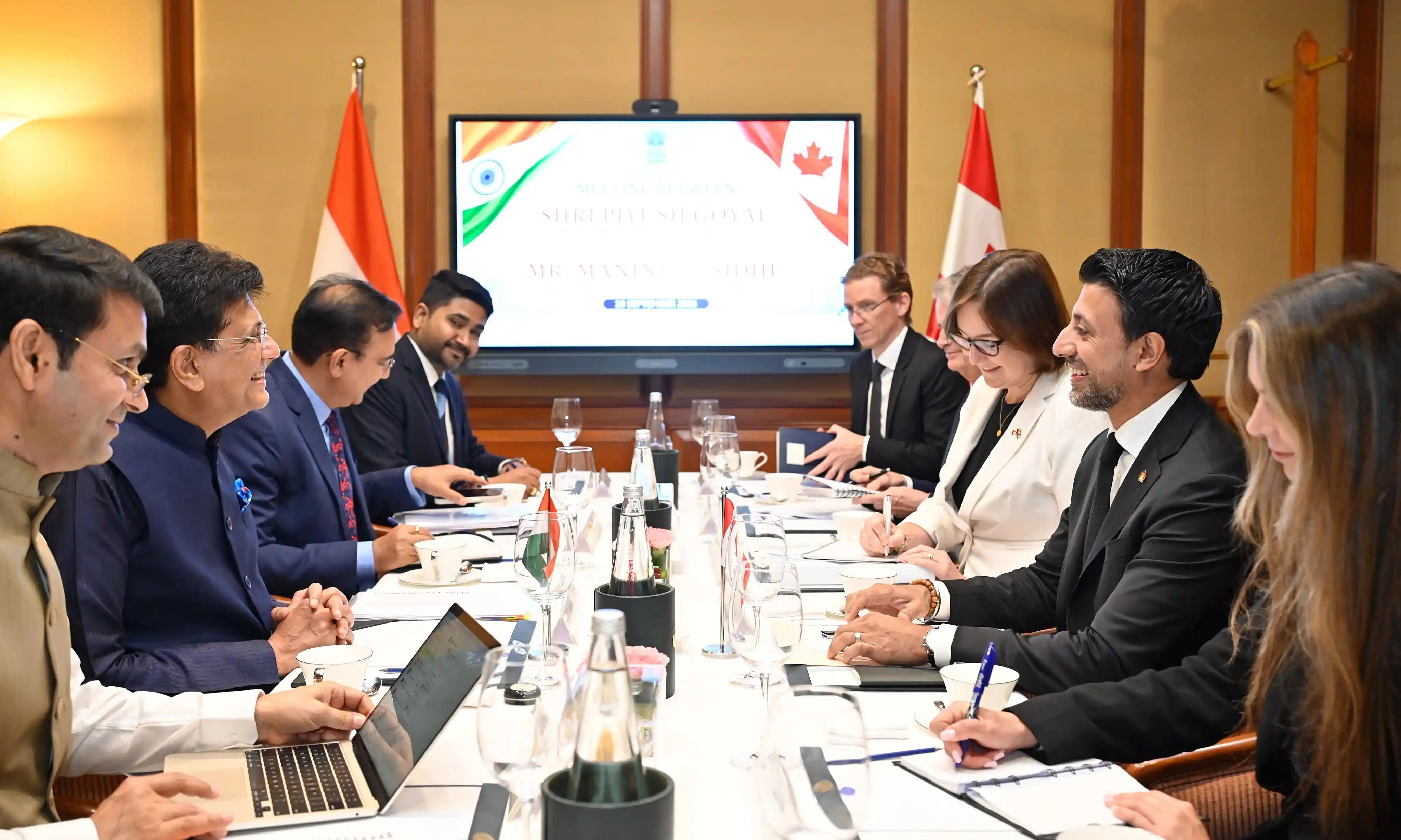
The elements of a strong economic relationship between India and Canada have never been lacking. What has been missing, at different points, has been the political and institutional momentum to bring these ingredients together.
The contrast is striking. Canada has capital, energy, food, technology, critical minerals and considerable expertise in advanced industries. India has a large and growing market, a competitive manufacturing base, an expanding digital economy, a substantial pool of skilled professionals and rapidly rising requirements for energy and natural resources. There is also a deep people-to-people connection between the two countries. Yet, for much of the past two decades, the economic relationship remained well below its potential.
There are now signs that this may be changing.
The Joint Leaders’ Statement of March 2026 gave the renewed relationship a substantial economic dimension. It identified energy, critical minerals, clean technologies, science and technology, space, resilient supply chains and talent mobility as areas for deeper cooperation. Most importantly, it put the Comprehensive Economic Partnership Agreement (CEPA) back at the centre of the economic relationship.
With both governments determined to conclude the agreement by the end of 2026, the question now is what kind of CEPA India and Canada will construct—and how effectively it can be used to reshape the economic relationship.
That ambition needs to be viewed against the history of the relationship.
A relationship that has consistently under-traded
When India and Canada established a Joint Study Group in 2009 to examine the feasibility of a comprehensive economic agreement, bilateral merchandise trade was only around US$4 billion. The study concluded that there was considerable scope for expanding trade and investment, and negotiations for a CEPA began in 2010.
Nine rounds had been held by 2015, but the process subsequently lost momentum.
On 11 March 2022, both sides, through their respective trade ministers, agreed to consider an Early Progress Trade Agreement (EPTA) as a transitional step towards the comprehensive agreement. The proposed EPTA was itself envisaged as a substantive arrangement, covering goods, services, rules of origin, sanitary and phytosanitary measures, technical barriers to trade and dispute settlement. Nine rounds of EPTA negotiations were held between March 2022 and July 2023, before Canada paused the process in late August 2023.
Trade, however, did not stop.
Canadian sources put 2025 two-way merchandise trade at CAD13.6 billion (US$9.73 billion), while combined trade in goods and services stood at CAD30.4 billion (US$21.75 billion), with education-related services accounting for the largest share of service trade.
The opportunity is to change the composition of the relationship
Canada has the resources to become a more important supplier of LNG, LPG, crude oil, uranium and other energy products, while India is one of the world’s largest and fastest-growing energy markets. The March Joint Leaders’ Statement recognised this complementarity and established a Strategic Energy Partnership covering conventional energy, civil nuclear cooperation, clean energy and critical minerals. A CAD2.6 billion (US$1.88 billion) long-term uranium supply agreement between Cameco and India’s Department of Atomic Energy gives this ambition a concrete foundation. The two sides are also working towards a long-term LPG supply arrangement.
Critical minerals offer another natural area of convergence.
Canada possesses significant resources and expertise in minerals that are becoming increasingly important to batteries, clean technologies, advanced manufacturing and modern industry. The bilateral memorandum on critical minerals provides a basis for moving beyond simple resource transactions towards exploration, processing, investment, technology and supply-chain partnerships.
Clean energy provides a similar opportunity. Canada needs to expand renewable generation and storage as it modernises its electricity system. India has developed considerable capabilities in solar deployment, storage and scalable renewable-energy solutions. The two sides have agreed to cooperate across solar, wind, bioenergy, small hydro and storage.
Technology could ultimately prove an even larger canvas.
Canada has strengths in artificial intelligence, advanced research, quantum technologies and aerospace. India has a large digital ecosystem, a substantial technology workforce and experience in deploying digital platforms at scale. The renewed bilateral science and technology architecture provides a mechanism for turning some of these complementarities into actual projects. Space is another area where three decades of institutional cooperation between ISRO and the Canadian Space Agency provide a useful foundation.
CEPA: from political commitment to economic architecture
The negotiations also begin from a markedly asymmetric tariff structure. Canada already maintains MFN duty-free treatment on 77.8 per cent of its tariff lines, with a simple-average MFN tariff of just 3.8 per cent. India, by contrast, has duty-free treatment on only 4 per cent of its tariff lines and an average MFN applied tariff of 15.8 per cent. This means that, in negotiating CEPA, India will have to contemplate considerably greater opening of its market to Canadian goods, while Canada will need to provide additional preferential access beyond the already relatively liberal MFN regime it applies to Indian exports.
The adjustment is unlikely to be instantaneous. Tariff concessions are expected to be phased, with longer transition periods for sensitive sectors and faster liberalisation where the two economies are more clearly complementary. For India, the challenge will be to use this transition to improve the competitiveness of domestic producers; for Canada, it will be to translate preferential access into commercially meaningful exports rather than simply securing tariff concessions on paper.
The real significance, therefore, will lie not merely in the tariff reductions agreed on day one, but in the trajectory of market opening that CEPA establishes.
Four rounds have now been completed, and the political commitment on both sides is strong enough to make conclusion of the agreement by the end of 2026 a realistic objective. The target of taking bilateral trade to US$50 billion by 2030 is ambitious, but the greater significance of CEPA lies in what it could do to the structure of the relationship.
India will seek better access for its goods and services, particularly pharmaceuticals, engineering products, machinery, IT and professional services. Canada will have strong interests in agriculture and agri-food, energy, minerals, wood products and other resource-intensive sectors. These are not always easy negotiations. Domestic sensitivities on both sides are real and will need to be accommodated.
Canada, too, will have to manage domestic sensitivities, particularly in supply-managed sectors such as dairy, poultry and eggs, where it has indicated that it will protect the existing regime. The eventual balance will therefore depend less on headline tariff averages than on which products are liberalised, by how much and over what period.
Services may ultimately prove more important than goods. India’s competitiveness in technology and professional services complements Canada’s strengths in financial services, education, engineering, research and specialised expertise. Predictable arrangements for the movement of business professionals, consistent with domestic regulatory requirements, will therefore matter greatly.
The objective should not be the most ambitious agreement on paper. It should be an agreement whose provisions businesses on both sides progressively use—and whose benefits become more visible as the phases of market opening unfold.
From political reset to economic resilience
The economic relationship cannot, of course, be completely separated from the wider bilateral relationship. The experience of recent years demonstrated how quickly political and security differences can spill over into other areas of the relationship.
But there is another way of looking at this.
A sufficiently broad economic relationship can provide resilience. When businesses, investors, universities, energy companies, technology firms and financial institutions have substantial stakes in each other’s markets, the relationship acquires constituencies with an interest in continuity.
This does not mean that economics can substitute for diplomacy. Nor should commercial interests obscure differences that the two countries may continue to have on political and security questions.
It does mean that a mature bilateral relationship needs some economic ballast to withstand political weather.
CEPA can provide the framework. Its significance will not be measured simply by the tariff schedules announced when it comes into force. It will be measured by what happens over the years that follow: whether Canadian energy companies see India as a natural long-term market; whether Indian manufacturers can secure reliable supplies of critical minerals; whether Indian technology companies can expand in Canada with greater ease; and whether Canadian institutional capital finds a wider range of opportunities in India’s growth story.
The phased nature of market opening may, in fact, be an advantage. It gives businesses time to adjust, governments time to address emerging frictions and investors time to build the partnerships that tariff preferences alone cannot create.
India and Canada have spent many years discussing the potential of their economic relationship. The political will now appears to be in place to give that relationship an institutional foundation.
The challenge is to build a relationship resilient enough to make those complementarities work—and to ensure that the economic gains from the new partnership become sufficiently broad and durable to reinforce the wider bilateral relationship.