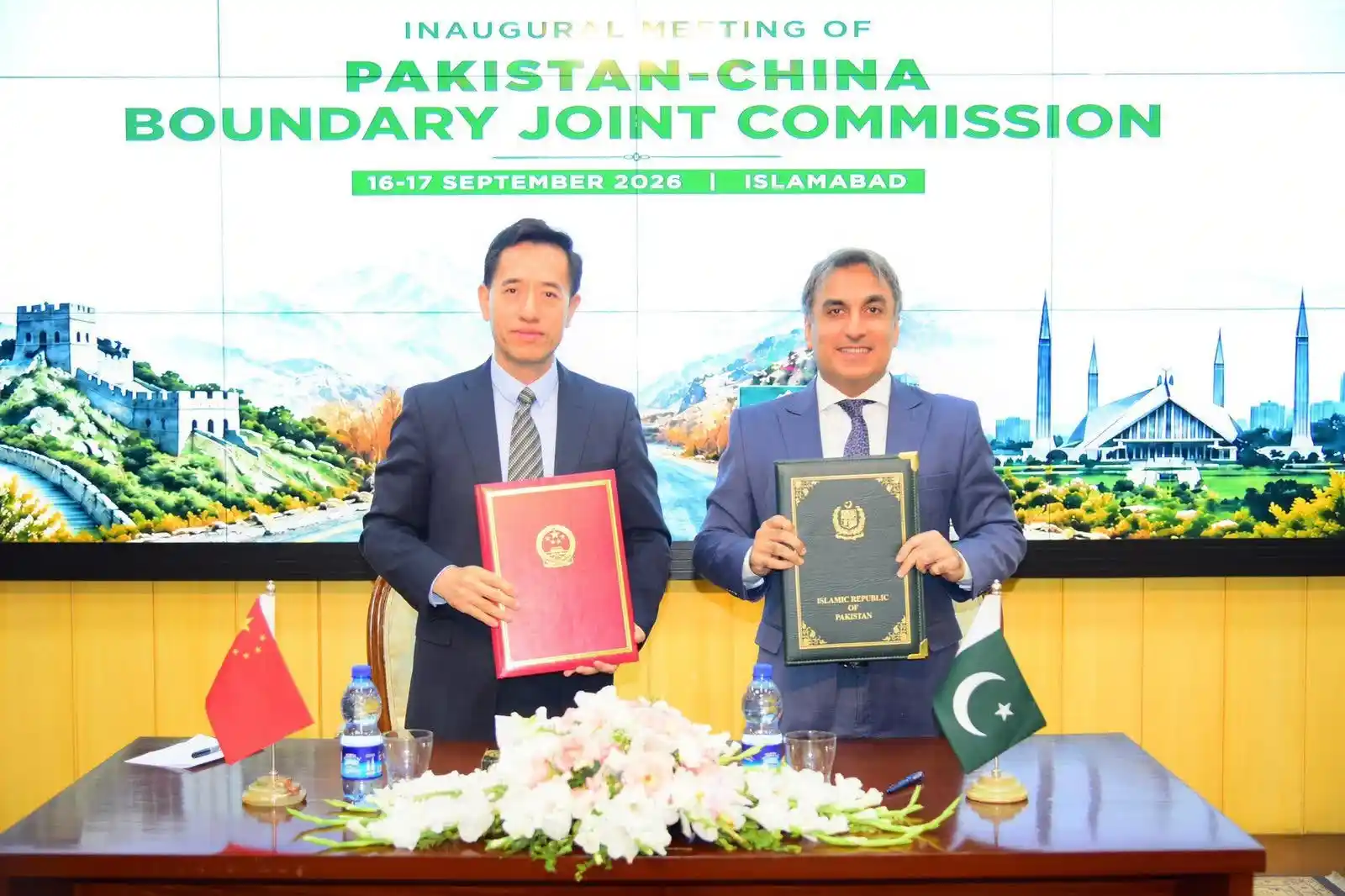
On September 16-17, 2026, Pakistan and China established a new border commission in Islamabad. India promptly dismissed the initiative as lacking legitimacy. According to Ministry of External Affairs spokesperson Randhir Jaiswal, Pakistan has no authority to enter into boundary agreements concerning territory it occupies illegally. India has never recognised the 1963 China-Pakistan Boundary Agreement, a March 19 agreement in which Pakistan ceded control of approximately 5,180 square kilometres of the Shaksgam Valley, part of the former princely state of Jammu and Kashmir, to China to delineate the boundary between the two countries in the Karakoram region. India has consistently rejected this transfer, arguing that Pakistan was not entitled to make decisions about territory under Indian sovereignty. Although the rhetoric is familiar, the emphasis of India’s objection has shifted. Previously, Beijing and Islamabad would reference Kashmir in joint statements without further action. In contrast, the current development involves creating a permanent commission with a defined mandate, designated co-chairs, and scheduled follow-up meetings in China.
The origins of this commission predate most contemporary reports. The concept was incorporated into the 2013 Agreement on the Boundary Management System, signed in Islamabad during the visit of China’s then-premier Li Keqiang. Article 45 of that agreement provided for a joint commission, but the provision remained dormant for thirteen years. This changed on 16 and 17 September 2026, when Li Ya of China’s Ministry of Foreign Affairs and Bilal Mahmood Chaudhary, Pakistan’s Director-General for China, formally inaugurated the commission. Its mandate includes border surveys, customs coordination, regulating the movement of goods and people, and overseeing the Khunjerab Pass. The Khunjerab Pass is not only the sole land route between China and Pakistan, but also an important corridor for trade, security movements, and energy projects. Situated at a high altitude in the Karakoram Range, it functions as the main gateway for traffic and goods moving as part of the China-Pakistan Economic Corridor, supporting direct connectivity vital to both countries’ strategic and economic interests.
India’s objection concerns not border management, but the legitimacy of the border itself. The dispute originates from 2 March 1963, when Pakistan transferred approximately 5,180 square kilometres of the Shaksgam Valley, part of the former princely state of Jammu and Kashmir (also known as the Trans-Karakoram Tract), to China. India has consistently refused to recognise this transfer. According to India, the 1947 Instrument of Accession incorporated all of Jammu, Kashmir, and Ladakh into India, rendering Pakistan’s 1963 transfer illegitimate and any subsequent arrangements void. Islamabad, however, disputes this interpretation and has characterised India’s objection as ‘baseless and legally untenable.’ Both parties stay entrenched in their respective positions, with little prospect for change.
Consequently, the commission’s joint surveys and customs coordination carry greater significance than may be immediately apparent. While these activities may appear routine, systematic surveys, verification of border markers, and the establishment of customs protocols throughout Gilgit-Baltistan and the Shaksgam Valley generate a documented record of shared governance. Such administrative procedures contribute to the normalisation of disputed territories, not through public declarations, but through sustained bureaucratic engagement. For Beijing, these measures safeguard investments in the China-Pakistan Economic Corridor and the Karakoram corridor. For Islamabad, they reinforce its western border through collaboration with a major power, thereby countering India’s ongoing claims. The strategic effects of these actions are evident, even if neither party states them explicitly.
The timing of these events matters. For almost two years, India and China have sought to ease tensions along the Line of Actual Control. The October 2024 disengagement in Depsang and Demchok followed a standoff. Despite this progress, both countries admit the situation is not fully resolved, though it is less tense. The new Pakistan-China border arrangement on India’s western border, happening at the same time as this fragile peace in the north, brings back old worries. Officials say that India could face pressure on more than one border at once. This issue is not limited to South Asia. India’s Indo-Pacific partners, including Quad members, will likely watch closely to see if India’s claim that administrative steps cannot replace legal rights claims over disputed land is a general principle or just for this case. This is especially important in the South China Sea, where several countries challenge China’s broad territorial claims and its building of administrative structures on disputed areas. If India stands firm and maintains that practical actions do not give legal rights, it could set an example for others facing similar challenges. The result will show how much India’s stance shapes how territorial disputes are handled in places like the South China Sea, where questions of sovereignty and control through ongoing activities are still hotly debated.
It is important to understand what a diplomatic statement can and cannot do. Rejecting the commission does not stop its work. Pakistan and China have already said the next meeting will be in China, regardless of what New Delhi says. India should focus on making its position clear: sixty years of administrative actions between Islamabad and Beijing, no matter how routine, do not equal legal ownership. Defending this view takes more than press releases. It means investing in briefings on infrastructure and defence along both the LoC and the LAC, regularly reporting unauthorised projects in occupied areas to the UN and other groups, and working closely with Quad partners to make sure land-border issues do not limit India’s choices at sea. India could also try several diplomatic and legal steps. For example, it could start talks with China and Pakistan to lower the risk of conflict, while also seeking more international support through outreach to groups like the G20 and BRICS. Filing legal objections at the International Court of Justice or backing third-party legal efforts could help show its legal position, even if these actions are mostly symbolic. India might also build stronger ties with neighbours like Nepal and Bangladesh to support a united regional stance on territorial integrity. While none of these steps will stop the new commission, they ensure that the record Pakistan and China are building will be challenged at every stage, rather than quietly accepted as fact.