The new comprehensive strategic partnership gives New Delhi and Tashkent a chance to turn a strong bilateral relationship into a practical platform for regional cooperation.
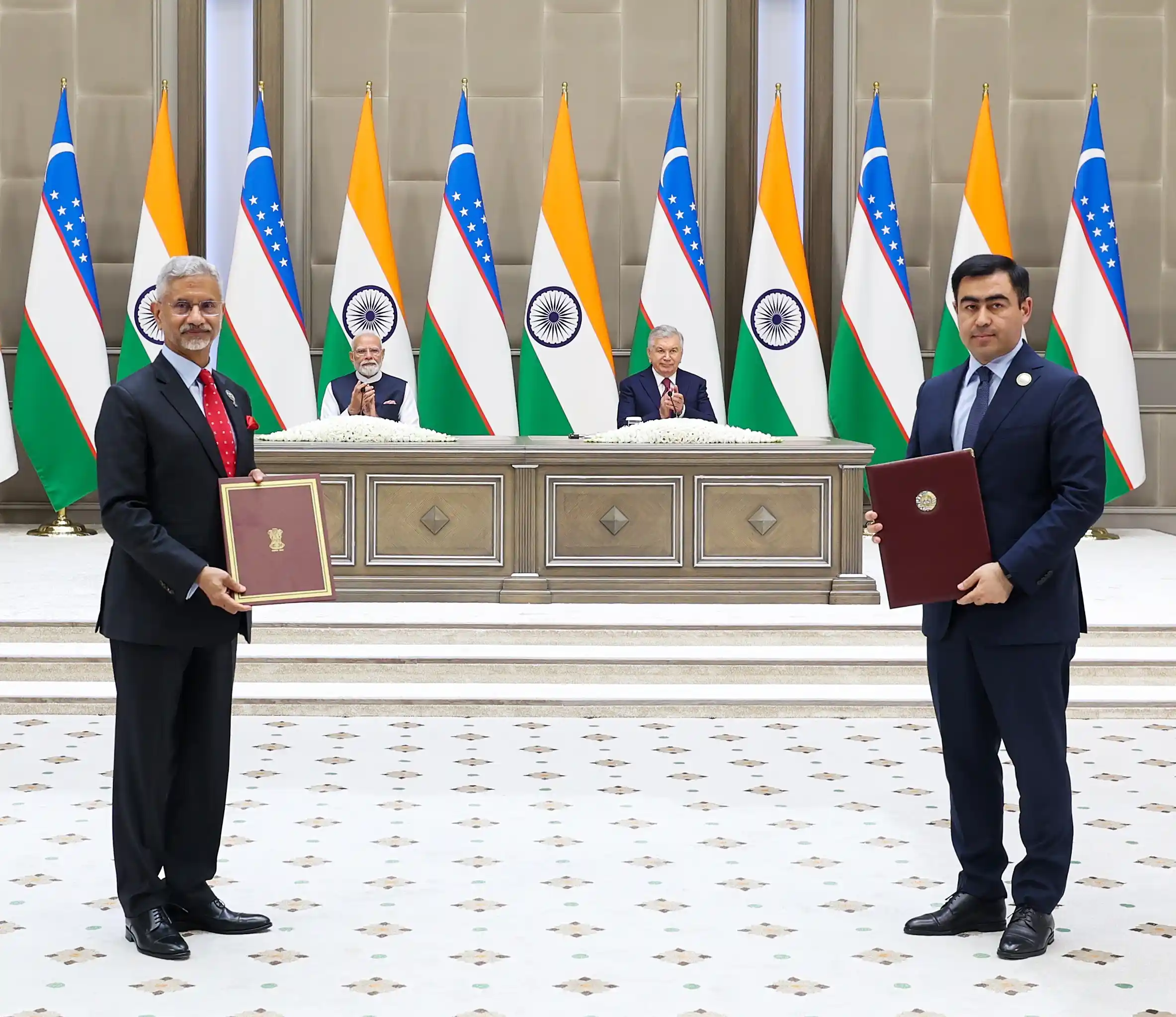
Prime Minister Narendra Modi’s state visit to Uzbekistan on 29–30 August produced a long list of agreements. The most consequential outcome, however, was the decision to elevate bilateral ties to a Comprehensive Strategic Partnership. The joint statement also created a foreign minister-led mechanism to oversee implementation and raised the intergovernmental commission to ministerial level. These changes matter because they can move the relationship from periodic announcements to sustained delivery.
For India, the larger strategic question is how to translate a successful partnership with Uzbekistan into a more effective Central Asia policy. New Delhi has valuable relations with every state in the region, and each partnership has its own logic. Yet regional initiatives often lack a clear implementation base. Uzbekistan is well placed to provide one. It sits at the geographic centre of Central Asia, borders all four of the region’s other republics as well as Afghanistan, and has made regional cooperation a central part of its foreign policy. An Uzbek anchor would complement India’s other Central Asian partnerships by giving joint projects a place to start, test and scale.
The Tashkent opening
The economic case is stronger than it was only a few years ago. According to the Embassy of India in Tashkent, bilateral trade rose from $980.4 million in 2024 to $1.318 billion in 2025, an increase of roughly 34 percent. The two governments have now set a target of $5 billion by 2030. Reaching it would require average annual growth of about 31 percent from the 2025 level. That is possible only if both sides widen the range of traded goods, reduce non-tariff barriers and lower the cost of moving money and merchandise.
The August agreements address these constraints more directly than earlier declarations. The two sides decided to form a working group on non-tariff and investment barriers, examine the next steps toward a preferential trade agreement on a time-bound basis, and strengthen links between Invest India and the Investment Promotion Agency of Uzbekistan. A commercial agreement between NPCI International Payments Limited and Uzbekistan’s National Interbank Processing Centre will allow Indian UPI applications to scan Uzbekistan’s UZQR merchant codes. For travellers and small businesses, payment interoperability is a concrete form of connectivity while slower transport projects are still taking shape.
The relationship also has more social depth than the trade figures suggest. Indian investment in Uzbekistan is estimated at about $451 million. Four Indian universities operate in the country, and more than 16,000 Indian students study there. India helped establish Uzbekistan’s first IT Park in Tashkent, while Indian training and scholarship programmes have reached thousands of Uzbek citizens. These networks create a constituency for cooperation outside government and give new initiatives access to firms, universities and skilled people.
Why Uzbekistan can serve as an anchor
Uzbekistan offers India three advantages at once. The first is convening capacity. Tashkent has invested heavily in improving relations within Central Asia and has promoted dialogue between Central and South Asia. This makes it a credible venue for projects that begin bilaterally but require wider regional participation. India would gain more from using that capacity than from treating every bilateral track as a separate compartment.
The second advantage is sectoral complementarity. Uzbekistan can supply uranium and other critical minerals, while India can contribute processing technology, finance, standards and a large market. Uzbekistan’s pharmaceutical clusters can host Indian manufacturing and research partnerships. Its demand for digital public infrastructure, artificial intelligence skills and modern urban services aligns with Indian capabilities. The new cooperation between Gujarat and Samarkand offers a useful model: links between Indian states and Uzbek regions can turn national agreements into projects with identifiable local partners.
The third advantage is strategic compatibility. Both countries favour diversified foreign relations and retain room for independent decisions. Uzbekistan does not ask India to choose between competing regional powers, and India does not seek exclusive alignments in Central Asia. This creates space for practical coalitions in trade, climate adaptation, education, counterterrorism and connectivity. Such cooperation can coexist with the region’s ties to China, Russia, Europe, Türkiye and the Gulf states.
From bilateral gains to regional platforms
A stronger anchor strategy should begin with a small number of measurable regional platforms. The first should be trade facilitation. India and Uzbekistan could pilot electronic customs data exchange, interoperable certificates and a digital help desk for small exporters. Once tested, these tools could be offered through the India–Central Asia framework. The aim should be to reduce clearance time and uncertainty, not merely to add another committee.
Connectivity requires the same practical discipline. India and Central Asia remain separated by difficult geography and political risk. The 2025 India–Central Asia Dialogue supported Uzbekistan’s membership in the International North–South Transport Corridor, and the August 2026 joint statement again called for multimodal routes and lower transport costs. The next step is to publish route-level data on transit time, freight charges, insurance and border delays. A diversified corridor strategy should combine available links through Iran and the Caspian with air cargo and other viable routes. Dependence on a single node would leave trade vulnerable to the next geopolitical shock.
A second platform should connect critical minerals to industrial skills. Geological cooperation is useful, but long-term value will come from laboratories, processing, recycling and technical training. Joint centres involving Indian firms and Uzbek universities could train specialists and certify materials to internationally recognised standards. This would give Uzbekistan a larger share of value added and help India diversify supply.
A third platform should focus on health and human capital. The Tashkent Pharma Park can host joint production and clinical research, while the large community of Indian medical students in Uzbekistan can support academic links, telemedicine and hospital partnerships. The two governments should agree on transparent quality benchmarks, student protection and mutual recognition pathways. A partnership that protects people and improves professional standards will be more durable than one measured only by enrolment or investment totals.
Climate cooperation can provide a fourth regional public good. India’s $1 million grant for ecological rehabilitation in the Aral Sea region is modest, but it can become a demonstration project if it combines Indian dryland technology with Uzbek experience in afforestation and community adaptation. Results should be published openly and linked to a wider India–Central Asia programme on water efficiency, heat resilience and land restoration.
The test is delivery
The new foreign minister-led mechanism should therefore function as a delivery council. It could maintain a public dashboard covering a limited set of targets: progress toward $5 billion in trade, removal of identified barriers, use of digital payments, transit performance, investment projects and education outcomes. An annual review involving businesses, universities and regional authorities would expose delays early and keep cooperation from becoming capital-centred.
Uzbekistan should anchor this next phase because the bilateral relationship already contains the institutions, people and political trust needed for implementation. The case does not rest on symbolism or geography alone. It rests on whether New Delhi and Tashkent can turn their new partnership into working systems that other Central Asian states find useful. If they do, the August summit will be remembered less for the upgrade in diplomatic terminology than for giving India’s Central Asia policy an operational centre.