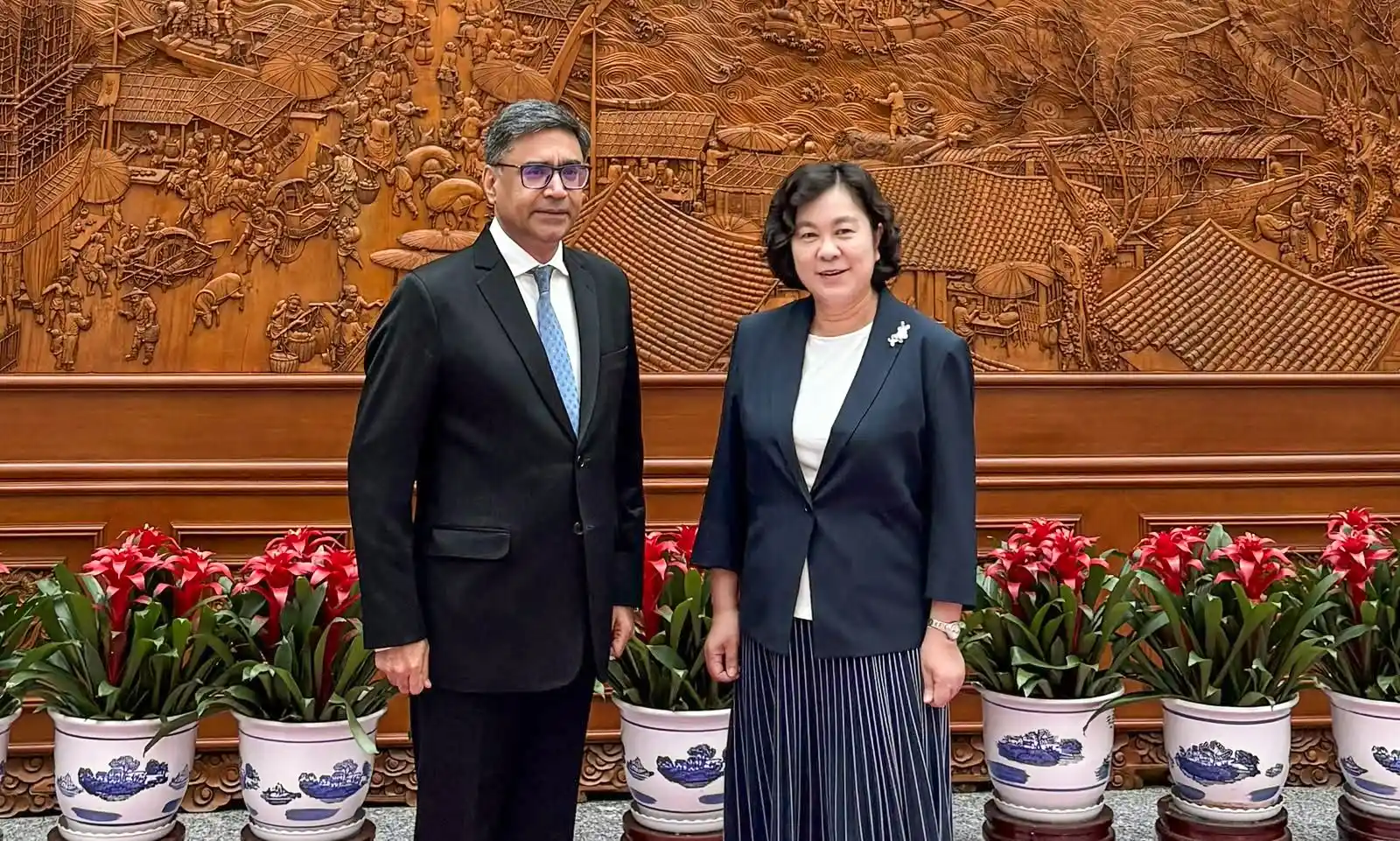
Foreign Secretary Vikram Misri’s two-day visit to Beijing, concluded on July 28, 2026, marks more than a routine diplomatic exchange. It is a calibrated step in a broader, cautious reset between India and China, one that seeks to move beyond the post-Galwan template of crisis management toward a more structured, issue-based partnership. Coming on the heels of External Affairs Minister S. Jaishankar’s meeting with Chinese Foreign Minister Wang Yi in Manila and ahead of high-level engagements expected in September, Misri’s talks signal a deliberate effort to build institutional momentum for a “new way” relationship—anchored in pragmatic cooperation, managed differences, and sustained dialogue.
The India–China relationship has endured its most severe stress test since the 2020 Galwan Valley clash, which triggered a four-year military standoff along the Line of Actual Control (LAC) and a deep freeze in bilateral ties. Yet, over the past 18 months, both capitals have incrementally rolled out confidence-building measures: disengagement protocols in eastern Ladakh, the resumption of the Kailash Manasarovar Yatra, relaxed visa regimes, and the restart of direct flights. These steps, while modest, reflect a shared recognition that prolonged estrangement serves neither country’s strategic or economic interests.
Misri’s visit—his first to China since the border standoff—capitalizes on this momentum. His itinerary was notably expansive, covering not just the Foreign Ministry but also the Communist Party’s International Department, the Central Party School, and the CPPCC’s upper house. This breadth underscores a shift from purely security-centric engagement to a multi-track approach that includes political, academic, cultural, and people-to-people dimensions.
Building a “New Way” Relationship: Key Themes from the Talks
The language emerging from both Indian and Chinese readouts of Misri’s meetings reveals a convergence on three core themes:
1. Leadership Guidance as a Strategic Compass
Both sides repeatedly invoked the “guidance of the leaders” as the foundation for resetting ties. This framing elevates the bilateral relationship above bureaucratic inertia, anchoring it in the political will demonstrated by Prime Minister Narendra Modi and President Xi Jinping during their SCO summit meeting in Tianjin in 2025 and subsequent interactions. By aligning operational diplomacy with leadership vision, both nations aim to insulate the relationship from episodic friction.
2. Border Stability as a Precondition, Not an Endpoint
While peace along the LAC remains non-negotiable for India, the dialogue now treats it as a baseline rather than the sole metric of success. Misri’s discussions with Hong Liang—a former head of China’s boundary department—suggest that border mechanisms are being institutionalized to prevent escalation, not to resolve all disputes. This pragmatic acceptance allows both sides to pursue cooperation in other domains without waiting for a final border settlement.
3. Expanding the Basket of Cooperation
The talks emphasized trade, economic relations, cultural exchange, and academic collaboration as priority areas. India’s concerns about trade imbalance and market access were raised during Jaishankar’s Manila meeting with Wang Yi, and Misri’s engagements likely reinforced this agenda. The inclusion of the Central Party School and think-tank exchanges points to a long-term strategy of building epistemic bridges—creating channels for intellectual and policy dialogue that can sustain ties even during political downturns.
The September Visit: Preparing the Ground for High-Level Diplomacy
Misri’s Beijing trip also serves as preparatory groundwork for a cluster of high-level visits expected in September 2026. Reports indicate that Chinese President Xi Jinping is likely to visit India for the BRICS summit, marking his first trip to India since the Galwan standoff. Simultaneously, Indian NSA Ajit Doval may travel to China for Special Representatives’ dialogue, continuing the track established in 2025–26.
These visits require meticulous logistical and diplomatic preparation. Misri’s meetings with senior CPC officials and party-school leadership are not merely ceremonial; they are part of a broader effort to align party-to-party channels with state-to-state diplomacy. In China’s political system, the Communist Party’s International Department plays a crucial role in shaping foreign policy execution, especially for neighboring countries. Engaging Sun Haiyan and Li Wentang allows India to tap into these parallel tracks, ensuring that September’s summits are backed by substantive pre-negotiations.
Moreover, the timing is strategic. With U.S. Secretary of State Marco Rubio planning Quad talks in Southeast Asia and potential U.S.–China high-level contacts on the horizon, both India and China have incentives to demonstrate autonomous agency in managing their relationship. A successful September summit could position India as a stabilizing force in Asia, capable of engaging China without compromising its strategic autonomy or Quad commitments.
Challenges and the Path Forward
Despite the optimistic tone, significant hurdles remain. The trade deficit, currently skewed heavily in China’s favor, continues to be a domestic political concern in India. Border incidents, though reduced, have not been eliminated. And strategic distrust—fueled by China’s Belt and Road initiatives in South Asia and India’s deepening ties with the U.S. and Japan—persists beneath the surface.
Yet, the emerging architecture of India–China ties suggests a mature, if cautious, approach. Rather than seeking a grand rapprochement, both sides appear to be constructing a modular relationship: one where cooperation in trade, climate, health, and multilateral forums can proceed even as security dialogues manage differences. This “new way” relationship does not ignore the past but refuses to be held hostage by it.
Misri’s visit, therefore, is best understood not as a breakthrough but as a brick in a larger edifice—one that seeks to replace the volatility of crisis-driven diplomacy with the stability of institutionalized engagement. If September’s high-level visits build on this foundation, 2026 could mark the year India and China transition from estranged neighbors to pragmatic partners, coexisting with clear-eyed realism and selective collaboration.